
Preaching Tools
No More Color-Coded Bookmarks
Logos gives you everything you need to research, outline, and preach, without losing the thread.
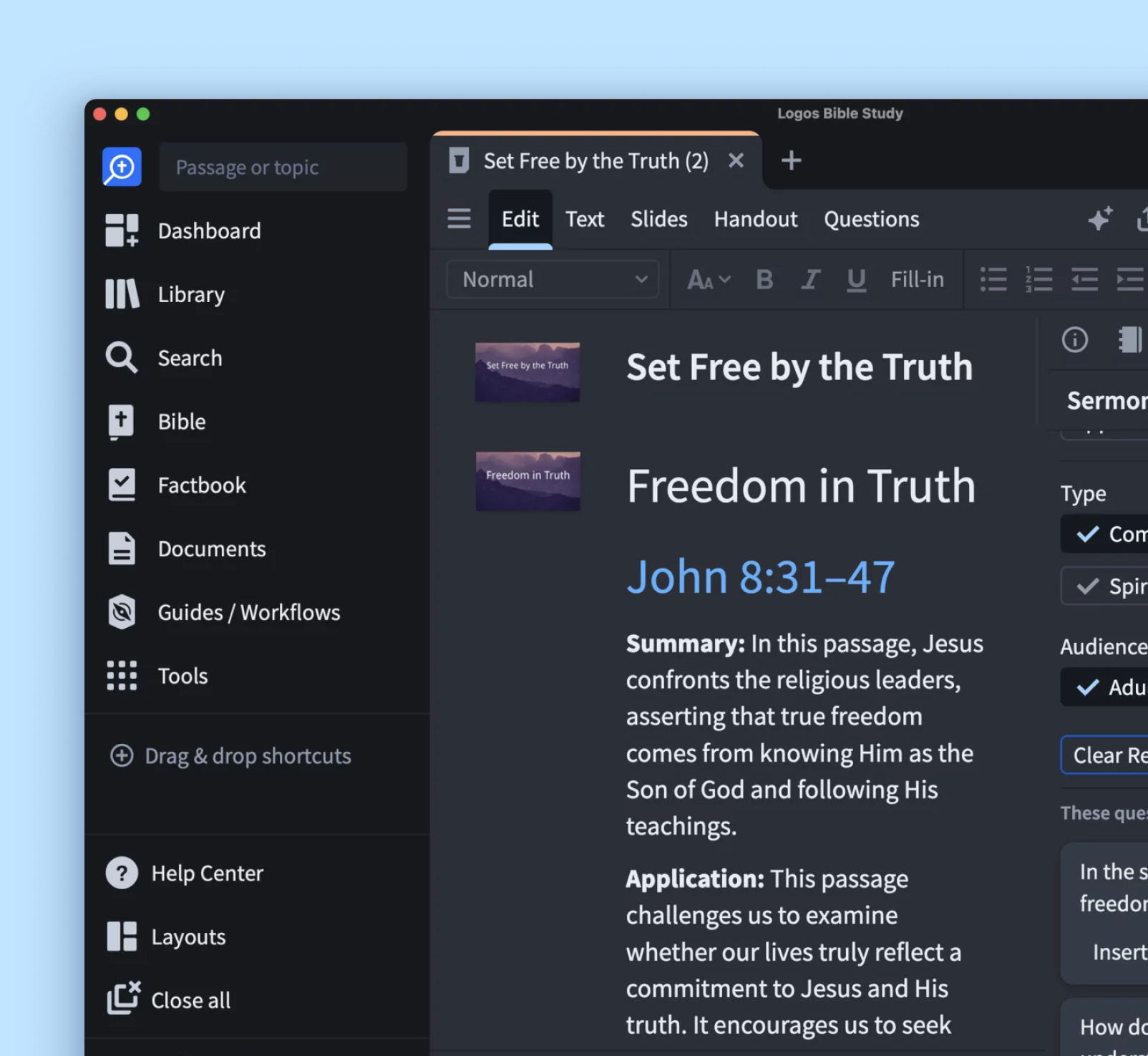
Outlining a sermon has never been easier
Find all the tools you’ll need in Logos—including some features you may not realize you needed.
Within Guides & Workflows, you can search for sample sermon outlines within your digital library–based on Scripture reference, topic, or theme.
Compile ideas and concepts for a future sermon at any time with your Sermon Notebook. Tag your notes within a passage, commentary resource–whatever piques your interest. Easily reference them down the road.
The Sermon Builder is designed to use templates based on an individual’s preaching style and preferences.
Quickly create a sermon manuscript, a slide presentation, handouts, and discussion questions simultaneously as you turn your outline into a polished message.
Developing a sermon outline
With Logos’s sermon outlines, everything you need to prepare to preach is within a few clicks’ reach. Our sermon builder and tools help you engage with Scripture for exegesis and exposition.
- In Logos, start with Factbook by entering anything in the Topic or Reference box
- Conduct your original research and review any sermon outlines available in your library.
- Head to the left-side panel, select Tools, and open Sermon Builder
- Use Sermon Assistant to help produce an initial outline you can refine
- Choose a Theology Guide, Exegetical Guide, or Word Study to add themes and insights
- Draft the body content of your sermon, referencing your entire digital library as you go
- Create application questions, handouts, or share your sermon
- Add to a series in Sermon Manager, your personal dashboard to track your teaching calendar

Logos Subscription
Try Logos Free
It’s risk free. Cancel, choose a different plan, or switch to the free version anytime.
Premium
$9.99/mo
After 30-day free trial


Pro
$14.99/mo
After 30-day free trial
An extra 200+ books for teaching and serious study
Smart tools for preparing sermons and talks
Translate into 110+ languages, including Chinese and Japanese
Search 300+ counseling topics
Max
$19.99/mo
After 30-day free trial
Frequently Asked Questions
A good sermon outline allows the preacher to clearly articulate the revelations they found in a biblical text so that they can guide their congregation to a greater understanding, awe, and love for God.
Sermon outlines, like all powerful messages, need to be carefully crafted to adequately summarize the author’s thoughts so it holds the listeners’ attention. What makes sermon outlines unique, of course, is their reference material–God’s Word. A well-prepared sermon honors God’s Word and can deeply move listeners through the work of the Holy Spirit.
Keep reading
- Context: Consider the historical context at play, as well as the logic in the larger narrative from the biblical author(s)
- Grammar: Analyze key words and phrases from reading multiple translations or Bible grammar dictionaries
- Semantics: Uncover the significance of particular words in your passage in its original language
- Syntax: Turn to a concordance to better understand any expressions in the Hebrew or Greek
- Background: Review the culturally significant elements that would have informed this passage
- Genre: Make note of the type of literature this passage falls into, and how those situate readings
- Textual criticism: Inspect the wording in the original language
- Translation: Compare the text across translations, either doing so yourself or by using a parallel Bible
- Grammar: Review the construction of phrasing and thoughts within the passage
- Argument diagram: Choose your method for observing, labeling, and identifying parts to the biblical author’s logic
- Historical-cultural context: Note the timeline which this text was expected to have been written and the implications
- Literary context: What’s the larger narrative that precedes this passage and follows it?
- Word study: Investigate individual words of interest to your study
Source: 8 Steps to Exegesis
Add richness to your message with influential writings
Select any starting point for your sermon idea and continue researching, taking notes, and meditating on the passage–all while referencing popular commentaries and sermon outlines from pastors across history.
Small Preaching: 25 Little Things You Can Do Now to Become a Better Preacher
Print Price: $18.99
Save $6.00 (31%)
$12.99
Christ Centered Exposition Commentary Series (44 vols.)
Collection Value: $535.56
Save $110.57 (20%)
$424.99
ESV Expository Commentary Series (12 vols.)
Collection Value: $564.88
Save $114.89 (20%)
$449.99
