
 Dustin Burlet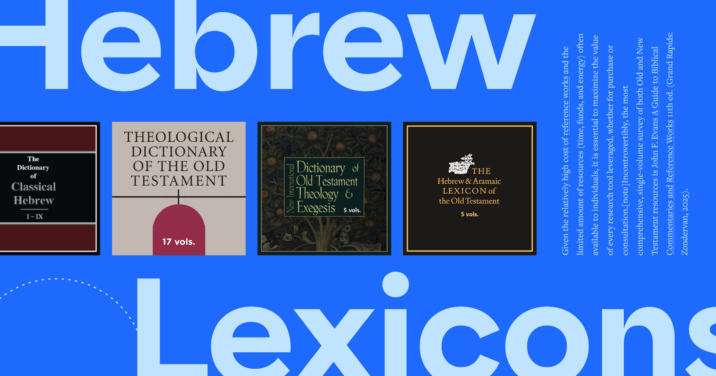
Given the relatively high cost of reference works and the limited amount of resources (time, funds, and energy) often available to individuals, it is essential to maximize the value of every research tool, whether for purchase or consultation.1 To that end, the purpose of this article is to survey some of the most prominent Hebrew Bible/Old Testament (HB/OT) lexicons and dictionaries and gauge their overarching effectiveness in terms of comprehensiveness, accuracy, and usability, i.e., to critically evaluate the “the lexical landscape.”
These primary-language tools tend to come in two main varieties:
- Traditional philological lexicons
- Theological dictionaries2
As per common parlance, however, I will (more or less) use the terms “lexicon” and “dictionary” interchangeably throughout this article.3
This guide is for anyone, student or scholar, who wishes to judiciously make use of the best study materials available. Ratings are on a one to five scale. A rating of one or two stars signifies a recommendation against its usage. A rating of three stars indicates that a resource is good but not great. I also designate resources according to three categories: layperson, minister (including Bible college and Christian university/seminary students), and scholar.4 While I have tried to be careful, it seems best to be a “shade too trenchant than a good deal too bland.”5 Suffice to say, though, we now suffer from an “embarrassment of riches.”6
The article begins with lexicons covering Hebrew and Aramaic, the most neglected of all biblical languages.7 After this, some non-English based dictionaries will be covered. To be clear, these are lexicons that are written in either French, Latin, or German, the three most common languages required for most research-based terminal degree programs. The last sections involve theological wordbooks/dictionaries and the numerous lexical works edited by David J. A. Clines.
Table of contents
- Hebrew and Aramaic lexicons
- Non-English based Hebrew and Aramaic lexicons
- Theological lexicons, wordbooks, and dictionaries
- Hebrew-only lexicons edited by David J. A. Clines
Final tabulations
Concluding comments
1. Hebrew and Aramaic lexicons
Frank Matheus, A Biblical Hebrew and Aramaic Lexicon (GlossaHouse, 2020)
★ | Minister
BHAL is based on Frank Matheus’s PONS Kompaktwörterbuch Althebräisch-Deutsch. It utilizes modern lexical approaches, offers efficient access to pertinent data in an uncomplicated but comprehensive way, is exceptionally cost-effective, and is extremely clear in its presentation.
With respect to the fundamentals,
- The verbs are cited as roots without vowels.
- Verb forms are listed in the usual order from the suffix conjugation (also known as the so-called “perfect”) and the prefix conjugation (the so-called “imperfect”) to the participle.
- The nouns are arranged (as normal) from status absolutus in the singular (citation form) to status constructus in the plural, with the grammatical assignments being represented by a number, the resolution of which can be found in the footer on each page (more on this later).
As noted by the author, this not only saves space but also helps to keep the lexicon “compact and well structured.”8 All ketib/qere variants are listed and are appropriately marked. Matheus also explicates:
The listed verbal forms follow the usual sequence from the third to the first person, from the masculine to the feminine, from the singular to the plural. The third person singular masculine is followed by the third feminine, then the second masculine and feminine and then the first person—then the same order in the plural. Forms with enclitic pronouns respective of suffixes are classified and marked by a small superscript e. The above-mentioned sequence from the third to the first person, etc. also applies to them, accordingly. Under number 4, the nouns with suffixes are listed in the following order: his book, her book, your book (m. & f.), my book; their book (m. & f.), your book (m. & f.), our book; his books, her books, your books (m. & f.), my books; their books (m. & f.) your books (m. & f.), our books. Pausal forms are only marked with a p for better distinguishability when they are listed directly next to the same contextual form.9
By way of comparison, while William L. Holladay’s A Concise Hebrew and Aramaic Lexicon of the Old Testament (Eerdmans, 1988) is four hundred and twenty-seven pages in total (twenty-nine pages of which cover Aramaic), BHAL is only three hundred and ninety-eight pages (twenty-five pages for Aramaic). One should also note that BHAL has substantially larger headings for each main entry (aleph, bet, etc.) and contains far more white space than Holladay. The total content, therefore, is substantially less per entry in BHAL than in Holladay.
In addition to this, another irritant is the egregious fact that BHAL does not leverage bold face type for the actual definition of each word (unlike Holladay). This makes searching through the lexicon itself a somewhat cumbersome and unnecessarily dense task, at times. One does note, though, that all (undisputed) incidents are recorded in BHAL via the open dot sign (⁰).
The definitions themselves are, as a whole, quite clear (though somewhat lackluster). Disappointingly, however, unlike Holladay who uses the full terms for each of the Aramaic stems, e.g., Peal, Hitpeel, Hafel, etc., BHAL only uses abbreviations. In addition, unlike Holladay, Hebrew cognates for any given word are not included in the definition. This means that students looking to learn biblical Aramaic via the comparative method are at a (severe) disadvantage using BHAL.
In sum, while Frank Matheus’s A Biblical Hebrew and Aramaic Lexicon is an up-to-date tool that could, perhaps, supplement (at least in certain ways) Holladay’s trusted work, one would be hard-pressed to persuade me that it substantially improves on (let alone supplants) that text. In fact, I would argue that, given the choice, one would be foolish not to opt for Holladay.
Benjamin Davidson, The Analytical Hebrew and Chaldee Lexicon (Hendrickson Academic, 1981)
★ | Minister, Scholar
By offering generous parsing details for Hebrew and Aramaic lexemes, this book bridges the gap between “effort and results,” thereby facilitating greater reading fluency.10 Said otherwise, instead of teaching the fundamentals of Hebrew grammar, this work equips users with the “means of making speedy and sure after progress,” freeing them from the “tedium and disappointment of uncertainty” in their analytic studies.11
While once invaluable (though easily misused), it is now obsolete in light of modern Bible software, which exponentially increases productivity and provides searches of “intoxicating complexity” in a “fraction of a second.”12
Francis Brown, S. R. Driver, and C. A. Briggs, Hebrew and English Lexicon of the Old Testament (Clarendon, 1977)
★★ | Scholar
BDB is based on the earlier work of Wilhelm Gesenius (more on this later) and Edward Robinson.13 Its purpose is to “establish the ‘proper meanings’ of Hebrew [and Aramaic] words in light of their ‘extra-Biblical history and relationship’ and ‘cognate languages.’”14
As is known among most specialists, the linguistic (philological) material contained within BDB is “sorely” out-of-date.15 One recognizes, for instance, how the study of Akkadian was still in its infancy at that time. This is not to mention the discovery of Ugarit (1928–1929), and, of course, the important role of the Dead Sea Scrolls in general (1947–1956).16 Similarly, Paul D. Wegner (astutely) notes:
Much of the evidence cited from Arabic or South Arabic is dubious, since it is now commonly recognized that Arabic is a Southwest Semitic language and that Hebrew and Aramaic are Northwest Semitic languages. Thus similar words found in Arabic may not really correspond to Hebrew and Aramaic words that may look like cognates. BDB should not be used to determine a word’s etymology; in fact, serious errors have occurred by those unaware of this problem.17
Another problematic component of BDB is its arrangement by “root.” Pedagogically, this obstacle is effectively overcome through technology and Bruce Einspahr’s Index to Brown-Driver Briggs Hebrew and English Lexicon (Moody, 1977).18 Linguistically, however, the so-called “root fallacy” remains a perpetual plague to both the scholarly and the uninitiated alike.19 One wonders what BDB’s revisions might provide and how the editors might overcome this.20

The Abridged Brown-Driver-Briggs Hebrew-English Lexicon of the Old Testament
Regular price: $0.00

William L. Holladay, A Concise Hebrew and Aramaic Lexicon of the Old Testament (Brill, 2000)
★★★ | Minister, Scholar
As noted above, there is a dearth of up-to-date, user-friendly, and inexpensive lexicons covering Hebrew and Aramaic. This one—easily—is the best. Though little more than one-third the bulk of the Brown-Driver-Briggs or the larger Koehler-Baumgartner lexicons, it includes everything that a non-advanced First Testament reader needs.21
The lexicon leverages bold face type for word definitions and, unlike BHAL, contains clear and effective mark(s) for hapax legomenon vis à vis the dagger sign (†). One also notes that, unlike some other lexicons, every form of the word is listed in the entry. For those who are not as up-to-speed on their paradigms and are left scratching their heads over those “tricky” forms of the yiqtol or qatal, for instance, or the dreaded “find the verb” exercises, this is helpful.
J. A. Emerton lucidly states, Holladay also
gives references to, and many quotations from, representative Old Testament passages in which they are found. His work thus avoids a serious weakness from which short lexicons sometimes suffer, for they tend to list the principal meanings of words but [tend] to offer insufficient help to the reader in learning how they are used in particular contexts in the Old Testament.22
I heartily concur with Emerton’s assessment.
A Concise Hebrew and Aramaic Lexicon of the Old Testament (CHALOT)
Regular price: $34.99
Jonathan Gibson and Bryce Simon, An Interpretive Lexicon of Old Testament Hebrew and Aramaic: Analysis of Adverbs, Conjunctions, Interjections, Particles, Prepositions, and Pronouns (Zondervan, 2024)
★★★★ | Minister, Scholar
This interpretive lexicon is compiled to provide users with a “one-stop guide” for the “syntactic function and semantic range” of the aforementioned critical components of Hebrew grammar.23 That is, the Interpretive Lexicon
provides a taxonomy of synaptic functions for keywords across the main Hebrew and Aramaic lexicons and grammars. All entries are given page numbers and section references so that they can be conveniently researched in print and digital formats. Functioning both as a lexicon and an interpretive handbook, this resource helps the user quickly and easily determine the range of translation possibilities for a variety of Hebrew and Aramaic terms. It also serves to help the reader of the Old Testament Scriptures move beyond a gloss translation to careful interpretation culminating in a more accurate (re)translation.24
A two-page glossary of definitions covering parts of speech, such as the meaning of “particle” or “gerund,” for example, is helpful, as is the four-page enumeration of various grammatical-functional subcategories, like “ablative,” “comitative,” “pleonastic,” “proclitic,” and “syndesis.”
A Hebrew lexeme that seems to have been unintentionally overlooked is “all” (כל). This indefinite pronoun (with a quantifying function) often carries the sense or nuance of “totality.”25 Likewise, מכל, “from all,” a term of considerable theological import in Genesis, is also absent.26
At times, one gets frustrated with the fact that the Interpretive Lexicon is “merely” a compendium. That is, there is little to no guidance for interpretive possibilities. Instead, the editors defer this to the grammars.27 In this way, I would, perhaps, have found more value if someone had updated Robert D. Chisholm’s From Exegesis to Exposition: A Practical Guide to Using Biblical Hebrew (Baker, 1999) instead or Williams’ Hebrew Syntax, as it (more or less) does many of the same things as the Interpretive Lexicon but has the added bonus of providing abundant textual examples.
Another minor point of criticism of the Interpretive Lexicon involves Gibson and Simon’s handling of waw. To be clear, “the seemingly endless functions of waw are actually not so much functions of waw alone but of the larger clausal and supra-clausal structures of which waw is a part.”28
The altogether lack of indices (especially Scripture) is also unfortunate, as not a few users are likely to make the most use of this lexicon while working through specific (syntax) issues from Scripture. Perhaps a reprinting or revision of the volume might help remedy this infelicity.
Though some may quibble that J. C. L. Gibson’s Davidson’s Introductory Hebrew Grammar~Syntax, 4th ed. (T&T Clark, 1994) and Russel T. Fuller and Kyoungwon Choi’s Invitation to Biblical Hebrew Syntax: An Intermediate Grammar (Kregel, 2017) fail to appear within the Hebrew resources noted, nothing of substance (in my opinion) is lost. On the Aramaic side, however, I am unsure as to why only Cook and Rosenthal are cited. Fortunately, Scott N. Callaham’s Biblical Aramaic for Biblical Interpreters: A Parallel Hebrew-Aramaic Handbook (GlossaHouse, 2021) remedies this problem, as it is the only reference that is “keyed” to the main Aramaic grammars (much like Williams does for Hebrew).
To close, as Andrew G. Shead maintains within the endorsements section of the volume:
Here, then, is a compendium that belongs in every serious biblical studies library. It promises countless hours of saved labor for students of Hebrew/Aramaic Scriptures, and a careful curation of scholarly opinion that will empower exegetes to make informed choices.
Highly recommended!
An Interpretive Lexicon of Old Testament Hebrew and Aramaic: Analysis of Adverbs, Conjunctions, Interjections, Particles, Prepositions, and Pronouns
Regular price: $29.99
Robert R. Duke, Biblical Hebrew and Aramaic Dictionary (Zondervan, 2024)
★★★★★ | Minister, Scholar
BHAD is unique among all other lexicons for a variety of reasons. For one, Duke alone provides both the English and Hebrew names for the biblical books, exposes students to texts in both Paleo- and regular Hebrew script, and gives the full list of forms of the entry.
Duke’s volume, though, does not intend to replace any of the standard Hebrew lexicons. As the author himself states:
This dictionary is attempting to bridge a gap for intermediate students who know basic Hebrew grammar and vocabulary but find standard lexicons, like The New Brown-Driver-Briggs-Gesenius Hebrew and English Lexicon (BDB) or The Hebrew and Aramaic Lexicon of the Old Testament (HALOT) to dense for easy access. While BDB and HALOT include helpful and essential reference data, the mid-level language student can feel overwhelmed and lose some of the initial passion they had for the Hebrew language. Thus, the goal has been to create a resource that simplifies without falsifying the data.29
Duke goes on to assert:
Since having the original concept and pouring [sic] over existing resources to complete this project, I have seen myself as a curator. Just like in museums, a curator needs to select the best way to present content to tell a story. My curatorial activity has focused on helping students see the diversity in the ways Hebrew and Aramaic words exist in the Bible. The final product provides a quick reference tool that continues to draw them down the path to mastery.30
The project itself was guided by five principles:
- Include all Hebrew words that appear ten or more times, as well as all Aramaic verbs and non-verbs that occur five or more times.
- List verbs by the first letter of the “perfect” third masculine singular (3ms) form, rather than by the root.
- Design a user-friendly layout to simplify locating the specific forms found in the biblical text.
- Incorporate material in Paleo-Hebrew and unpointed texts from the Dead Sea Scrolls (some of which are biblical quotes as preserved in Qumran).
- Provide comprehensive indices to help locate words more readily known by their root.31
One notes that the Hebrew and Aramaic entries are not separated into two distinct sections, thus helping students see the similarities and differences when cognate entries are next to each other. Nonetheless, the Aramaic sections are differentiated by gray text.32
For verbs, easily the greatest challenge for a work valuing “ease of use,” the order of material provided under each verbal entry is as follows:
- infinitive construct (infinite absolute) | suffixed forms
- perfects | suffixed forms
- imperfects | suffixed forms
- participles (construct form) | suffixed forms | passive participles | suffixed forms
- imperatives | suffixed forms
Concerning nouns, entries are arranged:
- plural (including dual forms)
- construct singular: suffixed forms
- construct plural: suffixed forms
With respect to adjectives:
- (1) ms | fs | mp | fp
- (2) suffixed forms33
People will find different ways to use this dictionary effectively.
- BHAD can be consulted alongside the biblical text to clarify unfamiliar words. While not exhaustive (nor intended to be), it provides enough vocabulary to cover the majority of biblical passages.
- The Hebrew and Aramaic examples can be used for self-testing. Instructors, for instance, could assign specific sections for quizzes or exams.
- BHAD is ideal for regular vocabulary review, especially for Paleo-Hebrew and unpointed texts (a practical approach might be reviewing one letter per day over a month to refresh forgotten words). Building confidence with extrabiblical material from Iron Age inscriptions, Qumran texts, and the Elephantine papyri, for example, will ultimately allow readers to engage more deeply with these fascinating corpora, enriching not only their understanding of Scripture itself but also its broader context.34
Miles V. Van Pelt puts it well in saying that any resource serving to advance the biblical languages “is to be welcomed by both instructors and students. The extrabiblical Hebrew citations … will set this resource apart from other introductory and intermediate tools.”35
Ludwig Koehler and Walter Baumgartner, eds., The Hebrew and Aramaic Lexicon of the Old Testament (Brill, 2000)
★★★★★ | Minister, Scholar
As indicated within its preface, HALOT seeks to “render accurately in modern language the meaning of the Hebrew words” by considering the “most important part of linguistics … the comparison of languages.”36
In evaluating HALOT, one notes that it benefits from the significant advancements in Semitic linguistics over the last century. This work draws from Hebrew texts from the Dead Sea region and other cognate Semitic languages to determine the meanings of rare Hebrew words.37
Words are organized alphabetically, addressing a major limitation of BDB. The first four volumes of the original printing cover Hebrew vocabulary. The fifth focuses on Aramaic.
There are two main drawbacks:
- The work is relatively costly (one can, though, save a ton at SBL if one has the luggage capacity!).
- Unless one owns it in Logos(!), it is cumbersome to use, as readers must frequently switch between volumes.
The unabridged two-volume study edition alleviates some of these issues. Fortunately, the two-volume edition matches the page numbers of the five-volume set.38
To conclude, as Benjamin J. Noonan maintains:
HALOT’s alphabetical arrangement of words gives it a distinct advantage over BBD in terms of ease of use. Its updated etymological data, presented in transliterated form rather than its original script, is also a significant strength. However, its etymological data is not without weakness. HALOT contains a number of questionable etymologies and comparisons, particularly with respect to Arabic, that sometimes overshadow semantic and syntactic evidence from the biblical text itself. Finally, like BDB, HALOT suffers from use of glosses rather than definitions.39
Irrespective of these infelicities, HALOT two-volume study edition remains the best multi-volume lexicon of Hebrew-Aramaic. Period. It should be consulted by all serious religious students. As Richard S. Hess states, “KB remains the lexicon of choice and this less expensive edition is a welcome feature.”40
Hebrew and Aramaic Lexicon of the Old Testament | HALOT (5 vols.)
Regular price: $159.99
2. Non-English based Hebrew and Aramaic lexicons
Philippe Reymond, Dictionnaire D’Hebreu Et D’Arameen Bibliques (Société Biblique Française, 1998)
★★★ | Minister, Scholar
Parlez-vous français? Oui ou non? Uniquely, Canada stands apart as a bilingual country with French and English as its two official languages. Given such, I have had the privilege of having not a few Francophone students in my Hebrew grammar class(es).41
For those looking to leverage (theological) French alongside their biblical Hebrew (and Aramaic) skills, this lexicon is considered to be the crème de la crème, as it leverages clear symbols for “certain,” “approximate,” and “disputed” translation values and is modestly priced. Daniel Bourget succinctly puts it: “Quand on me demande quel est aujourd’hui le meilleur dictionnaire hébreu-français, je ne réponds qu’après un temps d’hésitation.”42 Now to wait for more publishers to see the value of French, as they have done for Latin and German!
Franz S. J. Zorell, ed., Lexicon Hebraicum et Aramaicum Veteris Testamenti (Pontificium Institutum Biblicum, 1952)
★★★★ | Minister, Scholar
As alluded to above, there seems to be an uptick in the availability of basic resources for learners of ecclesiastical Latin.43 For students of the First Testament, however, there is no better stop than Zorrell. As Mark D. Futato Sr. told me, “I taught myself Latin in grad school just so I could use Zorrell.”44 Hildrup concludes, “many a generation of ecclesiastical students of Hebrew [and Aramaic] will realize their indebtedness to its learned and industrious authors.”45 Frederick W. Danker also describes this work as being “beyond question a noteworthy achievement, and to be blessed for, among other things, Zorell’s treatment of ben Sira’s Hebrew diction.”46 Danker explains,
The Aramaic treatment originally planned for this lexicon was shifted to a more comprehensive consideration of Aramaic usage. Lexicon linguae aramaicae Veteris Testamenti documentis antiquis illustratum, ed. E. Vogt (Rome: Pontifical Biblical Institute, 1971). After this change in plan, Zorell’s work bore the title Lexicon Hebraicum Veteris Testamenti, and the finishing touches were completed in 1984.47
It is arranged in two columns with an effective use of spacing and symbols. One notes that all proper names are befittingly transcribed as in the Vulgate.
Wilhelm Gesenius, Hebräisches und Aramäisches Handwörterbuch über das Alte Testament, ed. Herbert Donner et al. (Springer Verlag, 2013)
★★★★★ | Scholar
G. Geoffrey Harper poignantly writes, “‘Do I [really] need to learn German?’ The look in the student’s eye betrays the answer they hope to hear. Developing an ability to interact with German literature is a daunting, yet often required, task for [many] anglophone doctoral students.”48 Despite the not-insignificant challenges involved, however, there is good reason for every academic to seek to become increasingly intimate and more familiar with German scholasticism in toto.49 For those diligently engaged in Hebrew Bible/Old Testament (HB/OT) studies, this involves effectively leveraging Gesenius18.
Rightly understood as a “pioneer” in the study of Hebrew grammar and lexicography, the material of Wilhem Gesenius (1786–1842) still serves as the classic, standard reference material.50 For the sake of clarity, the seventeenth edition of Gesenius was originally published in 1915. The eighteenth edition of Gesenius took almost thirty years of publication.
Herbert Donner, the chief editor, outlines six guiding principles upheld within the eighteenth edition of this lexicon:
- Comprehensive inclusion of all forms of each word appearing in the Hebrew Old Testament, as presented within the Biblia Hebraica Stuttgartensia.
- Contextual clarity for words, making multi-word Hebrew constructions understandable.
- Constrained engagement with historical and stylistic inquiries.
- Selective inclusion of and/or reference(s) to text-critical issues.
- Thorough inclusion of proper names (including people and places).
- The incorporation of all relevant information on ancient Near East (ANE) history.
One notes that the editors have intentionally limited the lexicon’s scope to exclude all words not found in the HB/OT.51
Jacob Corzine’s comments are worth noting in full:
Gesenius 18 is structured differently than BDB. The words are not grouped alphabetically according to their root word, but rather arranged strictly alphabetically. In comparison with BDB or Gesenius 17, the new volume is more comfortable to use, as obvious progress in book publishing shows itself over a near one-hundred year gap. The different sections within an individual entry are much easier to identify, and the text is generally easier to scan searching for forms … since Gesenius lists most (now: all) forms of a word that appear in the Old Testament.52
In sum, there is no other one-volume lexicon that provides the same wealth of detail. Period.53
Hebräisches und Aramäisches Handwörterbuch über das Alte Testament (Gesenius-Buhl)
Regular price: $19.99

3. Theological lexicons, wordbooks, and dictionaries
Ernst Jenni and Claus Westermann, eds. Theological Lexicon of the Old Testament, trans. Mark E. Biddle, 3 vols. (Hendrickson, 1997)
★★★ | Layperson, Minister, Scholar
TLOT is an exceptionally user-friendly set of volumes, once published in German as Theologisches Handwörterbuch zum Alten Testament (THAT).54
There is much to commend concerning TLOT. First, in addition to traditional philological inquiry (see footnote two above), special attention was devoted to linguistics while remaining keenly aware of numerous pitfalls—hooray!55 The editors state, “It is not possible on the basis of word study alone to construct a theology. Cf. James Barr, Semantics of Biblical Language (SCM, 1983).56
Second, TLOT boasts an impressive cross-reference system, being “keyed” to BDB and HALOT —not to mention NIDOTTE, TDNT/TDOT, and TWOT (see below for more details on this). Before the digital age, this feature alone made TLOT particularly invaluable for many individuals. Following the Keep It Simple, Stupid (KISS) principle, TLOT was intentionally designed to help theologians and pastors with “minimal knowledge of Hebrew and OT studies” better understand and preach from the First Testament; hence, its accessibility is S-tier.57
To critique, lexicography has advanced significantly since these volumes were published (particularly the German originals). Also, technologically speaking, Bible software programs have made many of the distinguishing features of TLOT far less important than they used to be.
Gleason Archer Jr., R. Laird Harris, and Bruce K. Waltke, eds., Theological Wordbook of the Old Testament, single vol. ed. (Moody, 2003)
★★★★ | Layperson, Minister, Scholar
This work boasts 1,400 articles written by forty-three top-rate scholars, plus some four hundred sub-entries giving definitions only.
The new edition of this not-insignificant reference work combines the original two volumes (Moody: 1980) into one. The editors duly recognize a sensitivity to “exegetical fallacies,” stating,
Word study does not lead to a total understanding of the Old Testament text—or any text. Words must always be taken in context. They have a range of meaning, thus ’āmar may sometimes mean ‘speak,’ sometimes ‘command.’ Thus, it overlaps with dābar on the one hand and ṣāwâ on the other. Also, the etymologies of words are not always determinate of meanings … Biblical usage is therefore the best criterion of the meaning of a word, and to that end our authors have depended heavily on their concordances.58
That said, it is also worth noting that TWOT intentionally arranges words under roots, i.e., “the verbal root and the derived words are discussed together. But all the derivatives are also listed in their proper alphabetical position with a … numerical cross reference to lead the user to the root verb where, if it is theologically important, a discussion of the meaning of the root verb and all its derivatives will be found.”59 Users will have to ascertain for themselves the pros and cons of this.
While there is an Aramaic section (unlike TLOT, by way of example), it barely warrants mention as not a few times the entry is merely, “Usage similar to Hebrew.” That said, there are some occasional gems to be found and some refreshing reminders about Aramaic grammar. The best entries are those signed by Charles D. Isbell, such as ‘bā’û” (petition, request), ’aḥăwāyâ (declaration, interpretation), ‘ddān (time, period, span, year, era), and ‘ăbad (make, do, perform, create [Peal]; be made, be done, be performed, executed/carried out [Hithpeal]).
Broadly speaking, TWOT might be considered by some individuals to be more readable and “evangelical friendly” in its approach to Scripture, as compared to TLOT.60
Willem A. VanGemeren, ed., New International Dictionary of Old Testament Theology and Exegesis, 5 vols. (Zondervan, 1997)
★★★★★ | Layperson, Minister, Scholar
NIDOTTE contains more than three thousand articles written by more than two hundred scholars from twenty-four countries and over one hundred academic institutions. NIDOTTE is an indispensable resource and an invaluable addition to any biblical scholar’s collection—warranting regular reference and consultation.
NIDOTTE has four main parts:
- A guide (vol. 1a)
- The dictionary proper; which is clearly the heart of NIDOTTE, its raison d’être (vols. 1b–4a)
- A topical index (vol. 4b)
- Indices (vol. 5)
“The Guide to Old Testament Theology and Exegesis,” which is also available as a separate paperback volume (Zondervan, 1999), is comprised of several articles spanning a range of topics to help orient oneself to the task at hand.
- In the Introduction, Vanhoozer discusses hermeneutics
- Part I handles textual criticism (Waltke)
- Part II covers Old Testament history (Merrill and Long)
- Part III explores literary approaches (Longman) and narrative criticism (Satterthwaite)
- Part IV provides a theoretical approach to linguistics (Cotterell), followed by Walton’s “Principles for Productive Word Study”
- In Part V, Martens and Schultz cover various aspects of Old Testament theology
- Lastly, within the conclusion, VanGemeren illustrates how to use NIDOTTE more precisely through the effective examples of Ruth 1 and Psalm 119:1–861
For the sake of clarity, the topical dictionary delineates the theology of each book of the Old Testament, historical epochs (e.g., Kingdom of Judah, exile, intertestamental period), people and places (geography) of the HB/OT, extrabiblical literature (e.g., apocrypha and pseudepigrapha), and certain key concepts, such as, for example, “Retribution.” As noted above, the fifth volume (indices) is particularly helpful as it opens up greater access to cruising the dictionary.62 The most important of these, perhaps, is the Index of Semantic Fields, since NIDOTTE is the only lexicon available in print (that I am aware of) that arranges lexemes into “buckets of meaning,” thereby eliminating many exegetical fallacies.63
That said, neither TLOT, TWOT, nor NIDOTTE does this perfectly. Benjamin J. Noonan relates:
Each of these projects began after Barr’s critique of theological dictionaries. Therefore, they exhibit at least some awareness of the pitfalls inherent to providing a theological dictionary … Overall TDOT, TLOT, and NIDOTTE maintain a distinction between word and concept. However, they do not always do so successfully, in part because their structure inherently associates specific concepts with each word set, rather than the other way around. At the same time, because words are ultimately not separable form concepts, and because we as interpreters lack encyclopedic knowledge of ancient Israel due to our historical and cultural distance, theological dictionaries remain useful repositories of data.64
Just as Silva edited the NIDNTTE, one can only hope for a new, second edition of NIDOTTE.65
New International Dictionary of Old Testament Theology and Exegesis | NIDOTTE (5 vols.)
Regular price: $199.99
G. Johannes Botterweck et al., eds., Theological Dictionary of the Old Testament, 17 vols. (Eerdmans, 1977–2021)
★★★★★ | Minister, Scholar
The TDOT provides nearly exhaustive research and analysis of almost every lexeme and word group within the entirety of the HB/OT. As Robert B. Chisholm Jr. emphasizes in his review of volume 15: “This volume, like other volumes in this series, will be a valuable resource for biblical exegetes and theologians.”66
Volume 16 (2018), authored by Holger Gzella, covers Aramaic, while volume 17 (2021) is dedicated solely to indices. This volume tabulates the entries for over a thousand words covering four thousand pages across sixteen books published over a period of forty-five years. Whew!
There is little else to add concerning TDOT that hasn’t already been covered above. So at the risk of belaboring the point regarding the limitations of theological dictionaries, in general, it is worth quoting Benjamin J. Noonan (once again), who makes clear:
Although each project claims to offer a dictionary based on semantic fields, none fully delivers. NIDOTTE comes the closest to doing so in that it provides an index of semantic fields. Nevertheless, in each project semantic fields are not well defined, nor are they based on any clear criteria. Furthermore, entries do not always pay adequate attention to synonyms and antonyms. Here especially there remains significant room for growth, and hopefully future theological dictionaries will give greater consideration to this area.67
Theological Dictionary of the Old Testament and New Testament Collection | TDOT/TDNT (27 vols.)
Regular price: $849.99
4. Hebrew-only lexicons edited by David J. A. Clines
The Dictionary of Classical Hebrew (9 vols.); The Concise Lexicon of Classical Hebrew; and The Shorter Dictionary of Classical Hebrew: Revised
★★★★★ | Minister, Scholar
Professor David J. A. Clines passed away at the age of eighty-four (1938–2022).68 As noted by Stanley E. Porter, while “David made a sustained contribution to biblical studies over the course of over five decades … I think that David’s most significant contribution was arguably the role that he played in founding and serving as director/publisher of JSOT Press/Sheffield Academic Press and then Sheffield Phoenix Press.” Porter goes on to comment,
I think that the dictionary was only possible because of Clines’s attitude toward scholarly publishing as exemplified by both JSOT/SAP and SPP. His being publisher of those presses was probably what enabled the dictionary (in multiple volumes published over thirty years!) to come into existence.
Statistically speaking, the results of Clines’s lexical labors are staggering! To be clear:
DCH is the first ever lexicon published of the ancient Hebrew language as a whole; previous dictionaries have restricted themselves to the evidence of the Hebrew Bible, ignoring the Hebrew of the Dead Sea Scrolls, Ben Sira (Ecclesiasticus) and the ancient Hebrew inscriptions. Every occurrence of every word (apart from some of the most common particles) is cited in highly analytical articles. A pervasive theme of the Dictionary is its concentration on the meanings of words in context: for all nouns, for example, the verbs of which they are the subject or object are noted, and for all verbs, the nouns that are their subjects or objects. Two further innovative features of the Dictionary are its extensive bibliographies and its incorporation of more than 3500 words not previously recorded in Hebrew dictionaries. In addition to the full dictionary, a one-volume version of the Dictionary was published in 2009. All this is also available electronically as a module in two Bible software packages, Accordance and Logos.
The subsequent nine-volume Dictionary of Classical Hebrew, Revised (2018–25) continues apace to be prepared for print and software format issue, and once published in entirety will be 25% longer at 5 million words, with 100,000 improvements and a further 2,800 words compared to the original dictionary. This will be accompanied by The Shorter Dictionary of Classical Hebrew Revised … with 1 million words, and the more compact Concise Dictionary of Classical Hebrew Revised (forthcoming 2025).69
Two things need to be made clear prior to elaborating on more of the particulars of these specific lexicons. First, much like BDB and HALOT, the DCH and the CDCH leverage glosses rather than definitions for each entry. Noonan’s words concerning this are worth quoting in full:
Glosses imply one-to-one correspondence between the Biblical Hebrew … word and the modern gloss. This can be misleading when their meanings do not match up entirely. It does not, furthermore, line up with current lexicographic practice. Especially when the dictionary user is unaware of the cultural world of the source language, lexicographers recommend giving an explanatory equivalent … The challenge here is to know how much description is necessary—and practical—for the user. Nevertheless, biblical lexicographers would do well to incorporate definitions with at least some encyclopedic knowledge into their lexicons.70
It is worth noting, therefore, that The Dictionary of Classical Hebrew Revised (DCHR) is said to often present an “extended definition” and that the articles on “plants and animals … as well as persons and place names” are said by the editors to explicitly offer “encyclopedic information.”71
Second, it needs to be made clear that, unlike BDB and HALOT, The Dictionary of Classical Hebrew Revised intentionally excludes etymological data. Clines explicitly states:
Cognates in other Semitic languages have not normally been listed in this Dictionary. Such information has become traditional in Hebrew lexica of the last two centuries, but its presence in a Hebrew dictionary is quite problematic, and it is difficult to see what purpose it serves. Theoretically speaking, that is, data about the meaning of cognate words in Akkadian and Arabic, for example, are strictly irrelevant to the Hebrew language; and, practically speaking, there is evidence that the significance of the cognates has been systematically misunderstood by many users of the traditional dictionaries.72
As noted by reviewers, this feature is rarely (if ever) appreciated among most users of Clines.73 Benjamin Noonan (likewise) avers:
It is true that etymological data is typically only included in diachronic … dictionaries, which Hebrew Bible lexicons are not. It is also true that biblical lexicographers have frequently misused etymological data, as BDB and even the recent HALOT demonstrate. However … the Hebrew Bible’s many rare words require the use of etymology, and abuse does not preclude proper use.74
Noonan continues to argue:
Furthermore, etymology is helpful for distinguishing homonyms … and including etymological data facilitates the comparative method for the Semitic language. It would therefore be rash to exclude etymological data altogether. Nevertheless, there is room for debate on how best to include such data.75
Statistically speaking, it is prudent of Noonan to highlight the rarity of words within the HB/OT and their unique relationship to cognate languages. This is especially poignant given how Akkadian is the earliest attested Semitic language and that no other Semitic language—except for Eblaite—shares vocabulary with Akkadian as closely as Hebrew does, with 53 percent of Akkadian words having Hebrew cognates.76 As Gordon P. Hugenberger and Nancy L. Erickson maintain, this close relationship has “proven indispensable for illuminating meanings and definitions of Hebrew terms.”77 In this way, “Akkadian is, arguably, the most important language for a better understanding of the Old Testament other than the biblical languages themselves.”78
Such matters notwithstanding, Clines’s exclusion of cognate word(s) is valid. He states:
It is often said, for example, that the function of noting the cognates is to indicate how it is that we know the meaning of the Hebrew word to be such and such; but this is incorrect, since there is usually a quite complex set of evidences for such matters, ranging from internal consistency within the Hebrew texts to the testimony of ancient versions and to Jewish lexicographical and exegetical tradition; and there is no reason to privilege the particular type of evidence, problematic as it is, that is provided by the cognate languages. We have not, in fact, taken it as a general requirement of our task to justify the meanings we propose for the Hebrew words (however desirable such an undertaking may be); that is too complex a task to be accomplished within the confines of a dictionary.79
In brief, though some may quibble, Clines’s strikes the right balance within DCHR. That is:
When a cognate in another language has been adduced in support of a proposed new word, that cognate is mentioned in the bibliographic entry after the gloss … On the same principle, a Biblical Hebrew (BH) word supporting a newly proposed word has a similar entry … Cognates in other languages have not been noted in The Dictionary of Classical Hebrew Revised proper, though loanwords have been; but not in the particular case of new words we think it helpful, and indeed necessary, to provide the evidence.80
Some additional features and characteristics:
- Unlike BDB and HALOT, for example, DCHR also includes an exceptionally thorough users-guide.81 Though not as comprehensive in nature as NIDOTTE, Clines’s introduction provides everything readers require to be effectively oriented to the text.82
- Especially helpful are the separate bibliographies for each letter (and lexeme) at the end of each volume and the statistical information provided.
- Unlike all other lexica (at least that I am aware of), the DCHR shows for each word “in the four corpora of Classical Hebrew (Hebrew Bible, Ben Sira, the Dead Sea Scrolls and the Inscriptions) the number of occurrences; and in the case of verbs, occurrence statistics are also given for each of its voice (binyanim).83
- DCHR has an English-Hebrew index, lists synonyms, antonyms, syntagmatic relations, and judiciously organizes words into semantic fields for a nuanced understanding. There are 354 semantic fields (following that of Reinier de Blois’s SDBH noted above).84
DCHR is (beyond doubt) the best multi-volume print lexicon of the Hebrew language. Period.
Final tabulations
To follow is each of the main lexical resources listed above—with their rankings.
Best resources for laypersons
- NIDOTTE
- Consider Lee M. Fields, Hebrew for the Rest of Us, 2nd ed. (Zondervan, 2023)
Best resource for ministers and students
- HALOT
- NIDOTTE & TDOT
- DCH & DCHR
- BHAD
Best print resources for scholars
- HALOT
- Gesenius18
- NIDOTTE & TDOT
- DCH & DCHR
- Vogt (Aramaic)
Concluding comments
As noted at the beginning of this article, we suffer from an embarrassment of riches regarding Hebrew and Aramaic lexicons. Of course, besides the tools listed above, vocabulary builders, chrestomathies, and (perhaps especially) grammars can all advance the effectiveness of one’s study of the original languages.85 When combined with the vast array of resources available for the study of the New Testament and the Septuagint (LXX), in general, there is much cause to rejoice.
Related articles
- Original Language Research: What to Do, What Not to Do
- Pastor, Are You Making These Common Lexical Mistakes?
- How to Write a Greek or Hebrew Word Study Paper
- The Definitive Guide to Bible Commentaries: Types, Perspectives, and Use
- Top Preaching Tools & Resources That Belong in a Pastor’s Library

- Incontrovertibly, the most comprehensive, single-volume survey of both Old and New Testament resources is John F. Evans, A Guide to Biblical Commentaries and Reference Works, 11th ed. (Zondervan, 2025).
- As John A. Cook astutely states: “Although both types of reference may treat comparative Semitic data and survey the range of meaning and syntactic constructions to a greater or lesser degree, the theological dictionary ultimately aims at treating theological concepts organized around certain key words to which these are related. Thus, the theological dictionary stands in a unique, and somewhat precarious, position between that of a philological lexicon (which treats words) and a biblical theology (which treats concepts).” John A. Cook, “Lexicons, OT,” in Kevin J. Vanhoozer, ed., Dictionary for Theological Interpretation of the Bible (Baker, 2005), 451–52.
- As Douglas Stuart states: “A lexicon is a dictionary. The fact that the term ‘lexicon’ has been used instead of the term ‘dictionary’ by biblical and classical scholars is simply a quirk of linguistic history, well deserving of a word study of its own.” Douglas Stuart, Old Testament Exegesis: A Handbook for Students and Pastors, 5th ed. (Westminster John Knox, 2022), 113. For more details on these matters, consult the (most pertinent) articles included within A Guide to Old Testament Theology and Exegesis from Willem A. VanGemeren, ed., The New International Dictionary of Old Testament Theology and Exegesis (Zondervan, 1997).
- The self-same rubric, from which I, unabashedly, cribbed (including, at times, some exact wording and phrasing) also appears in Tremper Longman III, Old Testament Commentary Survey, 5th ed. (Baker, 2013), 2.
- D. A. Carson, New Testament Commentary Survey, 7th ed. (Baker, 2013), x.
- Cf. Brevard S. Childs, Old Testament Books for Pastor and Teacher (Westminster, 1977), 16.
- See Miles V. Van Pelt, Basics of Biblical Aramaic, 2nd ed. (Zondervan, 2023), xi. Veritably, we must “free Aramaic from an ancillary role in the shadow of the Hebrew Bible and … unveil its contribution to the formation and exchange of ideas, customs, and traditions in the entire Near East.” Holger Gzella, Aramaic: A History of the First World Language, trans. Benjamin D. Suchard (Eerdmans, 2017), ix.
- Frank Matheus, A Biblical Hebrew and Aramaic Lexicon (GlossaHouse, 2020), ix.
- Matheus, Biblical Hebrew and Aramaic Lexicon, ix.
- Davidson, Analytical Hebrew and Chaldee Lexicon (Hendrickson Academic, 1981), 2–3. A few other works that are in a similar style to Davidson include T. A. Armstrong et al. A Reader’s Hebrew-English Lexicon of the Old Testament (Zondervan, 2013); J. J. Owens, Analytical Key to the Old Testament, 4 vols. (Baker, 1989–92); and Todd S. Beall et al., Old Testament Parsing Guide, rev. ed. (B&H Academic, 2000).
- Davidson, Analytical Hebrew and Chaldee Lexicon, 5.
- Adam J. Howell et al., Hebrew for Life: Strategies for Learning, Retaining, and Reviving Biblical Hebrew (Baker, 2020), 144. Cf. Stuart, Old Testament Exegesis, 107, 192–94, and Paul D. Wegner, Using Old Testament Hebrew in Preaching: A Guide for Students and Pastors (Kregel, 2009), 55–66. See too Constanine R. Campbell, Keep Your Greek: Strategies for Busy People (Zondervan, 2010), 26–35.
- Tremper Longman III, Old Testament Commentary Survey (Baker, 1991), 37, alongside Benjamin J. Noonan, Advances in the Study of Biblical Hebrew and Aramaic (Zondervan, 2020), 79, and Robert R. Duke, Biblical Hebrew and Aramaic Dictionary (Zondervan, 2024), xvii. For more details on the interrelationship of German lexicography and grammar, in general, see BHRG §1–3 and IBHS §2.5. Of course, the sui generis work is Geoffrey Khan, ed., Encyclopedia of Hebrew Language and Linguistics (Brill, 2013).
- Noonan, Advances, 79, citing BDB, vi.
- Robert D. Chisholm, Fron Exegesis to Exposition: A Practical Guide to Using Biblical Hebrew (Baker, 1999), 14–15; Noonan, Advances, 80.
- Some of this material (including elements of the actual wording and arrangement) comes from Christopher Wright Mitchell, “The Use of Lexicons and Word Studies in Exegesis,” Concordia Journal 11 (1985): 128–33.
- Wegner, Using Old Testament Hebrew in Preaching, 40.
- While strident, Longman is (perhaps) not amiss in his assertion that “lazy and careless … exegetes” may misuse these tools as a “shortcut.” See Longman, Old Testament Commentary Survey, 42.
- For further details (besides Barr, Carson, Porter, and Silva), see Benjamin J. Baxter, “In the Original Text It Says”: Word-Study Fallacies and How to Avoid Them (Energion, 2012), alongside Douglas J. Moo, We Still Don’t Get It: Evangelicals and Bible Translation Fifty Years After James Barr (Zondervan, 2014).
- For more details (some of which I found in Noonan), see Jo Ann Hackett and John Huehnegard, “On Revising and Updating BDB,” in Janet Dyck and Wido T. van Peursen, eds., Foundations for Syriac Lexicography III: Colloquia of the International Syriac Language Project (Gorgias, 2009), 227–34, and this online article: “Jo Ann Hackett and John Huehnergard Receive NEH Grant for Biblical Hebrew and Aramaic Lexicon,” College of the Liberal Arts (Texas-U), July 11, 2013. https://liberalarts.utexas.edu/mes/news/jo-ann-hackett-and-john-huehnergard-receive-neh-grant-for-biblical-hebrew-and-aramaic-lexicon.
- Given its date, there is no need for me to mention the many positive, peer-reviewed material(s) that have already been published vindicating this assertion. Instead, see R. Kevin Carroll’s Biblical Languages and the Busy Pastor (GlossaHouse, 2022), 59–60, alongside Wegner, Using Old Testament Hebrew in Preaching, 40.
- John A. Emerton, “Review of ‘Holladay’,” Vetus Testamentum 22 (1972): 512. Cf. Don Parker, Using Biblical Hebrew In Ministry (University Press of America, 1995), 50–51, 61.
- Jonathan Gibson and Bryce Simon, An Interpretive Lexicon of Old Testament Hebrew and Aramaic: Analysis of Adverbs, Conjunctions, Interjections, Particles, Prepositions, and Pronouns (Zondervan Academic, 20214), xvii, xxxvii.
- Gibson and Simon, Interpretive Lexicon, xvii.
- See Douglas K. Smith, “Whom, Where, or What Could ‘All the Earth’ Mean? A Case Study in the Implications of Context and Intertextuality for Translating and Interpreting Kol Ha-Aretz (כל הארץ) in the Pentateuch,” Interdisciplinary Journal on Biblical Authority 1, no. 2 (2020): 135–53. Cf. Dustin G. Burlet, Judgment and Salvation: A Rhetorical-Critical Reading of Noah’s Flood in Genesis (Pickwick, 2022), 78, alongside the resources noted within Dustin G. Burlet “‘Waddya Mean ‘It’s Just Hyperbole!’ You’ve Gotta Be Kidding Me!’ The Prophet Zephaniah and the Book of Genesis,” Torch Trinity Journal 26 (2023): 43–80, and Dustin G. Burlet, “Antiquity and Arithmetic: A Rhetorical-Critical Reading of Hyperbole and Noah’s Ark,” Canon & Culture 18 (2024): 131–71.
- For more details concerning Genesis 3:1, for instance, see BHRG §30.4.2.e, 39.14.3.a, 41.9.d and IBHS §14.5.d.
- By way of example, consider the weight that can rest on a single preposition. Should Genesis 6:6, for instance, be rendered “Then the LORD regretted that he had made human beings on the earth”—a spatial preposition (GBHS §4.1.5.a)—or, instead, as “with the earth,” indicating a beth comitantiae, or a beth of accompaniment (see Ronald J. Williams’ Hebrew Syntax, 3rd ed. (University of Toronto Press, 2007), 99)? If the latter, it suggests the LORD not only regrets creating humanity but also the earth itself, which he intends to destroy along with all flesh (Gen 6:5, 11–13, 17; cf. 2 Pet 3:6). For more details, see Dustin G. Burlet, “Impassible Yet Impassioned: The Doctrine of Divine Impassibilty in Conversation with the Noachian Deluge of Genesis,” Didaskalia 28 (2017–2018): 96–128. It is, of course, recognized that arguments based on prepositional usage are “slippery.” For a nearly exhaustive analysis, see H. G. Hardy II, The Development of Biblical Hebrew Prepositions (SBL, 2022), which, I am pleased to say, does appear in Gibson and Simon’s Interpretive Lexicon.
- Miles V. Van Pelt, ed., Basics of Hebrew Discourse (Zondervan, 2019), 60.
- Robert R. Duke, Biblical Hebrew and Aramaic Dictionary (Zondervan, 2024), xi.
- Duke, Biblical Hebrew and Aramaic, xi. Duke also (graciously) states elsewhere: “We all have received a gift in a work like BDB … Today, though, we have many more technological tools that help overcome the barriers faced in the past with handling a right-to-left language that used different scripts. This tool then is updated less in areas of content and more in areas of presentation to help students enjoy learning Hebrew and encourage them to cross the bridge that leads toward more expert tools.” Duke, Biblical Hebrew and Aramaic, xvii.
- Duke, Biblical Hebrew and Aramaic, xvii.
- Duke, Biblical Hebrew and Aramaic, xix.
- For more information on prepositions, see Duke, Biblical Hebrew and Aramaic, xxii.
- Duke, Biblical Hebrew and Aramaic, xxii.
- Duke, “Endorsements,” in Biblical Hebrew and Aramaic.
- Noonan, Advances, 79, citing HALOT lxx and lxxi.
- See Wegner, Using Old Testament Hebrew in Preaching, 39.
- See Wegner, Using Old Testament Hebrew in Preaching, 39–40.
- Noonan, Advances, 81.
- Richard S. Hess, “Review of ‘HALOT: Study Edition’,” Themelios 28 (2002): 62. Cf. Ralph W. Klein’s review in Currents in Theology and Mission 29 (2002): 52–53; Gene M. Tucker, Review of Biblical Literature 4 (2002): 135–38. See too John Glynn, Commentary and Reference Survey, 10th ed. (Kregel, 2007), 33.
- I have also had the honor of working with Pierre Gilbert (Emeritus—Canadian Mennonite University), one of Canada’s top bilingual HB/OT scholars and author of (among other fine works) God Never Meant for Us To Die: The Emergence of Evil in the Light of the Genesis Creation Account (Wipf and Stock, 2020).
- Daniel Bourguet, Études théologiques et religieuses 68 (1993): 271. For more reviews, see Robert Martin-Achard, Revue de théologie et de philosophie 125 (1993): 200–02, and Jean Jacques Lavoie, Studies in Religion 47 (2018): 443–45. NB: I am indebted to my student (and friend!) Joël Benoit Lacroix here for assistance.
- See, for example, Derek Cooper, Basics of Latin: A Grammar with Readings and Exercises from the Christian Tradition (Zondervan: 2020), and Karen DeCrescenzo Lavery and Jonathan Kline, eds., Keep Up Your Biblical Latin in Two Minutes a Day: 365 Selections for Easy Review (Hendrickson, 2023).
- Mark D. Futato Sr. in personal correspondence with the author in 2024.
- William Hildrup McClellan, “Review of Lexicon Hebraicum et Aramaicum Veteris Testamenti Fasc. 1 āb to bālag and 2, bilgāh to ḥādāš,” The Catholic Biblical Quarterly 3 (1941): 379. As another reviewer states: “Lexicon igitur omnibus quorum interest optimum est instrumentum ad studium textus hebraici sacrorum librorum.” Arduino O. F. M. Kleinhans, “Review of ‘Zorell,'” Antonianum 33 (1958): 345. See too his other reviews.
- Frederick W. Danker, Multipurpose Tools for Bible Study, rev. ed. (Fortress, 2003), 97.
- Danker, Multipurpose Tools, 97. Thus, to be clear, the most up-to-date, cost-effective, and user-friendly (stand-alone volume) for ‘biblical’ Aramaic lexicography remains Ernst Vogt S. J., ed., A Lexicon of Biblical Aramaic: Clarified by Ancient Documents, trans. and rev. J. A. Fitzmyer S. J., Subsidia Biblica 42 (Gregorian and Biblical Press, 2011). Fitzmyer’s work (unlike BHAL) leverages a good majority of the texts found in the Judean desert, including some of the most recent work on certain fragmentary texts, such as the Genesis Apocryphon of Qumran Cave 1, for instance. In addition to this, Fitzmyer’s work employs a very conservative use of white space and judiciously leverages bold face type for all definitions. It also contains clear and effective mark(s) for hapax legomenon (unlike BHAL) while also retaining Holladay’s † for all undisputed incidents. Best of all, it contains snippet citations of the context for each passage under discussion. Of course, everyone ought also to leverage Holger Gzella’s Aramaic TDOT (Eerdmans, 2018). Logos users are also especially blessed to have James A. Swanson’s A Dictionary of Biblical Languages with Semantic Domains: Aramaic (OT) (Logos, 1997), as it arranges words according to Louw and Nida’s numbers. According to Douglas K. Stuart, however, “all these pale in comparison to the CAL, the Comprehensive Aramaic Lexicon. Constantly updated, it contains information about every Aramaic word ever discovered and has a great many supplementary tools such as grammatically tagged searchable texts of the Peshitta and the Targums. Even though it may take a few minutes for you to learn the transliteration and search system, the CAL gets you quickly to entries covering all the Aramaic known from the ancient world and is free to anyone online, so doing careful Aramaic exegeis without it is avoidable and unwise.” Stuart, Old Testament Exegesis, 115. For the sake of clarity, the CAL has over 40,000 headwords, over 100,000 lexical citations, and a database of approximately 3 million (!) lexically parsed words. Its goal is the creation of a complete lexicon of the language.
- G. Geoffrey Harper, “Review of Handbook of Reading Theological German,” Themelios 48 (2023): 193–95.
- Perhaps the best illustration of this is made clear through Raymond C. Van Leeuwen’s “Weisheit in the Intellectual Context of Its Day,” in Timothy J. Sandoval and Bernd U. Schipper, eds., Gerhard von Rad and the Study of Wisdom Literature (SBL, 2022), 9–45. Van Leeuwen maintains: “the English version (1972) of ‘Weisheit in Israel’ (1970) seriously misunderstood and mistranslated von Rad’s German original, and documenting the beginnings of 50 years of misunderstanding that ensued, I lay out the hermeneutical gap between von Rad’s Continental philosophical tradition (especially Heidegger, Gadamer, and Bonhoeffer’s ‘Ethik’) and the Anglo-American tradition of empiricism and positivism which shapes most English-speaking HB/OT scholarship, leading to further misunderstanding. The sad result was that few scholars from von Rad’s day to the present fully understood the depth of his Fragestellung and achievement. Along the way I discuss the relation of Weltanschauung and Horizont in hermeneutics.” The previous quote comes from the author’s website summation: https://www.academia.edu/118587532/Weisheit_in_the_Intellectual_Context_of_Its_Day. NB: I am indebted to David J. Fuller (private communiqué) for first drawing my attention to this article and its import for biblical studies.
- See Stuart, Old Testament Exegesis, 108, and Noonan, Advances, 38. Cf. Chisholm, From Exegesis to Exposition, 17. A brief but insightful bio is in Danker, Multipurpose Tools, 93–96.
- The basic structure and wording of this paragraph (and the one above) have been derived from Jacob Corzine’s “Review of ‘Gesenius’,” Concordia Theological Quarterly 78 (2014): 189.
- Corzine, “Review of ‘Gesenius,” 189.
- Personally, I am indebted to Douglas K. Smith for introducing me to Genesius18 who credits Peter Gentry for introducing him to it. Smith states that upon reviewing a draft of his initial PhD work, “A Comparative Discourse Analysis of the Genesis Flood Account in the Hebrew Masoretic Text and the Greek Septuagint” (Columbia Biblical Seminary, 2023), Gentry “expressed surprise that, amid a list of others I’d checked, that I had not used the latest Hebrew lexicon … and thus I came to be aware of Gesenius 18 and ordered the 1-vol. edition post haste.” Douglas K. Smith in personal correspondence with the author in 2024.
- The clearest exposé of Westermann is done by Alexander Coe Stewart in Stanley E. Porter and Zachary K. Dawson, eds., Pillars in the History of Biblical Interpretation, Vol. 3: Further Essays on Prevailing Methods (Wipf and Stock, 2021), 263–84.
- TLOT I:xiii. Concerning linguistics in general, while one could multiply bibliographic entries ad nauseum, perhaps the most accessible resource is Douglas Magnum and Josh Westbury eds., Linguistics and Biblical Exegesis (Lexham, 2017). I also look forward with eager anticipation to the release of Stanley E. Porter’s Hermeneutics, Linguistics, and the Bible: The Importance of Context (T&T Clark, 2025). For commentaries, the volume by Mark J. Boda and Mary L. Conway, Judges: A Discourse Analysis of the Hebrew Bible (Zondervan, 2022), represents, in my opinion, the most rigorous and thorough application of modern linguistics within that specific context. The most thorough representation of systemic functional linguistics (SFL) to the HB/OT (that is not directly a commentary) is by David J. Fuller, A Discourse Analysis of Habakkuk, Studia Semitica Neerlandica 79 (Brill, 2019). The introduction alone is worth the price of the volume so as to firmly get a handle on SFL. Cf. Zachary Dawson, The Message of the Jerusalem Council in the Acts of the Apostles: A Linguistic Stylistic Analysis, Lingustic Biblical Studies 22 (Brill, 2022).
- TLOT I:xiv.
- TLOT I:xiv. NB: KISS is not intended to be derogatory in any fashion (consider, for instance, the popular For Dummies books that continue to corner the market). Instead, it is an efficiency (design) principle that was coined in 1960 by the US Navy. Cf. The superb leadership volumes written by Captain D. Michael Abrashoff. Simply put, the KISS principle maintains that most systems (and people) work at optimal capacity if they are left uncomplicated; therefore simplicity (function) is the key goal.
- TWOT 1:iii.
- “Suggestions for Use,” TWOT 1:xi.
- NB: I am indebted to Rick Wadholm Jr. for some of the specific wording of this sentence alongside his assistance in “ranking” both TWOT and TLOT. Private communiqué. For more details, see the formally published reviews.
- Some of the wording, phrasing, and arrangement of this material have been derived from Philip Johnston, “Review of NIDOTTE,” Themelios 24 (1999): 42–45.
- “Directions,” NIDOTTE 5:1.
- To this end, however, Logos users are also especially blessed to have access to Swanson’s Dictionary of Biblical Languages, as most definitions are categorized by semantic domain according to the numbering system set forth in the Lexicon of Louw and Nida. See also the full series. Special mention, though, should also be made of the Semantic Dictionary of Biblical Hebrew (7094 entries), edited by Reinier de Blois with the assistance of Enio R. Mueller. Though incomplete, this dictionary is quite helpful as it provides definitions (instead of glosses) of terms. As Kyle Dunham relayed, “I find that to be quite helpful in determining the semantics of a given term through its purview and collocation (i.e., how a native speaker might conceive of and use the term). Thus, e.g., HALOT lists terms for the Hebrew word ‘ab, such as ‘father, ancestor,’ as does DCH, ‘father, parent.’ SDBH has this: ‘direct male progenitor; ► who normally provides protection, care, instruction, and discipline; ≈ is usually regarded with respect and associated with wisdom, security, and comfort.’” More discussion(s) concerning ‘glosses’ vs. ‘definitions’ will be given below in considering the Dictionary of Classical Hebrew and Dictionary of Classical Hebrew: Revised. NB: This message was communicated to me through “Nerdy Biblical Language Majors” forum on Facebook (2024). For more details on the “Semantic Dictionary of Biblical Hebrew,” see Noonan, Advances, 83.
- Noonan, Advances, 84. Noonan also maintains (same page/volume): “The best theological dictionary to date, one that entails New Testament Greek in addition to Biblical Hebrew and Biblical Aramaic, is the Lexham Theological Wordbook, edited by Douglas Magnum.” This is because the Lexham Theological Workbook, more than all other theological dictionaries—recognizes that there’s a connection between words and concepts but doesn’t equate words with concepts (see too pp. 75–76). I expand on this point later on. One notes, Lexham Theological Workbooks is only available digitally (via Logos) and that each lexeme is listed under a specific concept (like a Bible dictionary).
- See Dustin G. Burlet’s review of Christopher A. Beetham, ed., The Concise New International Dictionary of New Testament Theology and Exegesis (Zondervan Academic, 2021), in CATR 11 (2022): 111–14.
- Robert B. Chisholm, “Review of ‘TDOT,'” Bibliotheca Sacra 165 (2008): 496.
- Noonan, Advances, 84. As noted above, certain digital and “online only” lexicons, like the Semantics of Ancient Hebrew Database (SAHD), seek to overcome some of these limitations.
- For something of an autobiography by Clines concerning lexicography, in general, see, “How My (Lexicographical) Mind Has Changed, Or Else Remained the Same,” in Richard A. Taylor and Craig E. Morrison, eds., Reflections on Lexicography Explorations in Ancient Syriac, Hebrew, and Greek Sources (Gorgias, 2014), 233–40. Cf. David J. A. Clines, “Towards a Science of Comparative Classical Hebrew Lexicography” in Tarsee Li, and Keith Dyer, eds., From Ancient Manuscripts to Modern Dictionaries (Gorgias, 2017), 227–45; and Anne E. Gardner, Anne Thompson, and Beryl Turner, eds., Selected Studies in Ancient Language Lexicography, Linguistics and Translation (Gorgias, 2025).
- See also https://sheffieldphoenix.com/david-j-a-clines-1938-2022/.
- Noonan, Advances, 85.
- DCHR 1:18.
- DCHR 1:28–29.
- As one reviewer of DCHR, vol. 1, opines “Ein gravierender Nachteil gegenüber Gesenius und HALOT bleibt das Fehlen etymologischer Parallelen aus anderen Sprachen. Damit fällt bspw. auch der Wortschatz der Mescha-Inschrift unter den Tisch, die aufgrund ihrer umstrittenen sprachlichen Zuordnung keine Aufnahme unter die behandelten Inschriften fand.” Peter Stein, “Zeitschrift für die alttestamentliche,” Wissenschaft 131 (2019) 504.
- Noonan, Advances, 85.
- Noonan, Advances, 85.
- Gordon Hugenberger and Nancy L. Erickson, Basics of Akkadian: A Grammar, Workbook, and Glossary (Zondervan, 2022), 1. For more details, see Paul V. Mankowski, Akkadian Loanwords in Biblical Hebrew (Eisenbrauns, 2020), yet note the reviews, particularly that of Victor Hurowitz within the Journal of the American Oriental Society 122 (2002): 136–38, who states, “it remains unclear how Mankowski has gathered his loanword proposals. Did he examine independently the entire biblical lexicon, or did he rely only on the dictionaries and previous studies of loanwords … why does Mankowski choose to discuss only some of the proposed but rejected loanwords” (p. 137).
- Hugenberger and Erickson, Basics of Akkadian, 1.
- Hugenberger and Erickson, Basics of Akkadian, 1. Learning wise, John Huehnergard, A Grammar of Akkadian, 3rd ed. (Eisenbrauns, 2011) remains a time-honored classic that should also not be ignored.
- DCHR 1:25.
- DCHR, 1:25. Cf. Mervyn Richardson, “Review of David J. A. Clines (ed.), The Dictionary of Classical Hebrew Revised. II. Beth-Waw (Sheffield Phoenix, 2019),” JSOT 47 (2023): 164–65.
- See DCHR 1:1–81.
- Cf. Noonan, Advances, 85.
- See DCHR 1:11.
- See DCHR 1:68–79.
- See H. H. Hardy II and Matthew McAffee, Going Deeper with Biblical Hebrew: An Intermediate Study of the Grammar and Syntax of the Old Testament (B&H Academic, 2024).


 Dana Harris
 Ben Hicks