
 Dana Harris
As someone who has done lots of home improvement projects in the past few years, I have come to realize how valuable proper tools are. But as with most jobs, there isn’t one tool that works on every project. The right tool makes all the difference—as well as understanding how to use it properly! As the old saying goes, “Use the right tool for the right job in the right way.”
The same holds true for understanding biblical Greek words. The right tools in this case include lexicons (or lexica) and dictionaries.
Table of contents
Understanding Greek lexical tools
Before we look at some specific lexicons and dictionaries, let’s consider what they are and what they offer. We’ll also need to have some basic concepts in place to know how to use these powerful tools.
What’s the difference between a lexicon and a dictionary?
A lexicon is a type of dictionary, but it involves two languages, such as Greek and English, whereas a dictionary may deal with one language, such as English. Nonetheless, both lexicon and dictionary are terms commonly used for resources on biblical Greek words.
Both dictionaries and lexicons are used to understand the meaning of a word. Yet, whereas dictionaries often provide shorter, more general translation possibilities of a Greek word, a lexicon provides more detailed information, including examples of usage, a word’s evolution, and possibly even bibliographic entries for further study. The terms lexicon and dictionary are sometimes used interchangeably, but it is important to understand they have different aims.
What’s the difference between a gloss and a definition?
A lexicon often includes both definitions and glosses. A gloss (or translation gloss) is a possible translation for a given word; for example, one translation for the Greek word λόγος (logos) is “word,” although there are many other possible translations, including “statement,” “report,” or “matter.” On the other hand, a definition explains what a word means or how it functions without actually translating the word. Here’s an example definition for λόγος: “a communication whereby the mind finds expression.”1 Another lexicon defines θεωρέω as follows: “to observe something with continuity and attention, often with the implication that what is observed is something unusual.”2 The glosses for θεωρέω are “to observe,” “to be a spectator of,” “to look at.”
It is important to recognize that the meaning of a word depends on the context in which that word occurs.
There are merits to both definitions and glosses: Definitions avoid confusion when a gloss is unfamiliar or archaic (such as the gloss “snood” for κατακάλυψις, which is a type of head covering). Yet definitions can be cumbersome, whereas glosses are usually easier to understand initially. However, a list of glosses can suggest that any gloss could be used as a possible translation of a Greek word. It is important to recognize that the meaning of a word depends on the context in which that word occurs. As we saw, there are dozens of possible translation glosses for λόγος; only context determines which is the most appropriate for a given clause.
How are lexicons and related resources written?
It is probably best to speak of “compiling” lexicons rather than writing them. It is well-established that many Greek lexicons have simply borrowed from older lexicons without critical appraisal of the accuracy of a given gloss. In some cases (such as understanding the conjunction πλήν as a more colloquial alternative for ἀλλά) inaccurate understandings of Greek words have been perpetuated for decades, even centuries!3 Fortunately, some of these inaccuracies have been addressed in more recent works.
The approach to NT lexicography has evolved over many centuries, beginning with early “glossaries” of Greek words written in Latin. In the nineteenth century, many German lexicographers focused on the etymology (the origin and history of words) of words and how their meaning changed over time. Additionally, they sought to understand what these changes indicated about the culture and times of the biblical authors. As Michael Aubrey notes, these scholars “sought to bring together and articulate the social, cultural, and theological information that is associated with individual lexemes. They recognized that words are not self-contained phonetic vessels, but complex mental representations of human knowledge.”4
Part of this approach is helpful since words must be understood in their textual, cultural, and historical context. But some attempts to get into the mind of the biblical author go beyond the lexical data. These issues are more pronounced in theological wordbooks (discussed below). Problems also arise when “significant theological claims” are made about a given lexeme and when those claims are believed to be present every time that lexeme occurs.5 For example, λόγος does refer to the Incarnate Son of God, but certainly not every occurrence of λόγος in the NT has this reference. It is also important to understand that a word is not the same thing as a concept. For example, κληρονομία is often translated “inheritance,” but it is frequently associated with “eternal life” in the NT. So if you only searched for instances of κληρονομία in the NT, you would miss much about the concept of inheritance in the NT. Additionally, not every occurrence of κληρονομία in the NT is associated with eternal life.

Biblical Greek lexicons
Having gained a better understanding of some of these basic distinctions and their historical background, we can now survey some of the major lexicons and dictionaries for both the NT and the LXX.
We’ll begin with lexicons on biblical Greek.
A Greek-English Lexicon of the New Testament and Other Early Christian Literature (BDAG)
Perhaps the best known and most helpful NT lexicon is A Greek-English Lexicon of the New Testament and Other Early Christian Literature.
This work was begun in German by Walter Bauer, who added numerous references to extrabiblical sources, especially in the fourth German edition. In 1957, William F. Arndt and F. Wilber Gingrich translated Bauer’s work into English, although they also expanded the volume considerably. The second edition of this English work incorporated additional research from Bauer, which continued to broaden the scope of the extrabiblical references. Frederick W. Danker took over for Arndt after the latter’s death in 1957; this second (1979) edition was commonly referred to as BAGD (Bauer-Arndt-Gingrich-Danker). The third edition of this work was published in 2001 (Chicago); it is commonly referred to as BDAG (Bauer-Danker-Arndt-Gingrich), reflecting Danker’s increased role in its production as well as the continued dependence upon Bauer’s work.
The third edition offers both definitions and glosses for Greek words. For example, the entry for ἐπίσκοπος begins with a definition followed by one possible gloss (in italics): “one who has the responsibility of safeguarding or seeing to it that something is done in the correct way, guardian.”6 The entry continues by noting that this word referred to an “overseer” in the early church and offers extensive references to occurrences in extrabiblical Koine. It concludes with a bibliography for further study. The gloss “bishop” is noted as reflecting later ecclesial realities and thus to be avoided.

Your lexicons are smarter and easier to use in Logos.
Build your library better.
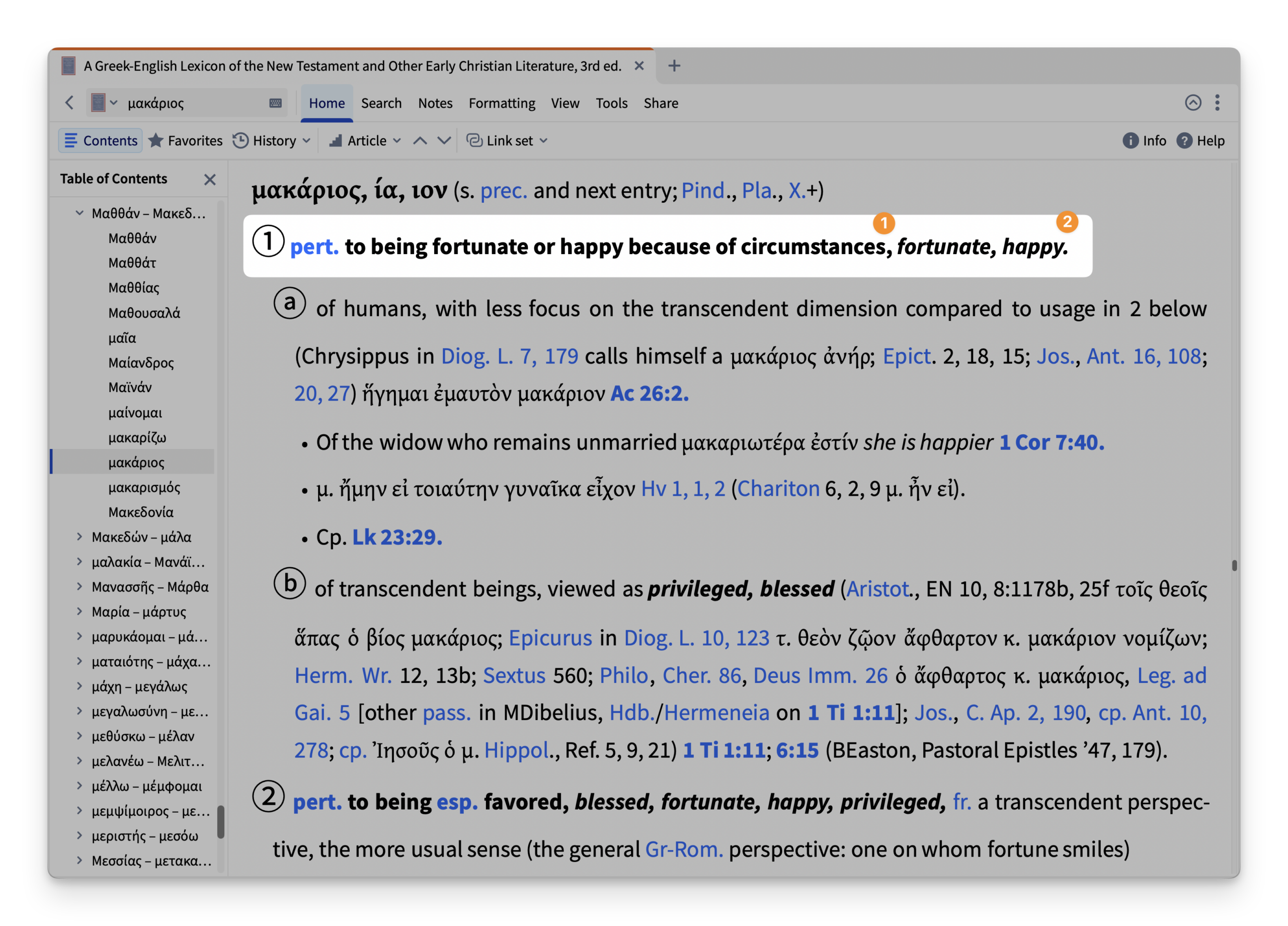
BDAG is the source for the definition of λόγος given earlier. The entry for λόγος (three full pages of double columns with small font!) offers three main definitions (bolded) with multiple subcategories (including additional definitions and glosses) and extensive biblical and extrabiblical references and bibliography. References to the NT are helpfully bolded.
A word of caution, however, is in order about biblical references. The determination of which NT references are examples of given subcategories involves interpretation and exegesis. Thus it may be possible to find the same biblical reference in more than one part of an entry. This should caution users of the lexicon from simply appropriating the gloss assigned for a given biblical word uncritically. In many cases, we will agree with BDAG, but it is helpful to understand that the assignment of these biblical references can be subjective.
Even so, many features contribute to the indispensable value of BDAG. Although this lexicon is about $150, it is worth putting on your Christmas or birthday wish list! A related work is The Concise Greek-English Lexicon of the New Testament, also by Frederick W. Danker (Chicago, 2009). This helpful resource is not a substitution for BDAG, but it is a helpful quick reference. It also offers definitions and glosses, but has more limited references to the Greek NT and extrabiblical sources.

A Greek–English Lexicon of the New Testament and Other Early Christian Literature, 3rd ed. (BDAG)
Regular price: $164.99
Greek-English Lexicon of the New Testament: Based on Semantic Domains (Louw and Nida)
Another important tool is the Greek-English Lexicon of the New Testament: Based on Semantic Domains, edited by J. P. Louw and Eugene A. Nida.
Rather than an alphabetical listing of Greek words (as is the case for most lexicons, including BDAG), this lexicon classifies Greek words into ninety-three semantic domains (such as “Kinship Terms,” “Reconciliation,” “Forgiveness,” “Agriculture,” “Status,” and so on).
As noted, earlier lexicons and theological wordbooks sought to understand the “mindset” behind biblical Greek words, but as noted, this can lead to reading too much into a given word and importing that meaning into every occurrence of that word. The emerging field of lexical semantics was critical of these older approaches (and rightly so, in some cases). Instead, linguists sought to break words down into their various components (componential analysis) understood in contrast to other words. For example, a “human” could be a man, woman, boy, or girl, but an “adult” could only be a man or a woman.7 Such analysis led to the identification of the ninety-three semantic domains, which group related words together into small subdomains.
Looking back at the example of θεωρέω, this word is listed under three semantic domains: Domain 24 (Sensory Events and States; Subdomain A: See); Domain 32 (Understand; Subdomain B: Come to Understand); and Domain 90 (Case; Subdomain M: Experiencer). Our example definition above is listed under 24.14.

In addition to offering a definition and possible glosses, Louw and Nida’s work also offers “contextual notes,” which list scriptural examples or explain idioms. For example, in 90.79, they note that this use of θεωρέω is “normally in negative expressions indicating what one will not experience,” which helps to understand the use of θεωρέω in John 8:51.8
This work is helpful for addressing a common mistake that Greek students often make, which is to think that all possible glosses for a given Greek word are equally possible every time that word appears in the NT or the LXX. Instead, Louw and Nida’s work shows how dependent words are on the context in which they appear. This work also makes it easier to consider options that biblical writers had in their lexical choices since we more easily see semantically related words.9 Finally, subdomains make it easier to see synonyms (in nearby subdomains) and antonyms (in more distant subdomains) for a given word or group of words.
A benefit of this lexicon, then, is that you can more easily see how individual Greek words are organically connected with other words. This reflects the way that language users actually categorize words, something along lines of “words of a feather flock together.” People simply don’t organize the words that they know alphabetically! Yet people also don’t usually understand what a word is based on how it contrasts with another word (componential analysis). Instead, people often understand what a word means based on their experience with that word. For example, a person knows what a bird is because they’ve experienced one singing in their back yard. They aren’t thinking that a bird has certain components and lacks other ones.
A limitation of this work is that it can be difficult to use since the same Greek word can appear in more than one semantic domain. The work comprises two volumes. The first volume is organized around the ninety-three semantic domains. The second volume lists all NT Greek words alphabetically and then lists the domain(s) and subdomains where the word is discussed. This latter volume also offers a list of English words to access domains and a Scripture index keyed to domains.
Another limitation of Louw and Nida is that it is limited to the Greek of the NT. Even so, Louw and Nida’s work is very helpful for understanding biblical Greek words.
Drawing upon Louw and Nida is Mark Wilson’s Mastering Greek Vocabulary Through Semantic Domains. This compact volume follows the structure of the ninety-three semantic domains from Louw and Nida’s lexicon, but offers brief glosses (sometimes only one). It is a helpful way to visualize how “words of the same semantic domain flock together.”
Greek-English Lexicon of the New Testament Based on Semantic Domains
Regular price: $35.99
A Greek-English Lexicon (LSJ or LSJM)
A Greek-English Lexicon was originally edited by Henry George Liddell and Robert Scott, but a later edition (Clarendon, 1996) was updated by Henry Stuart Jones and Roderick McKenzie. This lexicon spans from the classical era to about AD 600, including vocabulary from the LXX and the NT.
This massive volume is particularly helpful for understanding the semantic development of a given word over a long time period. This can be helpful in some situations, but if we are focused on how first-century language users understood a specific work in a given context, this may not be as helpful. After all, most of us don’t intuitively think through centuries of a word’s historical development when we consider what that word means!
Even so, this work can be helpful in understanding hapax legomena (words that occur only once) or words whose background could still influence NT usage. For example, παρρησία was associated by Athenians with free speech, which is still reflected in some glosses for this word: “outspokenness,” “frankness.”
See also its abridgment, An Intermediate Greek-English Lexicon (LSJI).
Customize the format of your lexicons in Logos for ease-of-use.
Biblical Greek lexicons focusing on the LXX
Several specialized lexicons have been developed for studying the vocabulary of the Septuagint (LXX).
A Greek-English Lexicon of the Septuagint (GELS)
The most comprehensive lexicon of the LXX is the one by Takamitsu Muraoka, A Greek-English Lexicon of the Septuagint (Peeters, 2009), covering the OT canon and the Apocrypha (deuterocanonical books). This work is based on the comprehensive textual work of the Göttingen edition of the LXX. Entries include various forms of words (e.g., various verb tenses forms, participles, passive forms) and definitions as well as glosses, which are illustrated by actual Greek texts (allowing users to see contextual connections) and biblical references. There are also references to cognates and some bibliographical works. Unique to this work is the addition of references to both synonyms and antonyms within the LXX corpus.
A Greek-English Lexicon of the Septuagint (LEH)
One of the most accessible lexicons for the LXX is the two-volume A Greek-English Lexicon of the Septuagint, edited by Johan Lust, Erik Eynikel, and Katrin Hauspie, now in its third edition (Deutsche Bibelgesellschaft, 2016). The work is very concise and yet offers morphological analysis, biblical references (including the OT and Apocrypha), translation glosses (but no definitions) often following LSJM, some references to the Hebrew from which the Greek was translated, and bibliographic references for many entries (including some not found in GELS).
The Greek of the Septuagint: A Supplemental Lexicon
As the title suggests, this work by Gary Alan Chamberlain (who collaborated on LEH) is not an exhaustive lexicon. It mainly supplements the LXX references in BDAG. Morphological information is offered, especially for less common forms, as well as biblical and extrabiblical references.

Theological lexicons and dictionaries
As noted above, in addition to lexicons, there are numerous theological lexicons and dictionaries for the study of biblical Greek words.
The adjective “theological” before “lexicon” or “dictionary” is important. These works reflect the decades of (primarily German) scholarship that sought to understand the historical, cultural, and contextual associations in a given Greek word, often with the aim of understanding how the word could be understood theologically.
Theological Dictionary of the New Testament (TDNT)
The most extensive theological dictionary is the ten-volume Theological Dictionary of the New Testament, edited by Gerhard Kittel, Gerhard Friedrich, and George Bromiley (Eerdmans, 1976). TDNT is the English translation of Theologisches Wörterbuch zum Neuen Testament, translated by Bromiley.
This massive work has detailed, extensive entries for more than 2,300 biblical Greek words. The volumes are organized alphabetically, although related words are discussed in single entries. For example, the entry for ἅγιος (“holy”) also includes subentries for ἁγιάζω (“I set apart”), ἁγιασμός (“consecration”), ἁγιότης (“moral purity”), and ἁγιωσύνη (“holiness”). (Numerous other related words are also listed in the opening paragraph.) This twenty-eight-page entry starts with ἅγιος, beginning with a brief discussion of the word in classical Greek and secular Hellenistic sources. This is followed by a seven-page discussion of ἅγιος in the OT (both the MT and LXX) and extrabiblical Jewish writings (e.g., Jewish apocryphal writings, Philo, and Josephus). The next three-page section focuses on rabbinic Judaism. Finally, there is a ten-page discussion of ἅγιος in the NT. Following the entry for ἅγιος is a two-page entry for ἁγιάζω, single-page entries for ἁγιασμός and ἁγιότης, and a half-page entry for ἁγιωσύνη. Such extensive treatment of one significant NT word is representative of other entries, some of which are much longer.

Multiple authors contributed to this massive work. Often, one entry will have multiple authors. This is understandable given the scope of this work, yet there can be an unevenness in the depth and theological perspectives represented in individual entries.
This work represents nineteenth- and early-twentieth-century German scholarship at its height. Yet, as noted above, this theological approach to lexical semantics has been criticized, particularly for the confusion of a word with an associated concept (such as κληρονομία and “eternal life”) and for trying to determine the “mindset” of biblical writers. These criticisms have led some to abandon TDNT. Yet TDNT offers vastly more background information than is found in BDAG or Louw and Nida, so dismissing it completely is a mistake. Instead, we can gain from the cultural and historical background and accompanying reflections while at the same time being cautious of some of the (at times sweeping) theological claims found in entries.
There is also an abridged, one-volume book (Eerdmans, 1985).
The Theological Dictionary of the New Testament, Abridged in One Volume (TDNTA)
Regular price: $56.99
New International Dictionary of New Testament Theology (NIDNTT)
The New International Dictionary of New Testament Theology is a three-volume work edited by Colin Brown (Zondervan, 1979). The strength of this work is the breadth of scholars who contributed to it, such as J. I. Packer, F. F. Bruce, and D. A. Carson. Although a bit dated, many entries are worth consulting. Each entry covers classical (CL) usage, OT usage, and NT usage.
The main difficulty with this resource is its organization—entries cover related English words, such as “Abolish, Nullify, Reject.” The Greek verb discussed under this heading is καταργέω. The entry “Baptism, Wash” discusses three Greek verbs: βαπτίζω, λούω, and νίπτω. (This format follows the original design of Theologisches Begriffslexicon zum Neuen Testament, which focused on “theological concepts,” somewhat similar to semantic domains.) Its original publication was very difficult to use; fortunately, indexes were added as a fourth volume in 1986.
New International Dictionary of New Testament Theology and Exegesis (NIDNTTE)
The New International Dictionary of New Testament Theology and Exegesis (Zondervan, 2014) is the extensive revision of NIDNTT. This five-volume tool is the work of Moisés Silva, who updated and revised entries so extensively that the names of the original authors are not retained in individual entries.
The biggest revision reorganized entries into alphabetical order while still trying to retain the idea of concepts. Perhaps more importantly, NIDNTTE takes seriously the earlier criticisms of theological wordbooks and tries both to avoid those shortcomings and to incorporate more recent understandings of lexical semantics, such as the role that context plays in understanding a biblical Greek word. Silva describes this in terms of “collocation,” or how a word “combines with other lexical items.”10 As the title indicates, this work is more focused on exegesis, considering how words function in a given context. This shifts the focus from the word itself to the context in which it appears and how it functions there.
Silva also draws heavily upon the semantic domains established by Louw and Nida, which is reflected in the “List of Concepts” that is found at the beginning of each volume. A dagger indicates which Greek word has the most extensive discussion and often the fullest bibliography. Somewhat following NIDNTT, each entry discusses Greek literature (GL; classical and extrabiblical Koine), Jewish literature (JL; MT, LXX, Philo, Josephus, and some apocryphal works), and the NT. Some basic revisions include corrections of inaccurate material and omissions of outdated discussions.
See also its one-volume abridgment, The Concise New International Dictionary of New Testament Theology and Exegesis, edited by Christopher A. Beetham. This work is a valuable tool for quickly understanding the scope of a biblical word. It is more accessible than NIDNTTE and yet entries retain much of the essence of the longer entries in NIDNTTE.
New International Dictionary of New Testament Theology and Exegesis, 2nd Edition | NIDNTTE (5 vols.)
Regular price: $249.99
The Concise New International Dictionary of New Testament Theology and Exegesis
Regular price: $79.99
Exegetical Dictionary of the New Testament (EDNT)
Also sensitive to the criticisms of James Barr is the Exegetical Dictionary of the New Testament, edited by Horst Balz and Gerhard Schneider (Eerdmans, 1990–93).
Unlike TDNT, EDNT covers all the vocabulary of the NT. Moving beyond a lexicon, EDNT offers interpretations of lexemes in selected contexts. The adjective “exegetical” is important since the aim of this dictionary is to understand how a word functions and what it means in a given context and not necessarily to offer the theological conclusions of TDNT.
Theological Lexicon of the New Testament (TLNT)
The Theological Lexicon of the New Testament (Editions Universitaires, 1978, 1982) was published by Ceslas Spicq in French, with the English translation appearing in 1994 (Hendrickson).
This three-volume work is less extensive than the TDNT and focuses on contemporary papyri rather than drawing upon the extensive historical development of words from classical, MT, and LXX usage that characterizes TDNT (although Spicq does engage these sources). It is more synchronic, focusing on how words were used and understood in the first-century Koine context of the NT.
Unlike TDNT, this is the work of a single individual, which yields a more unified theological perspective. Although the work is organized basically alphabetically, entries often include related words. Spicq offers a select set of theologically significant NT words with an explicit theological aim that focuses on “the semantics and the religious and moral sense of the language of the New Testament.”11
True to his aims, Spicq offers many theological and exegetical insights into various NT passages, which can be helpful for Bible study and sermon preparation.
Analytical lexicons
Analytical lexicons are probably better understood as parsing guides.
The Analytical Lexicon to the Greek New Testament (Mounce)
The Analytical Lexicon to the Greek New Testament, by William D. Mounce (Zondervan, 1993), arranges entries alphabetically by morphological form. The lexical form is bolded and is accompanied by limited glosses (and some definitions) and NT references. Each entry includes morphological analysis and principal parts for verbs. For example, the entry ἀποκτανθείς offers a complete parsing, biblical reference, and morphological analysis and indicates that this derives from ἀποκτείνω. The entry for ἀποκτείνω lists this verb’s principal parts, variant spellings, simple glosses, and biblical references with more detailed glosses.
The Analytical Lexicon of the Greek New Testament
The Analytical Lexicon of the Greek New Testament, edited by Timothy Fribourg, Barbara Fribourg, and Niva F. Miller (Baker, 2000), also offers morphological analysis, biblical references, and more extensive definitions and glosses.
The Analytical Lexicon of New Testament Greek
The Analytical Lexicon of New Testament Greek, edited by Maurice A. Robinson, and Mark A. House (Hendrickson, 2012), offers more extensive historical background, some references to English translations, the theological significance for some words, and limited NT references. It offers complete parsing and morphological analysis.
The Analytical Lexicon to the Septuagint: A Complete Parsing Guide
The Analytical Lexicon to the Septuagint: A Complete Parsing Guide, by Bernard A. Taylor (Zondervan, 1994), does not include definitions or glosses and only provides complete parsing for Greek words in the LXX, arranged in alphabetical order.
Additional resources
If you have access to a good theological library, the following resources can sometimes be helpful for understanding biblical Greek words.
Zondervan Compact Greek Lexicon
A concise, hybrid volume worth considering is the Zondervan Compact Greek Lexicon, by Paul N. Jackson (Zondervan, 2025). This compact volume (slightly over 200 pages) lists lexemes alphabetically for both the Greek New Testament and the LXX, indicating the frequency of each word, and often providing verse references for less frequent words. Rather than merely listing possible glosses for a given word, glosses are divided into subcategories, sometimes summarizing the extensive entries in NIDNTT in only several lines of text. Relevant Greco-Roman and early church references are cited when necessary to indicate a word’s usage. Difficult, irregular forms are also listed with clear references to the lexical form.
The Vocabulary of the Greek Testament: Illustrated from the Papyri and Other Nonliterary Sources (Moulton and Milligan)
The Vocabulary of the Greek Testament: Illustrated from the Papyri and Other Nonliterary Sources, by James Hope Moulton and George Milligan (Eerdmans, 1980), is not an exhaustive lexicon, but rather a treatment of selective Greek NT words that seeks to incorporate extrabiblical information, particularly from discoveries of papyri and some inscriptions that were recent at the time when the work was compiled.
It is interesting to note that a given word, such as ἀποσπάω (“I pull, draw, lead away”) in Acts 20:30, does not imply violence but a “breach of contract” in some papyri. It is harder to know, however, how these extrabiblical sources illumine what Paul meant by this word. Even so, this resource can helpfully supplement our understanding of some biblical words.
See also the forthcoming revision of this work, Vocabulary of the Greek New Testament (Hendrickson, 2027).
The Brill Dictionary of Ancient Greek
The Brill Dictionary of Ancient Greek (Brill, 2015) includes references to Koine. For instance, the entry on λόγος has numerous references to the LXX and NT, including John 1:1 and Revelation 19:13. For frequent words, you are better served with BDAG or Louw-Nida. But for hapax legomena (words that occur only once in the Greek NT or only in the LXX), this dictionary can be helpful.
A Patristic Greek Lexicon
A Patristic Greek Lexicon, edited by G. W. H. Lampe (Clarendon, 1961), is helpful for seeing how biblical Greek words evolved in the first centuries of the church. For example, the entry for ἐπίσκοπος discusses how this office differed from πρεσβύτερος (“elder”) and how the terms were understood in the early church.
TL;DR: What’s the best biblical Greek lexicon?
So what’s the best biblical Greek lexicon?
- If I could only have one (gasp!), I would go with BDAG. It is the best single-volume work available.
- It would be great to supplement BDAG with Louw and Nida, if possible.
- If I could only have one theological dictionary, I would go with Beetham’s one-volume NIDNTTE.
- If I could only have one lexicon for the LXX, I’d go with L-E-H.
- Any of the analytical lexicons would be a helpful addition to one’s library.
- Of course, if your budget allows, the five-volume NIDNTTE is a wonderful tool to have around.
This handful of tools are the right tools for the job of understanding biblical Greek words!
Share your thoughts
What are the best Greek lexicons? Join us in the Word by Word group to share your thoughts.
Related content
- How to Use Greek Lexicons
- Original Language Research: What to Do, What Not to Do
- Pastor, Are You Making These Common Lexical Mistakes?
- How to Teach the Languages—& Actually Help Students Learn
- What Are the Best Hebrew & Aramaic Lexicons? Your Ultimate Guide
- William Arndt et al., A Greek-English Lexicon of the New Testament and Other Early Christian Literature, 3rd ed. (Chicago, 2000), 599.
- Johannes P. Louw and Eugene Albert Nida, Greek-English Lexicon of the New Testament: Based on Semantic Domains (United Bible Societies, 1996), 278.
- If you want a laugh-out-loud book about this lexicographical history, see John A. L. Lee, A History of New Testament Lexicography, Studies in Biblical Greek (Peter Lang, 2003).
- Michael Aubrey, “Linguistic Issues in Biblical Greek,” in Linguistics & Biblical Exegesis, ed. Douglas Mangum and Josh Westbury, Lexham Methods Series (Lexham, 2017), 177.
- Aubrey, “Linguistic Issues,” 178.
- William Arndt et al., A Greek-English Lexicon of the New Testament and Other Early Christian Literature (Chicago), 379.
- See Aubrey, “Linguistic Issues,” 179–81.
- Johannes P. Louw and Eugene Albert Nida, Greek-English Lexicon of the New Testament: Based on Semantic Domains (United Bible Societies, 1996), 808.
- Aubrey, “Linguistic Issues,” 184.
- Moisés Silva, ed., New International Dictionary of New Testament Theology and Exegesis (Zondervan, 2014), 13.
- Ceslas Spicq, “Preface,” in Theological Lexicon of the New Testament (Editions Universitaires, 1982), vi.


 Dustin Burlet

 Richard Harvey
 James Seward