
 Dustin Burlet
At the heart of all effective interpretation of the Hebrew Bible/Old Testament (HB/OT) lies a nuanced understanding of syntax (discourse).1 Syntax involves diligently studying the way(s) in which words, phrases, clauses, and sentences relate to one another to create meaning.2 Life-changing exegesis of Scripture requires more than merely being able to discern elementary phonology, morphology, and vocabulary.3 In the words of Bill T. Arnold and John H. Choi, “achieving a deep-level reading [of Hebrew] requires an [acute] understanding of syntactical relationships, a topic that beginning grammars simply cannot cover in detail.”4
This guide for second-year(-plus) Hebrew students helps to bridge the gap to some more intermediate/advanced reference works.5
The following resources are arranged roughly according to their level of technicality, depth, and pedagogical sensitivity.6 Readers will have to discern for themselves what level of proficiency in Hebrew grammar and syntax they would like to obtain overall. One must always keep in mind, however, “the ultimate goal of … Hebrew study: to know and love the Triune God and to love people who are made in his image.”7 Ad fontes!8
Table of contents
Introductory Hebrew grammars
For a beginning Hebrew grammar, I’ll be a “realist”9 and encourage you to stick with the textbook(s) you first used.10 Additionally, refreshers in English grammar can prove to be surprisingly helpful as well for beginners.11 There are also superb tools to assist those who are struggling with specific elements of Hebrew like weak verb morphology.12
Beyond these, the following list consists of some of the best introductory Hebrew grammars.
Williams, Ronald J. Williams’ Hebrew Syntax. Revised and expanded by John C. Beckman. Third edition. University of Toronto Press, 2007.
This short book is divided into four main sections:
- nominals,
- verbs,
- particles, and finally
- the syntax of clauses.
Notably, in the treatment of verbs, Beckman’s work prioritizes aspect over tense, yet it retains the “preterite imperfect” as a distinct grammatical category—a category that encompasses the “converted imperfect” or the wayyiqtol.13 Each individual section offers a concise introduction with one to three biblical examples for illustration (and a clear index of Scripture references).
Though now, regrettably, becoming increasingly dated, the bibliographic entries within each of the different sections are ample. The most helpful component for most users is that Beckman’s work is keyed to each of the other major Hebrew reference grammars, namely BHRG, Gesenius’ Hebrew Grammar, IBHS, and Joüon and Muraoka’s Grammar of Biblical Hebrew (all of which will be discussed later in the advanced Hebrew grammars section).
Do note that Williams’ Hebrew Syntax sometimes “obscures the difference between describing Hebrew syntax and providing English translation equivalents.”14 Even so, for overall utility and ease of use (not to mention its thoroughly broad coverage), it is exceptionally hard to beat!15
Chisholm, Robert B. From Exegesis to Exposition: A Practical Guide to Using Biblical Hebrew. Baker, 1998.
As esteemed professor of Old Testament John W. Hilber states,
In my view this is the best book for pastors to own beyond their first-year grammar. It includes a chapter on discourse grammar (grammar beyond the level of the sentence) that cannot be found in such concise form anywhere else I am aware of. It offers many practical illustrations in exegetical method.16
I heartily concur with this assessment, particularly when one combines this volume with A Workbook for Intermediate Hebrew: Grammar, Exegesis, and Commentary on Jonah and Ruth (Kregel, 2006) and A Commentary on Judges and Ruth (Kregel, 2013), where you can see the theory parsed out more clearly.17 It also helpfully cross-references to both Gesenius’ Hebrew Grammar and Waltke–O’Connor’s superb grammars. As a critique, all the examples given in Hebrew script are unpointed, which may “provide a slight hurdle for those who have come to depend on the vocalized text.”18
Despite its age (if only we had an update!) it remains sui generis since there is nothing else comparable to it available.
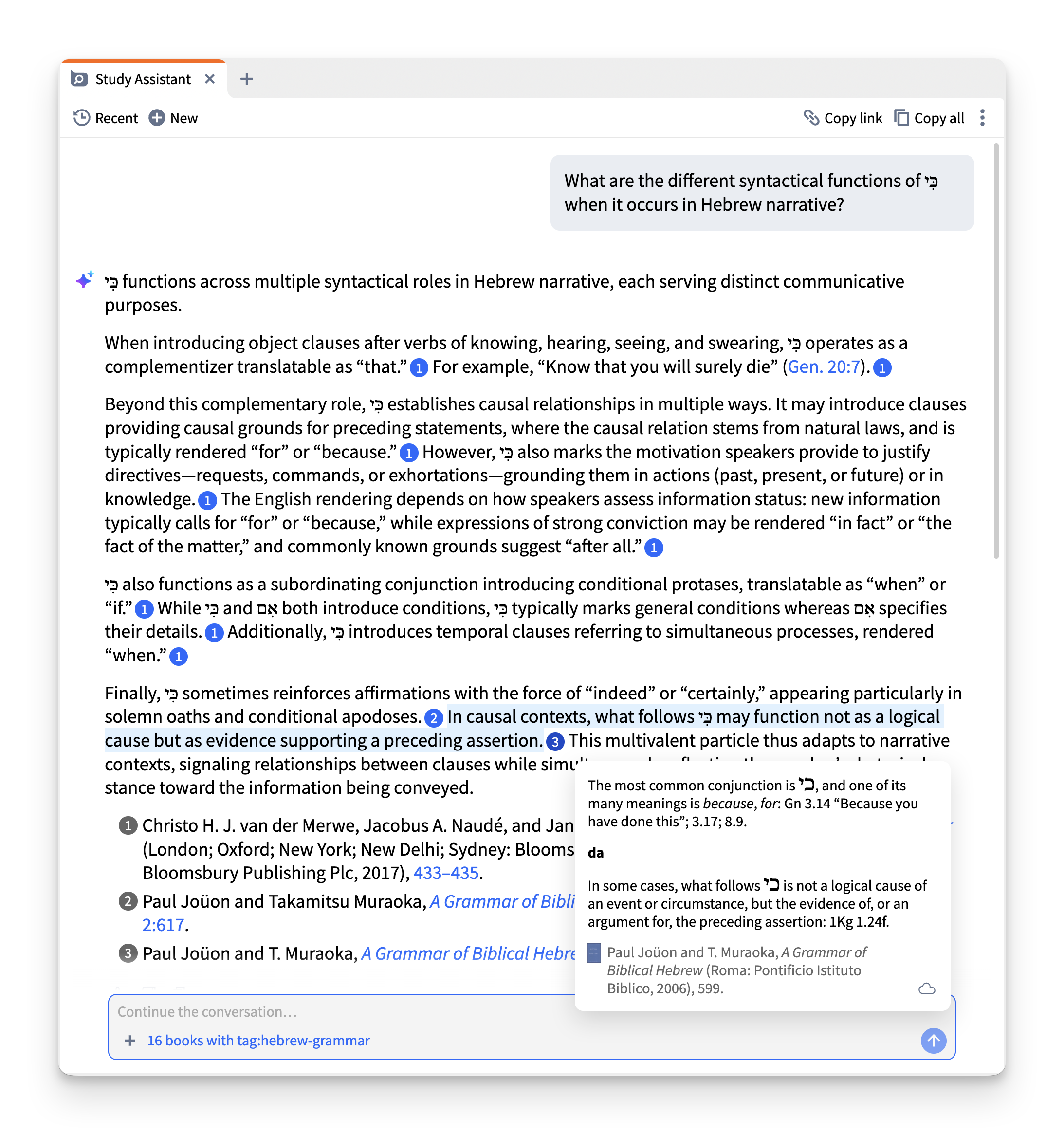
Honorable mention: Gibson, J. C. L. Davidson’s Introductory Hebrew Grammar–Syntax. Fourth edition. T&T Clark, 1994.
This book should not be confused with Davidson’s earlier counterpart, Davidson’s Introductory Hebrew Grammar, by James D. Martin. Notwithstanding its title, Gibson’s work is designed for more advanced students.19 It contains six main sections:
- syntax of the pronoun,
- syntax of the noun and nominal clause,
- syntax of the verb and its object,
- syntax of the infinitive and participle,
- syntax of the adverb and adverbial phrases and clauses, and
- syntax of the sentence.20
Often, paying attention to the reference works employed by trusted interpreters reveals (or vindicates) their value for exegesis more than published reviews. The proof is in the pudding! One example of this work’s astute grammatical insights may suffice. Genesis 6:8 reads, “But Noah found favor in the eyes of the Lord” (וְנֹחַ מָצָא חֵן בְּעֵינֵי יְהוָה). Old Testament scholar John Goldingay cites Gibson approvingly, commenting, “GKC [Gesenius’ Hebrew Grammar] 142b takes the word order with the subject first to indicate that the clause provides background information and that the verb should be rendered in the pluperfect. But it is simpler to take the word order as indicating that the clause offers a contrast with what precedes it (DG 142c).”21

Intermediate Hebrew grammars
Much like in the realm of boxing, a heavyweight champion might not necessarily be the best boxer pound for pound. Similarly, an intermediate guide is not necessarily better than an introductory one; rather, it represents a “step above” introductory works in terms of the scope and nuance of the material presented.
Patton, Matthew H., and Frederic Clarke Putnam. Basics of Hebrew Discourse: A Guide to Working with Hebrew Prose and Poetry. Edited by Miles V. Van Pelt. Zondervan Language Basics. Zondervan, 2019.
Basics of Hebrew Discourse (BHD) was intentionally designed to provide intermediate (second-year[-plus]) Hebrew students with a “functional introduction to the use and application of discourse analysis as a necessary component to textual analysis and the exegetical process.”22
For prose narrative, BHD does not treat waw (ו) as a discourse marker unto itself. To be clear, Patton (astutely) contends: “the seemingly endless functions of waw are actually not so much functions of waw alone but of the larger clausal and supra-clausal structures of which waw is a part.”23 In a related way, Patton clarifies that biblical Hebrew also uses sequences of verbs in certain forms and in a certain order in order to communicate discourse relationships. For instance, a waw + yiqtol after an imperative usually communicates purposes (“so that”) despite the absence of any particular discourse marker.24 Patton also judiciously maintains each verbal form (qatal, yiqtol, etc.) has its own “‘default’ meaning in terms of tense, aspect, and mood, but … these defaults can be overridden based on discourse considerations.”25
With respect to biblical Hebrew poetry, Putnam argues “a poetic line consists of a single clause: one clause per line and one line per clause” and (most distinctly) line length (as opposed to rhyme or meter, for example) is a “discourse-level device that the biblical poets used to organize their poems.”26 Uniquely, Putnam also opines that parallelism is “neither unique nor necessary to biblical poetry. It is a cohesive feature of biblical poems, a linguistic resource that helps to make biblical poems examples of patterned language.”27 Putnam suggests that the process for poetic discourse analysis consists of several steps:28
- list all nouns/verbs,
- parse verbs,
- gloss the text,
- determine the length (number of words) and structure (syntax) of each line,
- analyze the morphology of predicates,
- describe the type of each clause and its syntax, and
- look for semantic cohesion (semantic analysis, chiasm, ellipses, participant tracking) and logical cohesion (kinds of information/interclausal relationships).29
Modern linguistic theories can be ignored only to one’s peril.30 Veritably, “discourse analysis provides the stimulus and foundation for further literary, historical, and theological study.”31 Students and educators alike, though, must discern for themselves whether or not appropriating Patton and Putnam’s specific methodologies as laid out in Basics of Hebrew Discourse truly pay the dividends that they claim.32
The accompanying lectures are superb.
Hardy, H. H., II, and Matthew McAffee. Going Deeper with Biblical Hebrew: An Intermediate Study of the Grammar and Syntax of the Old Testament. B&H, 2024.
This book is designed for students of Hebrew who have completed an introductory grammar and are looking for an appropriate next step. Rather than using the fully deductive or strictly inductive methods, however, Hardy and McAffee have successfully navigated a mediating approach that embodies the transitional space between beginning grammars and advanced texts.
The book consists of three main parts.
- Part A introduces the Hebrew language, in general.
- Part B covers the verbal system (including stems) alongside volitives and the prefix and suffix conjugations.
- Part C covers nouns and noun phrases, pronouns, adjectives, participles, infinitives and temporal clauses, conjunctions, adverbs, and other particles, then prepositions.33
Aside from three guided lessons—(1) textual criticism, (2) semantic analysis, and (3) syntactic analysis—there are also four excellent appendices:
- Continuing with Hebrew
- Biblical Hebrew Vocabulary
- English to Hebrew Catalogue
- Glossary: Three Indices (Name, Subject, Scripture)
An extensive bibliography rounds things out.34
Only time will tell how this volume will fare in the future, but for many users, this is the most up-to-date resource on the block for intermediate Hebrew. The exercises and guided reading of biblical texts are particularly notable, even if the linguistic nomenclature is (as a whole) quite dense.35
Arnold, Bill T., and John H. Choi. A Guide to Biblical Hebrew Syntax. Second edition. Cambridge University Press, 2018.
With respect to its basic structure and outline, A Guide to Biblical Hebrew Syntax (GBHS) divides things into four main parts.
- The first three sections cover the key categories of individual words: (1) nouns, (2) verbs, and (3) particles.
- The fourth section moves beyond phrase-level phenomena and considers the larger relationships of clauses and sentences (nominal and verbal clauses, subordinate clauses, and additional sentence types).
- There are also two clear appendices (A: Stem Chart; B: Expanded Stem Chart).
- There is also a thoroughly helpful ten-page glossary (with cross references!).
While the first edition of GBHS used imprecise labels such as “perfect” or “imperfect” when discussing the verbal system, the second edition uses more accurate terms like yiqtol form/prefix conjugation or qatal form/suffix conjugation. Other such improvements abound. For instance, with respect to nouns, Arnold and Choi have (further) explained the marked difference between form and function concerning the terms nominative, genitive, and accusative, and note that though “some authorities believe we should abandon these grammatical labels altogether (especially ‘nominative’) when describing BH syntax” their objective is
to identify and describe the functions of the noun. Because the nouns in BH function syntactically in the same distinct ‘cases’ as its parent language, it is still helpful to distinguish three case functions in BH using the terminology nominative, genitive, and accusative. We will introduce other designations for these functions where appropriate to assist the advanced student … if the reader remembers that we are describing the syntactical functions of these nouns rather than their grammatical morphemes, we believe the traditional terminology is more helpful.36
Concerning the nominal clause, Arnold and Choi write “we are using ‘nominal clause’ narrowly defined to refer to clauses without verbs, and so as interchangeable with ‘verbless clause’ or ‘nonverbal clause.’ Terminology is a debated topic related to this subject.”37 Mention could also be made of the increased specificity concerning word order, the primary function of the Niphal (as medio-passive independent of any original function that was reflexive), and the particles.
From a technical standpoint, some readers may be disappointed that this volume does not do more than merely provide a “guide.” That is, it is no substitute for the “heavyweight” grammars. However, the effective use of biblical illustrations combined with a clear, easy-to-use format, copious footnotes and numerous other up-to-date references makes this volume one of the most accessible introductions currently in print to students of biblical Hebrew syntax. It easily remains (among guidebooks of this kind) my first recommendation—bar none.38

Honorable mention: Fuller, Russell T., and Kyoungwon Choi. Invitation to Biblical Hebrew Syntax: An Intermediate Grammar. Invitation to Theological Studies Series. Kregel, 2017.
This book is divided into three parts:
- the syntax,
- compositions, and
- MT accents.
Keys to its drills are supplied to further aid the student. There is also a helpful glossary in the appendix. In grammar, and particularly, in syntax, Fuller and Choi are fully persuaded that
Biblical Hebrew closely resembles Arabic. Since Arabic is the dominant living Semitic language and since modern Arabic preserves much of classical Arabic, it furnishes the best model for Biblical Hebrew [and Aramaic] grammar and syntax … The syntactical categories for this syntax, therefore, follow the categories of native Arabic grammarians as appropriate, rather than arbitrary or novel linguistic categories. This methodology emulates the study of classical languages for centuries.39
I especially found the section on Hebrew accents quite stimulating!40

Advanced Hebrew grammars
Finally, this next section explores some of the most substantial and advanced reference grammars (for syntax), while illustrating how to use them more effectively in exegesis.
Kautzsch, E., ed. Gesenius’ Hebrew Grammar. Second edition. Clarendon Press, 2006.
Frequently cited, this classic is widely considered to be the “Cadillac” of advanced Hebrew grammars.41 Commonly known as Gesenius–Kautzsch–Cowley (GKC) or simply Gesenius, this book has been the standard (advanced) reference grammar since the first German edition came out in 1813.42
GKC’s primary strength is its comprehensive survey of the grammar, combined with extensive textual citations that are easily accessible through the indices.43
In addition to its grammatical descriptions, GKC also contains a facsimile copy of the Siloam Inscription (with an English translation) alongside an eminently helpful Table of Alphabets which delineates the so-called “Square Script” of the text from Old Hebrew and the like.44 The value of this historical feature can be illustrated from Ezekiel 9:4:
וַיֹּאמֶר יְהוָה אֵלָו עֲבֹר בְּתוֹךְ הָעִיר בְּתוֹךְ יְרוּשָׁלִָם וְהִתְוִיתָ תָּו עַל־מִצְחוֹת הָאֲנָשִׁים הַנֶּאֱנָחִים וְהַנֶּאֱנָקִים עַל כָּל־הַתּוֹעֵבוֹת הַנַּעֲשׂוֹת בְּתוֹכָהּ
Now the Lord said to him [the man], “Pass over in the midst of the city—yes, in the midst of Jerusalem—and inscribe a mark on the foreheads of all mortals who mourn and lament concerning all the abominations which have been done in her.”45
While most Hebrew lexicons designate the תו as “mark, sign,” it is also the name of the final letter of the Hebrew alphabet—namely taw. As H. H. Hardy II translates, “Yahweh said to him, ‘Go, throughout the city, Jerusalem, and mark a taw on the foreheads of anyone who groans and sighs over all the abominations being done within it.’”46 The question thus becomes, which “mark” (taw) is being inscribed or written by the man? Is it the three-sided character of the Aramaic square script (ת) or the cross-like shape of the Old Hebrew script (x)? Two things clarify: (1) Ezekiel’s vision occurred prior to the destruction of Jerusalem, meaning that the taw would have originally been written in the Old Hebrew script,47 and (2) in Job 31:35, the same lexeme functions as a written mark of ownership, authentication, and protection, much like a signature or ancient seal.48 GKC’s careful attention to the history of the Hebrew language enables readers to see at a glance an interpretive possibility that might have otherwise remained hidden, thereby providing a valuable background for the New Testament’s otherwise enigmatic imagery of God’s people being “sealed” (Rev 7:2–4; cf. 13:16; 14:9, 11; 20:4).
Waltke, Bruce K., and M. O’Connor. An Introduction to Biblical Hebrew Syntax. Eisenbrauns, 1990.
Commonly abbreviated as IBHS, Waltke and O’Connor’s book presents a contemporary linguistics perspective and, what was once cutting edge (and nigh exhaustive) bibliographic information. The table of contents and indices are especially thorough.49
Tremper Longman III relates,
This volume was the first significant intermediate-to-advanced level grammar published [in English] in many decades. It is magnificently done in terms of both content and production. The section on the verbal system is especially important. This volume is a must-buy for students of Hebrew. It is also good for ministers who have let their Hebrew slip to get back into it.50
Don Parker is likely correct in stating that students should not read IBHS straight through but rather (to gain a quicker exegetical payoff) study the noun case functions and nominal clauses first,51 then the verbal system,52 and then, lastly, clauses.53
Joüon, Paul, and Takamitsu Muraoka. A Grammar of Biblical Hebrew. Subsidia Biblica 27. Editrice Pontificio Istituto Biblico, 2006.
Takamitsu Muraoka’s reputation as a linguistic scholar is well established.54 Muraoka’s work was considered by (notable) Hebrew experts at the time to be “the best overall general reference grammar for biblical Hebrew.”55 The work has been translated and significantly expanded from the original French edition. Particularly suited for advanced students and scholars, it is a volume that specialists of Hebrew simply can’t do without!56
The following examples illustrate Muraoka’s approach to grammar (syntax), translation, and exegesis. First, though controversial, Muraoka asserts on the basis of a close (syntactical/grammatical) reading of the preposition(s) involved that Tamar actually became pregnant by Judah for his best interests (see Gen 38:18). To be specific, Muraoka contends:
Tamar probably had heard of God’s promise to Judah’s grandfather, Abraham, that his descendants would be as numerous as the stars in the sky or as the sands on the sea beach. However, she saw that Judah was most likely to die with no grandchild. She thought that she must do something about this prospect. The moment she reached that conclusion, she did not lose a single minute.57
By way of another example, Muraoka rather effectively addresses, from my perspective, a thorny issue regarding capital punishment in Genesis 9:6. He (cogently) observes,
ב [beth] is used and not מן [min] because man is here the instrument of justice (the exception to the law which forbids the shedding of blood, vs. 5 [sic]): He who sheds a man’s blood, by (means of) a man shall his blood be shed.58
Lastly, the Hebrew phrase of “going and returning” (הָלוֹךְ וָשׁוֹב) within the Noachian Flood (see Gen 8:3) has oftentimes been used to justify great tidal waves. Instead, Muraoka observes that the infinitive absolute grammatical form should be employed in a “figurative sense of movement in time and hence continuation.”59 Thus, it is best rendered as “and the waters receded in a continuous [uninterrupted] fashion.”60 The same grammatical phenomena (infinitive, etc.) apply to the story of the raven sent forth by Noah who “kept flying back and forth repeatedly” (Gen 8:7).
Van der Merwe, Christo H. J., Jacobus A. Naudé, and Jan J. Kroeze. A Biblical Hebrew Reference Grammar. Second edition. Bloomsbury, 2017.
This fully revised edition of A Biblical Hebrew Reference Grammar (BHRG) serves as a user-friendly and up-to-date source of detailed information on the morphology, syntax, semantics, and pragmatics of biblical Hebrew verbs, nouns, and other word classes (prepositions, conjunctions, adverbs, modal words, negatives, focus particles, discourse markers, interrogatives, and interjections).
Incorporating the most important developments in modern linguistics, the second edition of BHRG is accessible enough for exegetes who have completed an introductory (or intermediate) course in biblical Hebrew while offering sufficient depth for advanced exegetes, scholars, and translators. In my view, not only is it one of the most linguistically sophisticated and accessible Hebrew reference grammars available, but also, in many ways, it remains my first pick for all students to read in its entirety.61
Honorable mention: Brockelmann, Carl. Hebräische Syntax. Neukirchener, 2004.
Brockelmann’s strength is that he does not limit himself to the Masoretic Text (MT) but includes examples from Ben Sira and epigraphic materials (such as the Zadokite Fragments, manuscripts from Qumran, the Moabite Stone, and the Kilamuwa and Karatepe inscriptions, for instance), giving a broader view of Canaanite–Hebrew dialects.62 Brockelmann’s sections on the numerals and prepositions, in particular, are “especially good” alongside, one notes, the use of emphatic lamedh [ל], the way in which climactic conditions are expressed, and the notes on ellipse[s].63
One added bonus of using Brockelmann (for certain users) is that it will help them interact more effectively with the German language (a daunting yet oft-required task for many anglophone terminal degree students).64
Special mentions
Although not Hebrew grammars, the following are worth mention for those interested in improving their grasp of Hebrew grammar and syntax.
Noonan, Benjamin J. Advances in the Study of Biblical Hebrew and Aramaic: New Insights for Reading the Old Testament. Zondervan, 2020.
While space precludes an exhaustive analysis, all students of the Hebrew Bible/Old Testament should consider perusing this work. Noonan offers a one-of-a-kind (pedagogically sensitive) compendium to the multifaceted issues of the academic community—it is truly exemplary.65
“Semitic cross-training”
We also do well to acknowledge the value of learning other Semitic languages as a way to improve one’s grasp of the Hebrew. It cannot be overstated, perhaps, how much value comes by learning Aramaic, arguably the most neglected of all biblical languages.66 It can also be an excellent way to improve your Hebrew grammar—particularly through the comparison/contrast model.67 Even the Targums themselves can play a role in improving one’s understanding of Hebrew syntax.68
It also behooves me to mention how much diving into cognate languages, such as Ugaritic and Akkadian, can bolster one’s overarching understanding of Hebrew as a Semitic language within the context of the ancient Near East.69
The goal, however, is not to accumulate more languages but to cultivate an increased awareness of how language communicates meaning so as to gain a clearer, more exact, and more persuasive understanding of God’s redemptive message, the gospel.70
Conclusion
No grammar can do everything. Some resources prioritize comprehensiveness or accessibility while others engage more intentionally with specific methodologies (such as linguistic theory). The best resource depends on where the student currently is in their journey and where they want to go. In the end, exegesis (and more exegesis!) remains the surest foundation for faithful research and life-changing engagement with Scripture. Ad fontes!
Share your thoughts
What Hebrew grammars do you turn to most? Join us in the Word by Word group to share your thoughts.
Related content
- What Are the Best Hebrew & Aramaic Lexicons? Your Ultimate Guide
- The 7 Best Books for Learning Hebrew Vocabulary
- Best Biblical Greek Lexicons & Dictionaries: Your Complete Guide
- How to Teach the Languages—& Actually Help Students Learn
- The Best Septuagint (LXX) Translations in Logos: A Comparison Guide

- As Grant Osborne so eloquently puts it, “grammar is the architectural blueprint of communication.” Grant R. Osborne, The Hermeneutical Spiral: A Comprehensive Introduction to Biblical Interpretation, rev. ed. (InterVarsity Academic, 2006), 65.
- Please note that this article focuses on Hebrew grammar and syntax rather than the broader field of hermeneutics. To be clear, while exegesis often concerns the interpretation of a particular set of texts, hermeneutics reflects on the nature, conditions, and validity of interpretation itself. See Stanley E. Porter and Jason C. Robinson, Hermeneutics: An Introduction to Interpretive Theory (Eerdmans, 2011); Anthony Thiselton, Hermeneutics: An Introduction (Eerdmans, 2009). See also Osborne, Hermeneutical Spiral.
- In a previous article, I explored most of the major Hebrew and Aramaic lexicons and how they help to determine the meaning of individual words. Yet (as I briefly noted within that work) words do not function in isolation. Their meaning is shaped by syntax—the way(s) words, phrases, and clauses relate to one another within sentences. In sum, words only make sense in a sentence, i.e., context reigns supreme! For that reason, every serious student of Hebrew needs more than just a lexicon. They also need a reliable (advanced) grammar. For more details, see Dustin G. Burlet, “Book Review: Why Read the Bible in the Original Languages?,” Theodidaktos 17 (August 2023).
- Bill T. Arnold and John H. Choi, A Guide to Biblical Hebrew Syntax, 2nd ed. (Cambridge, 2018), 1. Certain elements of this paragraph, including some exact wording and phrasing, also appear within Dustin G. Burlet, “Review of A Guide to Biblical Hebrew Syntax,” McMaster Journal of Theology and Ministry 19 (2017–2018): R58.
- This article is dedicated to Dr. August H. Konkel. On a personal note, I am grateful to the Nerdy Biblical Language Majors group on Facebook (which boasts 31,600 members as of July 18, 2026) for facilitating different interactions concerning this article. Also, while I did not always appropriate their feedback, I remain appreciative of the astute comments of several people who read this article in its iterations. Much thanks, especially, must go to Ty Christian Alexander, Edgar Camargo, David J. Fuller, Jason Gayoway, Jorin Green, Amy Hancock, Matthew Hamilton, Travis Johnston, Samuel A. Kim, Joël Benoit Lacroix, Steve Miller, Ion Mittler, Dike Odimuko, J. C. Schroeder, Douglas K. Smith Jr., Elijah van de Laar, and Daniel Bredin.
- Traditionally, these levels follow an R-1 (elementary proficiency), R-2 (limited working proficiency), R-3 (professional proficiency), and R-4 rating (full proficiency). As Paul D. Wegner astutely notes: “While these criteria may help determine what levels of proficiency to work toward, don’t sell yourself short—these decisions will affect the rest of your life. Aim high, and at the same time be realistic … I have often said that I would rather students get Bs in Hebrew with the intention of using the language for the rest of their lives than to get As but be so exhausted by the end of the coursework that they never want to see a Hebrew text again.” Paul D. Wegner, Using Old Testament Hebrew in Preaching: A Guide for Students and Pastors (Kregel, 2009), 20. Similarly, see David Alan Black, Using New Testament Greek in Ministry: A Practical Guide for Students and Pastors (Baker, 1993).
- See Adam J. Howell, Benjamin L. Merkle, and Robert L. Plummer, Hebrew for Life: Strategies for Learning, Retaining, and Reviving Biblical Hebrew (Baker Academic, 2020), 7. All emphases and italics removed.
- “Borrowed from Renaissance humanism, ad fontes is a well-known refrain from the Reformation in which the Reformers pushed for biblical studies to move back to the original sources, the ‘fountainhead’ of knowledge and revelation.” See Meredith Lee Myers, “5 Reasons to Study the Biblical Languages,” Tabletalk (online), March 2024, https://tabletalkmagazine.com/posts/5-reasons-to-study-the-biblical-languages/.
- This wording, “realist,” is borrowed from John F. Evans, A Guide to Biblical Commentaries and Reference Works, 11th ed. (Zondervan, 2025), 526.
- For more details on how to choose a Hebrew grammar for use as a faculty member within Christian higher education (though the insights provided therein can prove helpful for motivated self-learning as well), see Paul S. Evans, “Teaching Biblical Hebrew: Practical Strategies for Introductory Courses,” in Those Who Can, Teach: Teaching as Christian Vocation, ed. Stanley E. Porter (Pickwick, 2013), 135–57.
- To this end, see Gary A. Long, Grammatical Concepts 101 for Biblical Hebrew, rev. ed. (Baker Academic, 2013); Miles V. Van Pelt, English Grammar to Ace Biblical Hebrew (Zondervan, 2010); Kyle Greenwood, Dictionary of English Grammar for Students of Biblical Languages (Zondervan, 2020). See also Coulter H. George, How Dead Languages Work (Oxford, 2020).
- I am grateful for the superb work of Adam J. Howell, Weak Verb Morphology, Advancing Biblical Hebrew (Zondervan Academic, 2025). Among his many other fine works, see too his exceptionally refreshing volume Hebrew for Life. I also look forward to reading Joseph Habib’s The Relative Clause, Advancing Biblical Hebrew (HarperCollins, 2026).
- Williams, Hebrew Syntax, §176f. For a superb refresher of some of these (rather technical) matters, see Jason S. DeRouchie, How to Understand and Apply the Old Testament: Twelve Steps from Exegesis to Theology (P&R, 2017), 181–236. See also Laird Harris, Introductory Hebrew Grammar, 4th ed. (Eerdmans, 1979), 33–35.
- Robert D. Holmstedt, “Williams’ Hebrew Syntax (review),” University of Toronto Quarterly 78 (2009): 157.
- See, for example, the following reviews of Williams, namely Johannes Friedrich Diehl in Zeitschrift für die alttestamentliche Wissenschaft 120 (2008): 479 (from whom I cribbed the above example of the imperfect); Tamar Zewi in Hebrew Studies 49 (2008): 320–22; Evans, Biblical Commentaries and Reference Works, 526, alongside Douglas K. Stuart, Old Testament Exegesis: A Handbook for Students and Pastors, 5th ed. (Westminster John Knox, 2022), who also offers much the same “vote of confidence” as Evans.
- See Hilber’s syllabus for Hebrew Syntax Fall 2024 McMaster Divinity College (OT 3P1053).
- I (more or less) based many of my analytics of Hebrew within my own book on Chisholm’s method. Dustin G. Burlet, Judgment and Salvation: A Rhetorical-Critical Reading of Noah’s Flood in Genesis (Pickwick, 2022). For more details, see the fine overview provided by Mark Ward.
- Michael Kelly’s review of Chisholm within Westminster Theological Journal 63 (2001): 183.
- Gibson, Davidson’s Introductory Hebrew Grammar, viii. Don Parker comments, “A well-exampled, concise work, this revision and updating of a classic serves as a useful reference, especially for the analysis of the sentence or clause. Despite the title, it is more for intermediate than beginning study.” Don Parker, Using Biblical Hebrew in Ministry: A Practical Guide for Pastors, Seminarians, and Bible Students (University Press of America, 1995), 229.
- Parker recommends users “Read about the following first: nouns (16–59), verbs (60–121) and clauses (162–88)” and “Make [thorough] use of the subject and Scripture indexes.” Parker, Using Biblical Hebrew in Ministry, 229.
- John Goldingay, Genesis, Baker Commentary on the Old Testament (Baker Academic, 2020), 112.
- Patton and Putnam, Basics of Hebrew Discourse, 11.
- Patton and Putnam, Basics of Hebrew Discourse, 60.
- Patton and Putnam, Basics of Hebrew Discourse, 61.
- Patton and Putnam, Basics of Hebrew Discourse, 64.
- Patton and Putnam, Basics of Hebrew Discourse, 164.
- Patton and Putnam, Basics of Hebrew Discourse, 155.
- Patton and Putnam, Basics of Hebrew Discourse, 262.
- A new contender for this type of resource is David Emanuel’s A Primer of Biblical Hebrew Poetry: An Essential Guide for Reading and Analysis (Zondervan, 2025).
- For further details on avoiding exegetical fallacies with respect to Hebrew stems specifically, see John A. Cook, The Biblical Hebrew Verb: A Linguistic Introduction (Baker Academic, 2024). For more details in toto on avoiding exegetical fallacies (besides James Barr, D. A. Carson and Andrew Naselli, alongside Moisés Silva), see Benjamin J. Baxter, “In the Original Text It Says”: Word-Study Fallacies and How to Avoid Them (Energion, 2012), alongside Douglas J. Moo, We Still Don’t Get It: Evangelicals and Bible Translation Fifty Years After James Barr (Zondervan, 2014). The most accessible resource is Douglas Mangum and Josh Westbury, eds., Linguistics and Biblical Exegesis (Lexham, 2017). The best representation of systemic functional linguistics (SFL) to the HB/OT that is not a commentary remains David J. Fuller, A Discourse Analysis of Habakkuk, Studia Semitica Neerlandica 79 (Brill, 2019). The introduction alone is worth the price! Great profit can also be found in Stanley E. Porter’s Hermeneutics, Linguistics, and the Bible: The Importance of Context (T&T Clark, 2025). I also find David Alan Black, Linguistics for Students of New Testament Greek: A Survey of Basic Concepts and Applications, 2nd ed. (Baker, 1995), and Peter Cotterell and Max Turner, Linguistics and Biblical Interpretation (InterVarsity Academic, 1989) to be quite profitable.
- Patton and Putnam, Basics of Hebrew Discourse, 31.
- Some portions of this come from my own review of Basics of Hebrew Discourse within Canadian-American Theological Review 11 (2022): 87–90. See also reviews by James T. Milliken within The Westminster Theological Journal 83 (2021): 175–78; Andrew Scott Meeson within The Global Anglican 136 (2022): 272–73; Allan N. Moseley within Southeastern Theological Review 11 (2020): 91–92; Jennifer Noonan within Journal of the Evangelical Theological Society 63 (2020): 345–46; Brian Neil Peterson within Near East Archaeological Society Bulletin 65 (2020): 54–56; Ernst Wendland within Journal of Language, Culture, and Religion 2 (2021): 55–73. Of especial relevance to this discussion is David J. Fuller’s review of Patton and Putnam within Review of Biblical Literature 11 (2020), which reflects (as noted) Fuller’s exceptional command of linguistics and which provides a penetrating critique of the volume’s discourse-linguistic methodology.
- To wit, it should be noted that Hardy also wrote an entire (extraordinary!) monograph on said subject, namely, The Development of Biblical Hebrew Prepositions (Society of Biblical Literature, 2022).
- Since the chapter on particles is arranged by semantic function (rather than lexically), the Hebrew word listings (found under “H” in the subject index) do not consistently include compound forms, making them difficult to locate.
- See Peter Ballantine’s review of Hardy and McAffee in Journal for the Study of the Old Testament 48 (2024): 134–35, alongside Biblical Mastery Academy’s YouTube review (Jan. 31, 2024). I also appreciated the engaging interview that Hebrew Bible Insights conducted with both the authors (Oct. 28, 2024).
- Arnold and Choi, Guide to Biblical Hebrew Syntax, 7–8.
- Arnold and Choi, Guide to Biblical Hebrew Syntax, 177.
- Given the sheer number of critical—and, at times, rather strident—reviews of the first edition (for which I am indebted to Evans’s Biblical Commentaries and Reference Works, 527, for drawing my attention to most of them), I am surprised how few scholars engaged with the second edition of this exemplary text. As one reviewer put it: “Generelt forklarer A Guide to Biblical Hebrew Syntax komplekse grammatiske træk ved BH på en klar og overskuelig måde. Tilgangen er yderst præcis uden at være lakonisk. Lærebogen er krydret med den seneste forskning på området. Den har ligeledes en åben tilgang, fordi den også inkluderer andre opfattelser end den traditionelle eller end forfatternes.” Flemming André Philip Ravn’s review of Arnold and Choi within Nordisk judaistik 30 (2019): 119.
- Fuller and Choi, Invitation to Biblical Hebrew Syntax, 11.
- Given the dearth of accessible introductory material on the subject, as a whole, most students of the HB/OT have had little to no exposure to the intricate and oft-mysterious accentuation system(s) of the Masoretic Text. Regrettably, this situation often results in many individuals being unable to grasp the full import of these not-insignificant diacritical marks, usually deeming them to be of minimal value to exegesis and a clearer understanding of the text. To this end, I highly recommend as a starter course both Sung Jin Park, The Fundamentals of Hebrew Accents: Divisions and Exegetical Roles beyond Syntax (Cambridge, 2020), and, especially, Mark D. Futato, Basics of Hebrew Accents (Zondervan, 2020).
- Robert B. Chisholm, From Exegesis to Exposition: A Practical Guide to Using Biblical Hebrew (Baker, 1998), 17.
- As noted by Wegner in his inimitable volume, Using Old Testament Hebrew in Preaching, 45–46: “Wilhelm Gesenius (1786–1842) was a pioneer in the study of Hebrew. … His Hebrew grammar (Hebräische Grammatik) went through thirteen editions, and even after his death his work was carried on. E. Rödiger published the fourteenth to twenty-first editions, and Emil Kautzsch published the next seven editions. Kautzsch revised and enlarged the last of these seven editions to create the twenty-eighth edition, and Arthur E. Cowley published this second English edition in 1910 … James Barr comments, ‘This is the standard reference grammar for most serious students of Hebrew in the English-speaking world; it has been so for eighty years and looks like continuing for many more.’” An insightful (brief) bio is in Frederick W. Danker, Multipurpose Tools for Bible Study, rev. ed. (Fortress, 2003), 93–96.
- Much of this paragraph is indebted to Tremper Longman III, Old Testament Commentary Survey (Baker, 1991), 41. See also Brevard S. Childs, Old Testament Books for Pastor and Teacher (Westminster John Knox, 1977), 16.
- To be clear, “Biblical Hebrew is commonly separated into three temporal stages: early biblical Hebrew, standard biblical Hebrew, and late biblical Hebrew. These phases are roughly contemporaneous with the premonarcy, the Israelite/Judahite monarchies, and the postmonarchy periods. But they should be considered as overlapping rather than consecutive stages.” H. H. Hardy II, Exegetical Gems from Biblical Hebrew: A Refreshing Guide to Grammar and Interpretation (Baker Academic, 2019), 3. For more details on the Hebrew language, including its relationship with NW Semitic, in general, see William Chomsky, Hebrew: The Eternal Language (Jewish Publication Society, 1982); Eduard Y. Kutscher, A History of the Hebrew Language (Brill, 1982); Angel Sáenz-Badillos, A History of the Hebrew Language trans. John Elwolde (Cambridge, 1996); alongside Lewis Glinert, The Story of Hebrew (Princeton, 2017), I have also profited immensely from Ronald Hendel and Jan Joosten’s How Old Is the Hebrew Bible?: A Linguistic, Textual, and Historical Study (Yale, 2018). I am indebted to Dr. Ron Hendel and Rev. Dr. Henry Sun for drawing my attention to some of these matters, alongside the Nerdy Biblical Language Majors group on Facebook.
- My translation.
- Much of what follows is indebted to the in-depth discussion by H. H. Hardy II in his aforementioned Exegetical Gems (specifically pp. 4–6). A superb follow-up volume for many people (that is also written by Hardy) is Exegetical Journeys in Biblical Hebrew: 90 Days of Guided Reading (Baker, 2025).
- Iain Duguid puts it well concerning Ezekiel’s chronology: “What is clear and underlined in the present form of the text is that the opening vision of the prophet Ezekiel is placed in the fifth year of Jehoiachin’s exile, that is, 593 B.C., while the prophet lived among the exiles of Babylonia. Historically and socially, therefore, Ezekiel’s message was addressed to those in exile.” Iain Duguid, Ezekiel, NIV Application Commentary (Zondervan, 1999), 46–47. See too Daniel I. Block, The Book of Ezekiel 1–24, New International Commentary on the Old Testament (Eerdmans, 1997), 307.
- Alongside the standard commentaries, see the brief comments of the NET Bible.
- See comments by Parker, Using Biblical Hebrew in Ministry, 45.
- Longman, Old Testament Commentary Survey, 41. Parker comments that “IBHS [is] more of an updated traditional grammar focusing heavily on semantics and not specifically syntax (as the title indicates). Yet this does not devalue its contents.” Parker, Using Biblical Hebrew in Ministry, 60.
- Found in Waltke and O’Connor, Introduction to Biblical Hebrew Syntax, 125–72.
- Found in Waltke and O’Connor, Introduction to Biblical Hebrew Syntax, 479–95, 502–79.
- Found in Waltke and O’Connor, Introduction to Biblical Hebrew Syntax, 632–85. See Parker, Using Biblical Hebrew in Ministry, 229.
- This is evident most clearly, perhaps, in the volume’s dedication to Professor James Barr, FBA Regius Professor of Hebrew, Oxford University, 1978–89, in appreciation of Barr’s “outstanding scholarship and warmth of friendship” with Muraoka.
- Quote from Francis I Andersen’s review of Muraoka in Journal of Biblical Literature 112 (1993): 123–26. Interestingly, esteemed Hebraist Bruce K. Waltke (associated herein with his IBHS volume) originally used mimeographed versions of Muraoka’s grammar prior to the publication of his own volume. I am indebted to Waltke’s former student and my friend, Denis O. Lamoureux, for this fascinating tidbit.
- Evans, Biblical Commentaries and Reference Works, 527.
- See Takamitsu Muraoka, Why Read the Bible in the Original Languages? (Peeters, 2020), 23–24, alongside Joüon and Muraoka, Grammar of Biblical Hebrew, §132fN, and Gordon Wenham, Genesis 16–50, Word Biblical Commentary 2 (Word, 1994), 362.
- Joüon and Muraoka, Grammar of Biblical Hebrew, §132e.
- Some of this wording (albeit without quote marks) comes from Charles Albert Clough, “A Calm Appraisal of The Genesis Flood,” ThM (MA) Thesis, Dallas Theological Seminary, 1968, 46.
- Joüon and Muraoka, Grammar of Biblical Hebrew, §132fN, §123s (p. 397), and Bruce K. Waltke, ed., Joüon’s Hebrew Grammar (Dallas Theological Seminary, 1967), 77, 78. Cf. GKC §113r–u (pp. 343–44).
- See Oliver Glanz’s review of A Biblical Hebrew Reference Grammar (2nd ed.) within Andrews University Seminary Studies 57 (2019): 418–20.
- See D. W. Thomas’s review of Brockelmann in The Society for Old Testament Study (1957): 73.
- Thomas, review of Brockelmann, 73. The same author notes (same page) that another aspect of Brockelmann that is “[p]articularly interesting is the author’s rejection of H. Bauer’s theory of the Hebrew tenses, which has found advocates in Bergsträsser, G. R. Driver, and others.” For more details, see Noonan’s work (noted below).
- I first encountered this gem of a book through a careful reading of Claus Westermann’s “classic” commentary on Genesis 1–11. One also notes how judiciously Jan Christian Gertz leverages Brockelmann in Das erste Buch Mose [Genesis]: Die Urgeschichte Gen 1–11, 2nd ed. (Vandenhoeck & Ruprecht, 2021).
- Some of this paragraph has been derived (including elements of exact wording/phrasing) from Dustin G. Burlet’s review of Noonan within Journal of Language, Culture, and Religion 5 (2024): 81–84.
- Incontrovertibly, we are “spoiled for choice” here with respect to biblical Aramaic grammars. See Evans, Biblical Commentaries and Reference Works, 528. Of course, Edward Cook’s Biblical Aramaic and Related Dialects: An Introduction (Cambridge, 2022) has set a new standard for “reference” grammars. Personally, I find that there is no better “one stop shop” than Scott M. Callaham’s Biblical Aramaic for Biblical Interpretation: A Parallel Hebrew-Aramaic Handbook (GlossaHouse, 2021). For more details, see this interview with Callaham himself.
- To this end, I must reaffirm how helpful Callaham’s Biblical Aramaic is. The reason is that Callaham employs an exceptionally clear abbreviation system (J, M, R) to point to the corresponding sections of three standard intermediate biblical Aramaic grammars with a view “toward maximizing the book’s usefulness as a reference at the introductory and intermediate levels.” Callaham, Biblical Aramaic, xiii. These three grammars are: (1) Alger F. Johns, A Short Grammar of Biblical Aramaic, rev. ed. (Andrews, 1972) [J]; (2) Takamitsu Muraoka, A Biblical Aramaic Reader: With an Outline Grammar, 2nd rev. ed. (Peeters, 2020) [M]; and (3) Frank Rosenthal, A Grammar of Biblical Aramaic, 7th exp. ed. (Harrassowitz, 2006) [R]. Certain elements of the above paragraph, including some exact wording and phrasing, have also appeared in various forms within some of my formally published book reviews (not formally noted here), alongside my aforementioned Logos article on Hebrew and Aramaic lexicons.
- See Michael B. Shepherd, “Targums as Guides to Hebrew Syntax,” Themelios 47 (2022): 49–59. See also Paul V. M. Flesher and Bruce Chilton, The Targums: A Critical Introduction (Baylor, 2011).
- To this end, I cannot commend Zondervan enough for Michael Williams’s Basics of Ancient Ugaritic (2012) and Gordon P. Hugenberger’s Basics of Akkadian (2022) volumes alongside, of course, the many other notable scholars who helped to lay a foundation for this all-important discipline. For more details on methodology and history of interpretation in this area, see David J. Fuller, “William W. Hallo: Putting the Hebrew Bible in Its Ancient Near Eastern Context,” in vol. 4 of Pillars in the History of Biblical Interpretation, ed. Stanley E. Porter and Zachary K. Dawson, McMaster Biblical Studies Series (Pickwick, forthcoming).
- See William D. Mounce, Basics of Biblical Greek Grammar, Zondervan Language Basics, 4th ed. (Zondervan, 2019), xxviii. See also R. Kevin Carroll, Biblical Languages and the Busy Pastor: A Practical Guide to Keeping and Using Greek, Hebrew, and Aramaic in Ministry, GlossaHouse Dissertation Series 11 (GlossaHouse, 2022), alongside Parker, Using Biblical Hebrew in Ministry.


 Dana Harris
 Richard Harvey
 James Seward