
 Ed Stetzer
There’s a lot of change taking place in higher education, and Christian higher ed is no exception. Some seminaries are experiencing tremendous growth while others have declined. Some have even closed.
The latest data from the Association of Theological Schools (ATS) showed several schools, including four Southern Baptist schools (Midwestern, Gateway, Southeastern, and New Orleans) and the Talbot School of Theology, all showing very strong gains in headcount growth from the 2024 to 2025 school years.
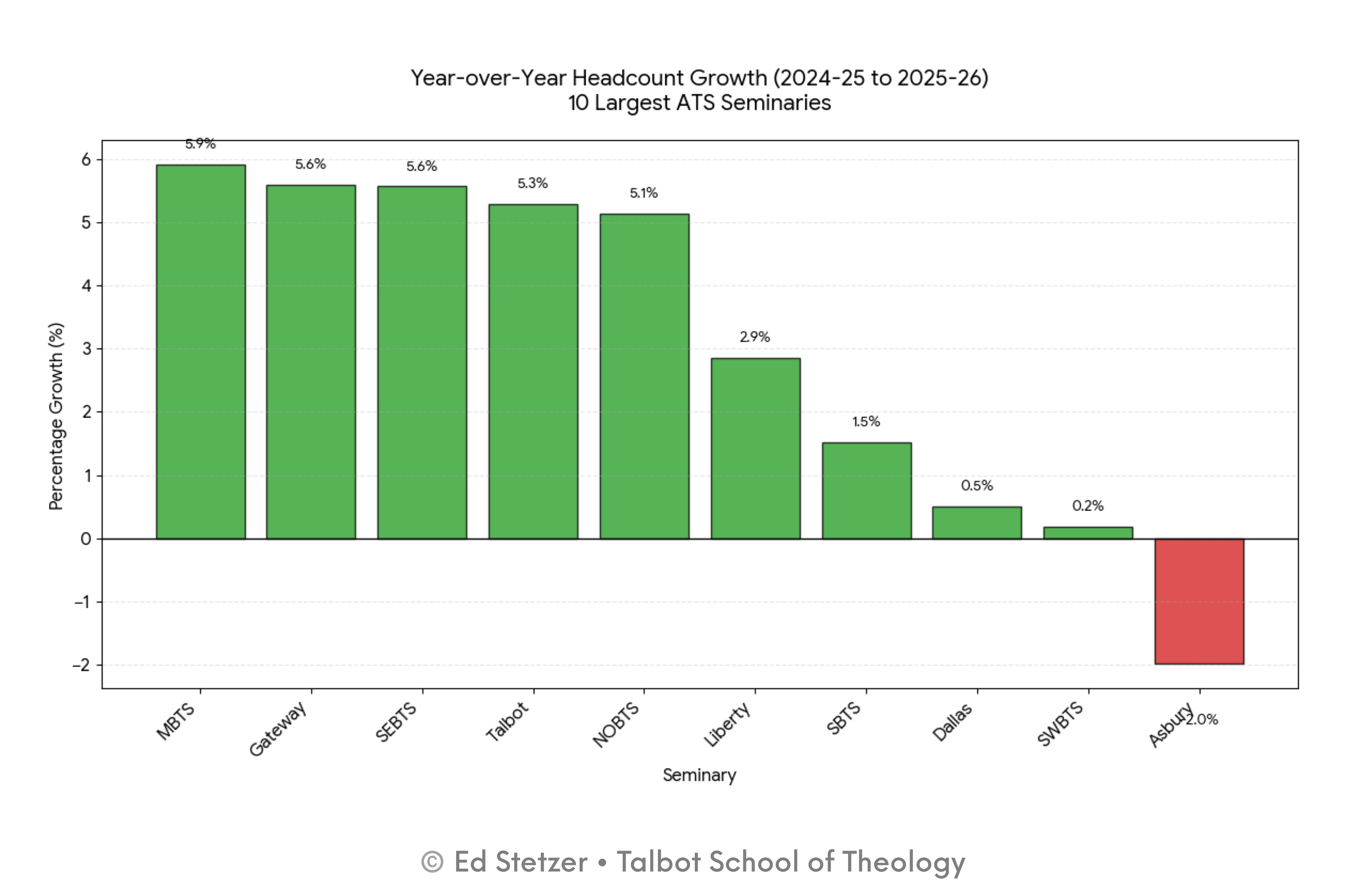
But the contrast between the schools that experienced the largest growth and those with the most attrition was enormous.
Some schools are surging. Others are stalled or shrinking. The question is, what separates the two? Why are some schools growing amidst this disruptive moment in academia, while others are not?
After years in higher education, as a founding dean of what evolved into the Litfin School of Divinity at Wheaton, and now as the dean of Talbot School of Theology, I’ve observed several characteristics shared by growing schools. Importantly, correlation does not equal causation. So while not a prescription that guarantees growth, it’s nonetheless worth identifying those traits that may be contributing to it.
Table of contents
1. Clarity around theological convictions
2. Deep partnerships with churches
3. Flexible & mission-oriented training
What about mainline seminaries?
The bottom line
1. Clarity around theological convictions
First, as I mentioned in my last article, growing seminaries tend to have a clear theological identity, combined with a commitment to historic Christian orthodoxy.
In the social media comments from my last article, some complained about the theological views of some of these larger, growing schools. But regardless of what you make of their theology, you can’t deny that these schools state clearly who they are, where they stand, and what churches they serve. This clarity may take different forms. We see conservative, multidenominational schools like Talbot growing, as well as Reformed, Baptist, Wesleyan, Pentecostal, and charismatic ones. Whatever the case, growing seminaries tend to communicate their theological commitments without ambiguity.
In our confused world, such clarity is kindness. It also seems to prove increasingly effective for them as institutions. This kind of clarity builds trust with pastors, denominations, and donors. Pastors will be more likely to recommend a seminary to prospective students when the seminary has made known what it stands for. Denominations will be more willing to send students to a school that aligns with their distinctives (or at least that honors those distinctives). Donors with clear convictions will be more inclined to invest in a school that shares their convictions.
By contrast, institutions that lack a coherent and clearly articulated theological identity can struggle to develop clear constituencies. Convictional ambiguity often combines with ambiguity around vision and mission, making it difficult for churches to know why they should partner with that specific school.
🔥 Join Ed Stetzer for an upcoming series presented by Logos on trends in theological education. Get access to exclusive interviews with institutional leaders to learn how to “future-proof” Christian higher ed.
2. Deep partnerships with churches
Second, growing schools have deep connections to the church.
It’s not an accident that many Baptist seminaries continue to grow, as they are connected to the largest constituency of churches in the United States. Southern Baptist seminaries serve and are funded by Southern Baptist churches. Liberty and Kairos also identify as Baptist.
But all large and growing schools will have a specific constituency. Dallas leads among the Bible churches. Asbury has deep ties with the Wesleyan and Arminian traditions, and now especially the Global Methodists. Talbot is the official seminary partner of several denominations, networks, and ministries.
Multidenominational seminaries have both a challenge and an opportunity here. We can bridge a variety of denominational traditions, offering unique educational opportunities. But that also means we don’t have a natural pool of students to draw from, so we must be especially intentional in pursuing local church relationships.
For years, many seminaries have operated independently from congregational life. But theological education hived off from the church misses the goal of theological education itself.1 The local church and the academy need deep partnerships where each benefits from the other.
Relationships with churches, denominations, and networks shape the educational experience itself. Formation ought not to be limited to the classroom. Students are not simply studying theology: They are preparing to lead ministries, serve congregations, and apply that rich theological knowledge within a local church. So many programs now include mentoring, contextual ministry training, and practical leadership development. At Talbot, we’ve launched Talbot Embedded to offer the best of residential education through regional learning cohorts facilitated by local church partners.
Seminaries that intentionally collaborate with churches often see stronger enrollment and greater long-term impact. The church is God’s vehicle of mission for the world, the center of his heart and purposes. So he seems to be honoring schools that are forming strong relationships with local churches.
3. Flexible & mission-oriented training
I will explore this theme more deeply in a future article in this series. But for now, suffice to say that growing seminaries combine flexible delivery methods with a missional approach to theological education.
The way seminaries deliver education has changed dramatically over the past decade. Many students today are already involved in ministry, often serving in churches or nonprofit organizations while pursuing their theological education.
As a result, growing seminaries frequently offer options for education in a variety of modalities and for a variety of purposes, depending on students’ needs. The most well-known (and perhaps most disruptive to traditional educational forms) is online education, but there are other creative and faithful approaches worth considering (again, see models like Talbot Embedded).
What about mainline seminaries?
The conversation about seminary growth tends to focus on evangelical institutions—and for good statistical reason. Evangelical schools represent a significant number of ATS member institutions. The ten largest seminaries in America are all evangelical. That’s a remarkable concentration.
But it would be a mistake to ignore what’s happening among some mainline seminaries, because the story there is more nuanced than simple decline as many assume.
Yale Divinity School, for instance, received a record number of applications for its class of 2025: an 18 percent increase over the prior year.2 Students at Yale now come from thirty-four different faith traditions.3 Duke Divinity School remains the only mainline seminary in the top twenty-five by enrollment, anchored by the resources of Duke University and the Duke Endowment. Candler School of Theology at Emory continues as a strong United Methodist seminary with an FTE of 412.
What’s driving interest in these schools? Several factors.
- The mainline schools often have significant endowments and can therefore offer robust financial aid, making seminary financially accessible in ways that many smaller schools cannot.
- Many of these schools are also connected to major research universities, which appeals to students interested in academic theology, ethics, public policy, and interdisciplinary work.
- Finally, some mainline seminaries have leaned into formation-heavy curricula—preaching, pastoral care, spiritual direction—that attract students across the theological spectrum.
Mainline seminaries make up roughly a third of ATS-accredited schools but enroll less than a fifth of its total students. The denominational decline of mainline Protestantism has inevitably affected their seminary pipelines. The schools that are bucking that trend tend to be the ones with a clear identity, strong endowments, and a willingness to serve students beyond their own denominational boundaries. These are not unlike the patterns we see among growing evangelical schools.
The bottom line
The data from ATS shows that some seminaries are experiencing encouraging growth. Such growth rarely happens by accident. Yes, God is sovereign. But God also calls leaders who can lead the way toward theological clarity, church partnerships, and creative models of education. In this way, seminaries can find themselves well-positioned to serve the church in a changing world.
And that is the ultimate goal, not just to grant degrees but to equip leaders for the work of the gospel.
Share your thoughts
What do you think? Join us in the Word by Word group to share your thoughts.
Resources for further reflection

Invitation to Educational Ministry: Foundations of Transformative Christian Education (Invitation to Theological Studies)
Regular price: $42.99
Shaping a Christian Worldview: The Foundations of Christian Higher Education
Regular price: $17.99
Exploring the History and Philosophy of Christian Education: Principles for the 21st Century
Regular price: $45.99
Mobile Ed: ED161 Christian Education: Foundations and Technology (11 hour course)
Regular price: $409.99
Related content
- 3 Pivotal Trends in Theological Education: The 2026 ATS Report
- 3 Misguided Narratives About Success in Seminary
- Top 5 Seminaries by Enrollment: Data & Trends
- Who Enrolls the Most Students? The Top 5 Christian Universities
- Equipped for the Future: How to Find the Seminary for You

- This hived off approach would have been foreign to early Christian theologians, most of whom also pastored local congregations!
- Yale Divinity School, “Record Number of Applications Received for YDS Entering Class,” Yale Divinity School News, April 25, 2025, https://divinity.yale.edu/news/2025-04-25-record-number-of-applications-received-for-yds-entering-class.
- Yale University, “Enrollment,” Yale Divinity School Bulletin and Catalog, March 25, 2026, https://catalog.yale.edu/div/enrollment/.


 Michael F. Bird
 Sean McGever
 Dottie Rhoads