
 Chris Date
Many Christians are surprised to discover that bonafide and respected Christians hold not only competing views on eternal conscious punishment but also outright alternatives to it. For example,
- N. T. Wright argues that the damned will indeed suffer in hell forever but will become less and less human until they no longer bear the image of God—something like the transformation of Sméagol into Gollum in Tolkien’s The Lord of the Rings.1
- Shawn Bawulski also affirms eternal torment, yet he maintains that the lost will in some sense be reconciled to God, submitting to him and ceasing to sin.2
Others have reconsidered the doctrine more dramatically.
- Preston Sprinkle recently abandoned eternal torment altogether after publishing a widely read defense of it only a few years earlier.3
- Around the same time, Terrance Tiessen also left the traditional view behind, despite having defended it not long before in a respected academic theological dictionary.4
Names like these—and they are just a sampling—demonstrate that faithful Christian theologians disagree with one another when it comes to the nature and duration of hell, even if the average Christ-follower in the pews doesn’t know it.
In this article, we’ll survey the terrain of this fiery (pun intended) yet in-house debate. We’ll explore
- Common misconceptions and key biblical terms
- The three views on hell across church history
- The exegetical and theological arguments for each view
- Answers to frequent questions and objections to hell
Conclusion
Afterlife and life thereafter: hell vs. the intermediate state
Many Christians seem to think that hell is where an unsaved person goes immediately after dying, but it’s not. The church has always affirmed that one day all the dead will be resurrected. Only then will the lost be sentenced to hell as final punishment.5 So, hell is where the unsaved are sent after being raised back to life from the dead.
By contrast, theologians use the phrase “intermediate state” for the time between death and resurrection. Most Christians have believed the righteous and unrighteous dead are nevertheless conscious as disembodied souls, and this is what the term afterlife typically refers to.6 But the hell debate concerns life thereafter, following the resurrection of the dead.
The KJV translation of the Bible may explain why many Christians confuse hell with the intermediate state. Its translators chose to render multiple distinct words, referring to different concepts, using the single English word “hell.” However, recognizing the distinctions between these words and concepts is critical for navigating the hell debate.

Sheol (שְׁאוֹל) or Hades (ᾅδης)
The words Sheol and Hades refer to the place of the dead in Old Testament Hebrew and New Testament Greek, respectively. The KJV thus translates the first several occurrences of Sheol as “grave,” like when Jacob, thinking his son Joseph has been killed, refuses to be comforted and says, “I will go down into the grave [שְׁאוֹל, Sheol] unto my son mourning” (Gen 37:35 KJV; see also Gen 42:38; 44:29, 31). The Septuagint (LXX)—the Greek translation of the Hebrew OT completed in the third and second centuries BC—renders this with the Greek word Hades, so NT figures and authors followed suit. In his psalm, David says God will not abandon the Messiah in “Sheol” (Ps 16:10), which Peter translates as “Hades” at Pentecost: “you will not abandon me to the realm of the dead [ᾅδης, Hades]” (Acts 2:27 NIV).
Use Logos to find every instance of Sheol (שְׁאוֹל) and Hades (ᾅδης) in the Hebrew Bible, the Septuagint (LXX), and the Greek New Testament, respectively.
Whether humans are conscious while dead in Sheol/Hades is the subject of a separate debate, but it is not where final divine punishment is meted out—that is, hell. In John’s prophetic vision of final punishment, he sees Sheol/Hades emptied of its dead in their resurrection, and it is thrown empty into the lake of fire before the resurrected lost subsequently join it there (Rev 20:13–15). Jesus’s story of Lazarus and the rich man (Luke 16:19–31), which is explicitly set in Hades (Luke 16:23) while the dead rich man’s brothers are still going about life as usual (Luke 16:28), therefore has little if any bearing on the hell debate. It says nothing about what awaits the rich man after he is raised for judgment.
Tartarus (τάρταρος)
In 2 Peter 2:4, the verb translated “cast them down to hell” by the KJV is ταρταρόω, which points to the present, ongoing imprisonment of fallen angels until their final punishment. The verb literally means, “to cast into or to cause to remain in Tartarus.”7
In Greek mythology, Tartarus was a place of punishment distinct from and far below Hades. Humans generally went to Hades after death, while Tartarus is where divine beings like the Titans were punished.8 Peter appears to co-opt the name of this place to say it’s where divine beings in Jewish theology—angels—are currently held in “chains of gloomy darkness to be kept until the judgment” (emphasis added). Like Sheol and Hades, then, Tartarus is a sort of intermediate state, but for divine rather than human beings. It is not hell, the place of final punishment.
Gehenna (γέεννα) and the lake of fire
Translating the aforementioned terms “hell” causes confusion, because they’re not about the final judgment. “Hell” should be reserved for Gehenna and for the lake of fire in Revelation.
The toponym Gehenna (γέεννα) transliterates the name of the Valley of the Sons of Hinnom (גֵּי בֶן־הִנֹּם), a valley outside of Jerusalem that serves in the OT as the setting of future divine punishment (e.g., Jer 7:30–34). Contrary to popular notions, the valley was not a garbage dump, nor was its name commonly used to refer to final divine punishment by Jews before the time of Jesus, who instead appears to have popularized its use as such.9 For example, when he quotes the prophet Isaiah’s description of future divine punishment (Isa 66:24) in the context of the new heavens and new earth (Isa 65:17), Jesus locates it in Gehenna (Mark 9:47–48).
The lake of fire also refers to hell and final punishment in the book of Revelation, albeit symbolically. Many Christians misunderstand the nature of prophetic visions of the future in Scripture, thinking seers were shown future events as they would literally unfold. They were not. Rather, seers were shown vivid symbols that represented future events, and these were often so perplexing they had to be explained by supernaturally gifted interpreters. Joseph, for example, has to explain to Pharaoh that, in his vision, fat cows being devoured by emaciated ones symbolize upcoming years of abundance followed by famine in Egypt (Gen 41). Likewise, an angel has to explain to John the Revelator that, in his vision, a monstrous beast’s seven heads symbolize a succession of seven kings, the sixth of which is alive at the time (Rev 17:10). As for the lake of fire, it symbolizes the final fate of all God’s enemies, including death itself (Rev 20:10–15).

A matter of life and death: 3 views of hell
This brings us to the topic at hand, to the three basic views of hell embraced among Christians through history. We’ve seen that this intramural debate does not concern the intermediate state between death and resurrection (Sheol and Hades), but rather the future and final punishment of the resurrected lost (Gehenna) and fallen angels presently imprisoned until then (Tartarus).
- But what is the nature of this final punishment?
- How long will it last?
- Can those sent to hell be saved at some point thereafter?
Theologians propose a wide range of ways to understand hell, but they are all variations of three basic views. Each affirms something denied by the other two.10
Claim Eternal conscious torment Annihilationism Christian universalism Eternal punishment Affirms Affirms Denies Universal immortality Affirms Denies Affirms Sin and evil eradicated Denies Affirms Affirms
1. Eternal conscious torment (or traditionalism)
Most Christians have believed in the doctrine of eternal torment or eternal conscious punishment, which is why it is often called traditionalism. This historically dominant view says that when the dead are resurrected—saved and lost alike—their risen bodies will all be rendered immortal, and they will live forever thereafter. The saved will go on to enjoy the blissful presence of God and the fellowship of the redeemed for all eternity, but the lost will live and suffer in hell forever, apart from God and his kingdom. Hell, then, is not a place where disembodied spirits or souls suffer forever. It is where resurrected immortals will live everlastingly in a miserable condition called “death.”
Traditionalists differ on many of the details of hell.
- Those who believe in separationism argue that hell is self-imposed—locked from the inside—its torments largely psychospiritual and self-induced.11
- Those who espouse belief in reconciliationism think everyone will be reconciled to God, but for the lost this means only that they willingly submit to God and accept their unending punishment.12
- The dehumanization view suggests the damned will grow less and less human, eventually ceasing to bear the image of God but remaining consciously separated from him forever.13
Notwithstanding such differences, these variations of eternal torment all include belief that the risen lost will be immortal and live forever in hell.
This belief in the universal immortality of resurrected humanity enjoys extremely historic pedigree among both Jews and Christians. It wasn’t the universal ancient Jewish report, but it is found in some writings prior to Christ.
- Written in the second century BC, the book of Judith says of the damned that God “will send fire and worms into their flesh; they shall weep in pain forever” (Jdt 16:17).
- And in the first or second century AD, the book of 4 Maccabees warns of “eternal torment by fire” (4 Macc 9:9) and “unceasing torments” (4 Macc 10:11).
Among Christian writers, eternal conscious torment appears as early as the second century.
- Tatian of Adiabene assures readers that, after death, humans “receive the immortal with enjoyment, or the painful with immortality.”14
- Athenagoras of Athens applies 1 Corinthians 15:54, with its language of resurrected immortality, to the saved and unsaved alike.15
- Two and a half centuries later, Augustine of Hippo says the quality of immortality, characteristic of the immaterial soul, will also be exhibited by the resurrected bodies of the damned.16
In the wake of Augustine, eternal conscious torment has dominated Christian thought when it comes to hell.
- In the medieval period, Anselm of Canterbury insists it is irrational to think guilty souls could ever die.17
- Like Augustine, Thomas Aquinas thinks the soul’s immortality will be communicated to the risen bodies of both the good and the evil.18
- Three hundred years later, the Reformer John Calvin denies that the risen wicked will ever die.19
Jonathan Edwards does likewise two centuries later.20 - In the mid-nineteenth century, Charles Spurgeon says the lost are “condemned to live forever in hell.”21
- In the modern era, traditionalists from C. S. Lewis to Wayne Grudem all teach that the resurrected lost will “live forever” in hell.22
This collective testimony, from these and many others of the brightest Christian thinkers throughout church history, should surely give doubters pause.
2. Annihilationism (or conditional immortality)
Conditional immortality (or conditionalism) is the view that only those who meet the condition of being saved will be raised immortal and live forever. The lost, in contrast, will be raised mortal and, as the consequence of their sin, die in hell, in both body and soul, never to live or experience anything ever again—an eternal capital punishment. If humans have non-physical spirits or souls that remain conscious after the first death, those of the lost will be slain and destroyed with their risen bodies in the second death, therefore entailing a complete end to their conscious existence. For this reason, conditional immortality is sometimes called annihilationism.
Conditionalists disagree with each other concerning some of the particulars, though.
- Some prefer the phrase terminal punishment (rather than conditional immortality or annihilationism) as best reflecting their view.23
- Some see death as the punishment meted out in hell, thinking any torment experienced by the damned will be caused by the means of their execution.24
- Others locate final punishment in the torment itself and think a just proportion thereof will eventually terminate in death.25
- Though most conditionalists believe the devil and his angels will be destroyed in hell along with unredeemed humanity, a view one might call partial conditionalism holds that demonic beings (but not human ones) will instead be tormented forever.26
Like eternal conscious torment, conditional immortality was believed among the Jews in the time of Jesus. It may have even been the majority report.
- In the book of Jubilees, final judgment is characterized as being “rooted out of the land of the living” (Jub 36:9) by a “devouring fire” resembling that which slew the inhabitants of Sodom and Gomorrah (Jub 36:10).
- The Dead Sea Scroll known as the Community Rule curses the wicked unto “the gloom of everlasting fire” (1QS II, 7–8) and “an abundance of afflictions” (Rule 4:12–13) until their ultimate “destruction” (Rule 2:6; 4:13–14), the Hebrew word כָּלָה meaning “complete destruction, annihilation.”27
- Wisdom of Solomon insists the unrighteous “will become dishonored corpses” (Wis 4:18); though “the righteous live forever” (Wis 5:15), “the hope of the ungodly is like … smoke before the wind” (Wis 5:14).
- Tobit 14:7 promises that saved Israelites will “live in safety forever” while “those who commit sin and injustice will vanish from all the earth.”
- The Psalms of Solomon (13:11) sing that “the life of the righteous goes on for ever,” but “sinners shall be taken away to destruction, and no memory of them will ever be found,” for they will be excluded from participation in the resurrection (Ps Sol 3:11–12).
The expectation that only the righteous will live forever, and that the unrighteous will finally be destroyed, is found in much of the intertestamental literature.
Conditionalists admit that their view has been in the extreme minority since the time of Augustine, but they argue that the earliest Church Fathers taught it.
- A half-century before Tatian and Athenagoras, Clement of Rome identifies immortality as a divine gift promised only to God’s people.28
- A contemporary of Clement, Ignatius of Antioch teaches that Christ died to secure immortality for his people, urging readers not to perish and forsake this gift.29
- Also predating Tatian and Athenagoras, the Didache instructs catechumens to thank God for “immortality, which Thou madest known to us through Jesus.”30
- Irenaeus of Lyons, a contemporary of Tatian and Athenagoras, says the unsaved reject God’s gift of “continuance” and “length of days for ever and ever.”31
Conditionalists therefore think they are following in the footsteps of the Protestant Reformers, willing to slough off what they see as centuries of unbiblical tradition accumulated since the time of the earliest Church Fathers.
To the chagrin of conditionalists, their view appears to be unrepresented among Christians from the time of Augustine to the Protestant Reformation, but it has enjoyed degrees of popularity since then. It was extremely popular, in fact, among Protestants of various denominations in the nineteenth century. As the Baptist conditionalist Jacob Blain wrote in the middle of that century, “the number who now hold the view is so large, and so decided in spreading light, that all efforts to stop its progress must be vain.”32
Such efforts were not in vain, and conditional immortality faded largely into obscurity in the late 1800s and into the 1900s, but it did not disappear altogether. Conditionalism persisted among some British evangelicals, including John Wenham, Stephen Travis, Michael Green, and even John Stott. To their ranks have since been added many other diverse thinkers: Clark Pinnock, John Stackhouse, Philip Edgcumbe Hughes, David Powys, Preston Sprinkle, Terrance Tiessen, and more.

What does the Bible say about hell? Get relevant verses and a synopsis with Logos’s Smart Search. Start your free trial.
3. Christian universalism (or apokatastasis)
Variously known as universalism, universal salvation, and universal reconciliation, this view of hell posits that everyone will ultimately be rescued from hell or will avoid it entirely. The Greek term apokatastasis, meaning a “restoration,” is also sometimes used of this view specifically, but believers in all three views affirm what they think the Bible means when it promises a “restoring” (ἀποκατάστασις) of all things in, for example, Acts 3:21.
- Universalists share with traditionalists a belief in the universal immortality of resurrected humanity, for the risen lost will live as long as it takes to be saved, and forever thereafter.
- However, universalists believe with conditionalists that all suffering will end and all evil will be eradicated—albeit by means of conversion rather than annihilation.
- Contrary to both eternal conscious torment and conditional immortality, universalists deny that the punishment of hell will be everlasting.
Universalism is often unfairly associated with liberalism and equated with outright pluralism. Some universalists are indeed liberals or pluralists and seem to think everyone will go to heaven when they die, regardless of what they did or believed in life. But self-identifying evangelical universalists typically argue that those who do not embrace Christ and receive salvation in the here and now will have the opportunity to do so on the Day of Judgment or thereafter in hell, and everyone will eventually do so, becoming saved and joining the community of God’s redeemed people.33 This sort of universalism, in which salvation is through faith in Christ alone, appears to be neither liberal nor pluralistic.
An evangelical universalism is somewhat similar to the Roman Catholic doctrine of purgatory, but they should not be confused with one another. In Catholicism, purgatory is not a view of hell at all, for it is not the final punishment of unbelievers. Rather, it is where believers, already united to Christ, are purged and purified of their sins through temporal punishments, rendering them fit to enter heaven.34 By contrast, an evangelical universalist believes hell is where resurrected unbelievers are sent, having not (yet) been united to Christ. But their punishment in hell is neither everlasting nor purely retributive: It is remedial, intended to purge and purify the damned of their sin and turn them to Christ in faith and repentance for their salvation. And this it will do to everyone sent to hell, eventually.
Unlike eternal conscious torment and conditional immortality, universalism cannot be found among Jews before and in the time of Jesus, but some Christians embraced it very early on in church history and have done so since.
- Clement of Alexandria and Origen of Alexandria, writing around AD 200, taught that hell will compel sinners to repent and be saved, purifying and cleansing them.35
- A couple hundred years later, the influential Trinitarian Gregory of Nyssa echoes Clement and Origen in affirming a purgatorial hell.36
- The nineteenth-century Congregationalist George MacDonald does likewise, identifying the sinful nature of the damned as that which is destroyed by their punishment in hell.37
Today, Christian philosophers like Thomas Talbott and Eric Reitan, and theologians like Robin Parry, bear the universalist torch of Clement and Origen.38

“Come now, let us reason together”: exegetical and theological arguments
We turn now to a survey of the exegetical and theological evidence offered in support of each of the three views of hell. Historical and philosophical concerns are not irrelevant, of course. Many traditionalists point to the overwhelming dominance of their view through most of church history, and many universalists lean on sophisticated philosophical arguments. However, we must always subject these to the greater authority of Scripture.
1. Fire, smoke, and suffering: the case for eternal conscious torment
The exegetical case for eternal torment predominantly relies on NT texts, but two passages in the OT are typically cited for its support, as well.
- Daniel predicts that the unrighteous will rise “to shame and everlasting contempt” (Dan 12:2). Traditionalists argue that this prophecy of the general resurrection requires the risen wicked to remain alive forever thereafter, or else they could not experience contempt everlastingly.
- Isaiah describes a scene of final divine judgment, saying of those who rebel against God, “their worm shall not die, [and] their fire shall not be quenched” (Isa 66:24; cf. Mark 9:48). Many traditionalists maintain this means these rebels will forever provide the worm and the fire with food and fuel. They will never be completely consumed.
Three NT texts are cited most frequently as evidence for eternal conscious punishment.
- At the end of Jesus’s description of final judgment, the wicked are told, “depart from me into the eternal fire prepared for the devil and his angels” (Matt 25:41). Many traditionalists understand this to be fire that burns forever because it never depletes those who fuel it. Christ concludes by saying they “will go away into eternal punishment, but the righteous into eternal life” (Matt 25:46). Since both the punishment and life to come are called “eternal,” the damned must consciously endure as long as the righteous do—so the argument goes.
- In his apocalyptic vision, John hears an angel proclaim that those who worship the beast “will be tormented with fire and sulfur.” Importantly, the smoke from their torment rises “forever,” and they have “no rest day or night” (John 14:9–11). Were their torment to end, it would cease to produce rising smoke. They must therefore suffer forever, which explains their unending restlessness.
- Later John sees the devil “thrown into the lake of fire and sulfur,” where the beast and its prophet were thrown a thousand years prior, and together the trio is “tormented day and night forever and ever” (John 20:10). Soon thereafter, the resurrected lost are thrown into the lake to join them (John 20:15), presumably facing the same unending fate there.
Traditionalists point to a few additional NT texts as support for their view.
- That the fire of hell is called “unquenchable” (Matt 3:12; Mark 9:43; Luke 3:17) is taken to mean it will never die out, again suggesting the damned continue to fuel it throughout eternity.
- According to Jesus, “weeping and gnashing of teeth” (Matt 8:12; 13:42, 50; 22:13; 24:51; 25:30; Luke 13:28) are characteristic of hell, which would be strange if those consigned to it weep and gnash only for a short time before dying.
- And Paul says the wicked “will suffer the punishment of eternal destruction, away from the presence of the Lord” (2 Thess 1:9). If destruction is just annihilation, the adjective “eternal” would be redundant, and it makes little sense to speak of people who no longer exist as being “away from” God.
Traditionalists are convinced that these and other texts are interpreted most faithfully as supporting the doctrine of eternal torment in hell.
Theologically, many traditionalists argue from the infinitude of God and Christ’s substitutionary atonement. Because God is of limitless and inestimable greatness, any sin against him therefore merits an infinite penalty. And since a finite creature cannot suffer an infinite penalty in a finite span of time, the damned must suffer eternally. God thus became man to suffer the infinite consequences of sin that no ordinary human could exhaust in his or her own suffering. Besides, the condemned will not stop sinning just because they are in hell. Their continued rebelliousness in hell will merit continued punishment.
Meanwhile, if the damned will be destroyed such that they cease to exist altogether, Jesus could not have borne that penalty in place of sinners without temporarily ceasing to exist himself. This would render the Trinity a binity or rend asunder the hypostatic union of his human and divine natures, with either alternative violating creedal orthodoxy. If Jesus did not bear that fate, though, then that cannot be what awaits the damned who obstinately refuse to appropriate his atoning work as substitute. Only everlasting conscious punishment, according to traditionalists, is therefore compatible with the work of Jesus as substitute.
2. Life, death, and immortality: the case for annihilationism (conditional immortality)
The exegetical case for conditional immortality (or annihilationism) includes OT texts that they contend traditionalists overlook. If a student of Scripture looks in the OT for descriptions of endless afterlife torment, one will struggle to find it. But if one instead asks more open-endedly what the OT says about the fate of the unrighteous, many texts seem to offer an answer. For example, the psalms promise that the wicked will be slain (Ps 34:21); they’ll wither like vegetation, be cut off, perish, and vanish like smoke (Ps 37:2, 9, 20); God will bathe his feet in their blood (Ps 58:10). Yet countless wicked people prosper in the here and now, dying peacefully in the lap of luxury and in the esteem of many. If they are to be exposed and punished with ignominious death, the psalms must be taken to indicate that the wicked must rise to face such a judgment in hell. Conditionalists also point out that in OT proof texts for eternal conscious torment, only the righteous rise unto eternal life (Dan 12:2), while the unrighteous are instead reduced to corpses (Isa 66:24).
The NT, however, is where conditional immortality finds its greatest exegetical support.
- Only the citizens of the New Jerusalem are depicted as having access in eternity to the tree of life (Rev 22:2), apart from which humans are doomed to die (Gen 3:22).
- John says the Son was given “that everyone who believes in him may not perish but may have eternal life” (John 3:16). In context, this seems to refer to life and death literally; it comes right after Jesus compares himself to the serpentine statue that literally saved the lives of Israelites from fatally venomous snakes (John 3:14; cf. Num 21:9).
- Paul writes, “the wages of sin is death, but the free gift of God is eternal life in Christ Jesus our Lord” (Rom 6:23), and his very next words suggest he means life and death literally, for he says that when a husband dies, his living widow is free to remarry (Rom 7:1–2).
- Jesus could not be clearer, conditionalists insist, when he warns his disciples to “fear him who can destroy both soul and body in hell” (Matt 10:28), using “destroy” to mean “slay” or “kill” (cf. Matt 2:13; 12:14; 21:41; 27:20; Mark 3:6; 9:22; Luke 6:9).
Importantly, the NT promises immortality in the resurrection only to the saved, and it implicitly denies the unsaved will receive it.
- Immortality must be sought, and God must grant it (Rom 2:7).
- He will grant it to those who belong to Christ (1 Cor 15:23), who will receive immortality and incorruptibility as prerequisites for inheriting the kingdom of God (1 Cor 15:50–55).
- Whereas Israelites “ate the manna in the wilderness, and they died,” Jesus says he “is the bread that comes down from heaven, so that one may eat of it and not die” (John 6:49–50; emphasis added).
- And when he is asked by the Sadducees about the resurrection, he says the risen saints will be unable to die because they are sons of God (Luke 20:35–36), implying those raised unto judgment apart from Christ will remain mortal.
Because of the texts above and others, some conditionalists insist that the Bible teaches their view as clearly as it does just about anything else.39
Turning to theology, conditionalists appeal to the holiness of God and to the substitutionary, atoning work of Christ. In conditional immortality, God is so holy and he hates sin so much that he will obliterate it forever in hell, finally killing and destroying those who stubbornly persist in it. Conditionalists point out that, in contrast, the traditional view of hell has God supernaturally guaranteeing sin exists forever by raising the lost with immortal bodies in which they never stop sinning.
As for the atonement, Jesus did not cease to exist when he died on the cross, but he did die. Importantly, the Bible seems to identify his substitutionary work primarily with his death (e.g., Matt 20:28; Mark 10:45; John 10:11; Rom 5:8), not his pain. Consequently, conditionalists contend that death must be the fate awaiting the damned in hell, not immortality and enduring life. In the estimation of conditionalists, the punishment traditionally thought to await the damned in hell could not be more unlike the death Jesus bore in the place of sinners.
3. Adam, Christ, and all things: the case for Christian universalism (apokatastasis)
Though it will come as a surprise to some, evangelical universalism is motivated not only by philosophy and sentiment but also by a genuine desire to affirm the teaching of Scripture. Even the staunchest critic of universalism must admit that some passages sound initially and at face value like support for universalism.
This is perhaps most true of texts comparing Jesus to Adam, in which both the words and logic initially seem like those of a universalist.
- Paul compares the respective impact of the first Adam and second, saying, “as one trespass led to condemnation for all men, so one act of righteousness leads to justification and life for all men” (Rom 5:18; emphasis added). Universalists maintain that the prepositional phrase “for all men” means the same thing on both sides of the comparison. Since Adam’s sin affected humankind universally, universalists argue that the saving work of Christ affects humankind universally.
- Similarly, Paul writes, “as in Adam all die, so also in Christ shall all be made alive” (1 Cor 15:22; emphasis added). Once again, the universalist wants “all” to mean the same thing in both clauses.
Other texts featuring words like “all” and “every” appear to offer prima facie support for universalism:
- Christ “gave himself as a ransom for all” (1 Tim 2:5–6), Paul writes.
- God “is the Savior of all people, especially of those who believe” (1 Tim 4:10).
- God exalts his risen Son “so that at the name of Jesus every knee should bow … and every tongue confess that Jesus Christ is Lord” (Phil 2:9–10).
The translation “all things” features in several passages that seem on the surface to indicate absolutely everyone and everything will be redeemed by God.
- He will “restore” all things (Matt 17:11; Mark 9:12; Acts 3:20–21).
- He will “unite” all things (Eph 1:9–10).
- He will “reconcile” all things (Col 1:19–20).
As for theology, universalism is heavily motivated by God’s nature as love. “God is love, John writes (1 John 4:8, 16; emphasis added)—not merely loving, but love itself. Of course, God’s attributes are not limited to love. A biblically derived view of hell will also account for his holiness and wrath. Nevertheless, even some traditionalists argue that this means every act of God toward someone must be an act of love toward that person, at least in some way and to some degree.40 Intuitively, neither eternally tormenting the damned nor annihilating them seems like an act of divine love for them. But it would certainly be loving of God to endlessly pursue their affection and salvation until they all embrace him and are thereby rescued from hell.
The rubber meets the road: FAQs
Before we close, let’s briefly consider how one might navigate some common questions about hell, especially in light of our survey above.
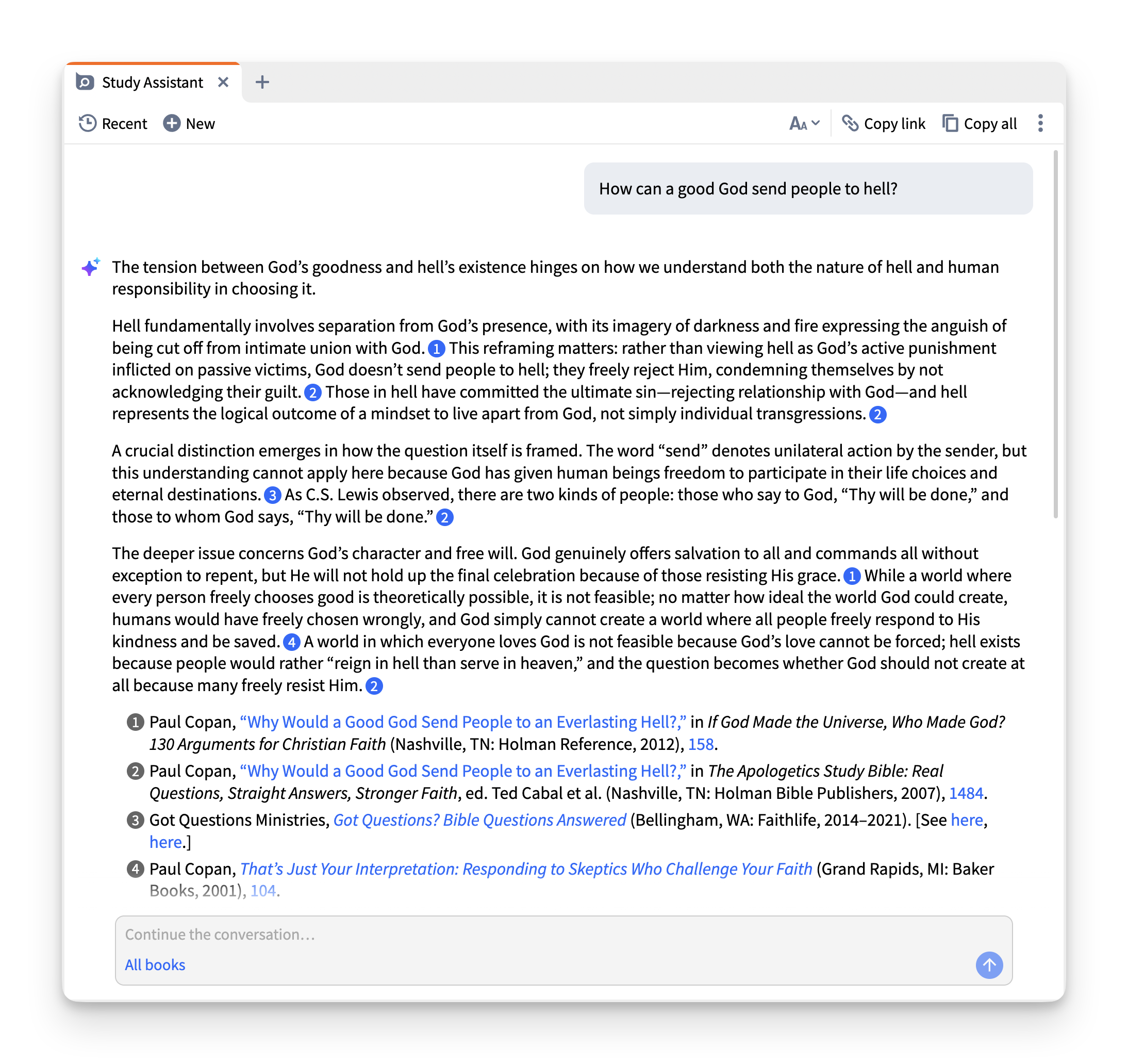
Use Logos’s Study Assistant to search reliable resources for answers to your questions like, Why does God send people to hell? Start your free trial.
1. Why would a loving God send people to hell—especially if he created people knowing they’d end up there?
When it comes to questions like this, the answers that are intuitive to some will be irreconcilable with what others find to be the intuitive answers to different questions:
- How could a just God let the unrepentant victimization of others go unpunished?
- Would a good God force people into heaven against their will?
- Why would God withhold the dignity and pleasures of life from people (by not creating them in the first place) simply because he knows they’ll ultimately reject him?
It’s okay to ponder questions like these, but if we’re genuinely seeking the truth, we’ve got to be careful not to fixate on some questions to the exclusion of others.
God is not only love. He is also holy and just—and his love extends beyond those he sends to hell. For instance, we think poorly of people who are apathetic to those suffering at the hands of others. We criticize people who refuse to execute justice on those who perpetrate evil. Well, hell is proof that God cares about victims, for he will use his power to bring justice to their oppressors. Indeed, he will do so because he loves those victims. To do otherwise would be unloving toward them.
This wouldn’t account, of course, for anyone sent to hell who hasn’t victimized others. But the reality is we finite mortals can’t possibly know what a maximally loving, holy, and just God would do—apart from him telling us.
2. How can those who go to heaven be happy if people they love end up in hell?
This question faces defenders of all three views of hell, and each view provides different resources for answering the question.
- Eternal conscious torment might say that when we’re resurrected and glorified, we’ll be sinless and see things from God’s perspective. We’ll see the perfect justice in the suffering of our lost loved ones in hell, and it won’t interrupt our eternal bliss.
- Annihilationism (conditional immortality) might say that when we lose a loved one in the here and now, we grieve to varying lengths and degrees, but our grief fades over time and we’re able to enjoy life. So, too, will our grief fade in the unending years after our lost loved ones finally perish in hell.
- Christian universalism (apokatastasis) might say that we’ll grieve for some time, knowing our lost loved ones are suffering in hell. But the knowledge they’ll one day willingly join us in heaven will keep us going as we look forward to when they do, and our grief is no more.
Of course, such answers will not fully satisfy everyone, but they can lead to further fruitful conversation.
3. What about the immature, those with cognitive disabilities, or people who have never heard the gospel? Will God send them to hell?
Each of the three views of hell has latitude within it for debating questions like these.
Believers in all three views can agree that, apart from Jesus Christ, no mature, able-minded human being is so good as to be without sin and merit eternal life. But perhaps a person can die too young and immature, or too lacking in cognitive/intellectual capacity, to be held justly accountable.
Maybe someone who has never heard the gospel, and is therefore unaware of how to be forgiven of their sin, will be shown mercy. Possibly, people in these categories will, on the Day of Judgment, be rendered capable of making a meaningful choice and be given a final opportunity to repent in faith and be saved. Possibilities like these and others have been perennially explored and debated by Christians for ages, regardless of which of the three views of hell they accept. But even if none of them is actually the case (as I suspect), no one will be sent to hell unjustly. God can be trusted to do what is right.
4. Is hell fair? Is its punishment fair and proportionate?
Several factors are often minimized, dismissed, or overlooked entirely by those who object that hell is unfair.
- For one thing, what people think is fair is heavily influenced by their culture, and cultural intuitions change with every generation.
- For another thing, we are sure to underestimate the gravity of sin. We are sinners ourselves, and with our finite capacities, we can’t confidently determine the full impact of one’s sin on oneself, on others, and on creation more broadly.
- Besides, people can’t even agree on the fair and proportionate punishment for crimes in the here and now. Ask ten people what the sentence should be for this or that crime, and you’ll probably get a multitude of answers.
Any judgments we make concerning the fairness of hell should be held with an open hand and a gigantic grain of salt.
Some views of hell might make answering these questions easier than others do, but ultimately, each view can defend the fairness of hell.
- Eternity of conscious punishment may seem disproportionate to a finite lifetime of sin, but crimes that only take moments to commit are often met with punishment that lasts far longer. No one objects when a spontaneous murder is punished with years of prison time. And sins committed while being punished may merit further punishment.
- Annihilationism (conditional immortality), or eternal capital punishment, may seem unfair to opponents of the death penalty, but half or more of all people support it.41 Besides, God could secure the death of the damned by simply withholding immortality from them. Surely, they are not owed immortality and eternal life.
- Christian universalism (apokatastasis), where the punishment of hell is both remedial and finite in duration, can certainly be understood in ways that make it fair and proportionate to sin.
5. Does the threat of hell make faith coerced instead of voluntary?
No, the threat of hell doesn’t coerce faith, because hell isn’t punishment for refusing to believe. It’s punishment for sins.
The government prohibits many activities and threatens punishment for them. Sometimes, it offers clemency to those found guilty of such crimes, provided they meet certain conditions (e.g., leaving the jurisdiction and never returning). Such criminals have already merited their just punishment. So if pardon is offered to one willing to meet certain conditions, the punishment for failing to meet those conditions isn’t a threat enacted to coerce them to do so (even if it feels that way). Rather, the punishment is simply what they would already have deserved.
Likewise, according to the worldview of Scripture, all mature and able-minded people have already sinned and merited their just punishment in hell. A pardon is offered to anyone willing to embrace Jesus Christ in saving faith. But the punishment of hell isn’t a threat to coerce one to believe. It’s what one already rightly deserves. People are free to reject the offer and face the punishment already coming to them, or to accept the offer and be pardoned through faith in Jesus.
Conclusion
As we’ve seen, Christian debate over hell isn’t about what happens when the lost die. That’s the intermediate state. Rather, it’s about what happens when the lost are resurrected and subsequently judged. According to eternal conscious torment, the resurrected lost will be immortal and live forever in hell, where their punishment will be everlasting misery of some sort. In conditional immortality, they’ll remain mortal and be slain in hell, both body and soul, their punishment consisting in the everlasting privation of their lives. And in evangelical universalism, they’ll be immortal and live forever, but their eternal lives will only begin in hell, which will purge and purify them of their sinfulness and rebelliousness until they repent and turn in saving faith to Jesus.
This has been a mere introduction to the kinds of difficult questions Christ-followers should be thinking about and prepared to address. All three views enjoy at least prima facie exegetical support and theological justification. So I invite you to deeper and humbler study with fellow Christians in prayerful submission to the Holy Spirit.
Share your thoughts
What is your view of hell? Join us in the Word by Word group to share your thoughts.
Chris Date’s recommended resources for further study
- Copan, Paul, and Chris Date. Concerning Hell: The Doctrine in Theological, Philosophical, Historical, and Biblical Dialogue. InterVarsity Academic, forthcoming.

The Fire That Consumes: A Biblical and Historical Study of the Doctrine of Final Punishment, 3rd ed.
Regular price: $36.99
Two Views of Hell: A Biblical & Theological Dialogue (Spectrum Multiview Books)
Regular price: $14.99
Mobile Ed: TH381 Perspectives on Hell: Four Views (4 hour course)
Regular price: $134.99
Related content
- The Afterlife & Intermediate State | Author & Bible Teacher Nancy Guthrie
- Is Your Definition of Salvation Too Small? The Bible’s Full Teaching
- From Genesis to Judgment: Original Sin Fully Explained
- He Is Risen—So What? 20 Things Jesus’s Resurrection Accomplished
- On the Immortality of the Soul: Comparing Jonathan Edwards & Plato

- N. T. Wright, For All the Saints? Remembering the Christian Departed (SPCK, 2003), 44–45.
- Shawn Bawulski, “Reconciliationism, a Better View of Hell: Reconciliationism and Eternal Punishment,” JETS 56, no. 1 (2013): 123–38.
- Preston Sprinkle, “Bearing the Curse of Hell,” presentation, Rethinking Hell Conference, Richardson, TX, March 9, 2018, https://youtu.be/mRI_poLkOms; cf. Francis Chan and Preston Sprinkle, Erasing Hell: What God Said About Eternity, and the Things We’ve Made Up (David C. Cook, 2011).
- Terrance L. Tiessen, “My Long Journey to Annihilationism,” in A Consuming Passion: Essays on Hell and Immortality in Honor of Edward Fudge, ed. Christopher M. Date and Ron Highfield (Pickwick, 2015), 17–31; cf. Terrance L. Tiessen, “Hell,” in Global Dictionary of Theology: A Resource for the Worldwide Church, ed. William A. Dyrness and Veli-Matti Kärkkäinen (InterVarsity Academic, 2008), 372–76.
- For instance, the Evangelical Dictionary of Biblical Theology offers a standard definition of hell as the “Place of God’s final retributive punishment … a final judgment and retribution for evil deeds.” Timothy R. Phillips, “Hell,” in Evangelical Dictionary of Biblical Theology, ed. Walter A. Elwell (Baker, 1996), 338; emphasis added. Likewise, in its entry on hell, the New Dictionary of Biblical Theology explains, “Many portray the punishment and torment as physical … the unrighteous are resurrected for judgment, confined to hell.” Philip S. Johnston, “Hell,” in New Dictionary of Biblical Theology, ed. T. Desmond Alexander and Brian S. Rosner (InterVarsity, 2000), 543; emphasis added. See also Tiessen, “Hell,” in Global Dictionary of Theology, 373; Norman L. Geisler, “Hell,” in Baker Encyclopedia of Christian Apologetics (Baker, 1999), 312.
- N. T. Wright, The Resurrection of the Son of God, Christian Origins and the Question of God (SPCK, 2003), 30–31.
- Johannes P. Louw and Eugene A. Nida, eds., Greek-English Lexicon of the New Testament Based on Semantic Domains, vol. 1: Introduction and Domains (United Bible Societies, 1988), 6.
- Gene L. Green, Jude and 2 Peter, Baker Exegetical Commentary on the New Testament (Baker Academic, 2008), 250–51; Peter H. Davids, The Letters of 2 Peter and Jude, Pillar New Testament Commentary (Eerdmans, 2006), 226–27.
- Kim Papaioannou, The Geography of Hell in the Teaching of Jesus: Gehenna, Hades, the Abyss, the Outer Darkness Where There is Weeping and Gnashing of Teeth (Pickwick, 2013), 80.
- See also Peter Grice, “‘Hell Triangle’: Christian Views of Final Punishment,” Rethinking Hell (blog), April 7, 2016, http://www.rethinkinghell.com/hell-triangle. This visual helpfully illustrates and further captures some of the diversity of thought within each view.
- E.g., C. S. Lewis, The Problem of Pain (Centenary, 1940; repr., HarperOne, 2001), 129–30.
- E.g., Bawulski, “Reconciliationism.”
- E.g., Wright, For All the Saints?, 44–45.
- Tatian of Adiabene, Address to the Greeks 14, in The Ante-Nicene Fathers, vol. 2: Fathers of the Second Century, ed. Alexander Roberts and James Donaldson, trans. J. E. Ryland, Early Church Fathers (Christian Literature Company, 1885).
- Athenagoras of Athens, On the Resurrection of the Dead 18.
- Augustine, City of God 21.3.2.
- Anselm, Monologion 71.
- Aquinas, Summa theologiae I.97.3.
- John Calvin, Institutes of the Christian Religion 3.25.9.
- Jonathan Edwards, The Salvation of All Men Strictly Examined (Boston: C. Ewer and T. Bedlington, 1824), 331–32.
- Charles Haddon Spurgeon, “Sermon XIII: The Death of Christ,” in Sermons of Rev. C. H. Spurgeon (New York: Robert Carter & Brothers, 1883), 217.
- C. S. Lewis, Mere Christianity (HarperCollins, 1972), 74; Wayne Grudem, Systematic Theology: An Introduction to Biblical Doctrine, 2nd ed. (Zondervan Academic, 2020), 803. See also John MacArthur Jr., Revelation 12–22, The MacArthur New Testament Commentary (Moody, 2000), 274; and Robert A. Peterson, “A Traditionalist Response to John Stott’s Arguments for Annihilationism,” JETS 37, no. 4 (December 1994): 566.
- E.g., John G. Stackhouse Jr., “Terminal Punishment,” in Four Views on Hell, ed. Preston Sprinkle, 2nd ed. (Zondervan, 2016), 61–81.
- E.g., Edward William Fudge, The Fire That Consumes: A Biblical and Historical Study of the Doctrine of Final Punishment, 3rd ed. (Cascade, 2011), 374.
- E.g., Stackhouse, “Terminal Punishment,” 64.
- E.g., David R. Reagan, Eternity: Heaven or Hell? (Lamb and Lion Ministries, 2010), 115–16.
- HALOT, s.v., “כָּלָה.”
- Clement, 1 Clement 35.
- Ignatius, Letter to the Ephesians 17.
- Didache 10.2, trans. James A. Kleist, Ancient Christian Writers (Newman, 1948).
- Irenaeus of Lyons, Against Heresies 2.34.3, in The Ante-Nicene Fathers, vol. 1: The Apostolic Fathers, ed. Alexander Roberts and James Donaldson, Early Church Fathers (Christian Literature Company, 1885).
- Jacob Blain, Death Not Life: Or the Destruction of the Wicked, 7th ed. (Buffalo, NY: Jacob Blain, 1857), vi.
- E.g., Robin A. Parry, “A Universalist View,” in Four Views on Hell, 116–17.
- Gregg R. Allison, Historical Theology: An Introduction to Christian Doctrine (Zondervan, 2011), 506–07.
- Clement of Alexandria, Stromata 7.2; Origen of Alexandria, On the First Principles 3.6.3.
- Gregory of Nyssa, On the Soul and the Resurrection.
- George MacDonald, Epea Aptera: Unspoken Sermons (London: Alexander Strahan, 1884), 31–32.
- Thomas Talbott, The Inescapable Love of God, 2nd ed. (Cascade, 2014); John Kronen and Eric Reitan, God’s Final Victory: A Comparative Philosophical Case for Universalism (Bloomsbury, 2011); Robin Parry, The Evangelical Universalist, 2nd ed. (Cascade, 2012).
- E.g., Glenn A. Peoples, “Sure as Hell: Is Scripture Really Clear About Final Punishment?,” Rethinking Hell (blog), February 17, 2016, https://rethinkinghell.com/2016/02/17/sure-as-hell/.
- E.g., R. Zachary Manis, Sinners in the Presence of a Loving God: An Essay on the Problem of Hell (Oxford, 2019).
- Death Penalty Information Center, “The Death Penalty in 2025: Public Opinion,” December 15, 2025, https://deathpenaltyinfo.org/research/analysis/reports/year-end-reports/the-death-penalty-in-2025/public-opinion.


 Michael F. Bird
 Glenn Butner
 Lucas Stamps