
 Kirk E. Miller
Since we no longer have the original manuscripts, is our text of the New Testament reliable? Given the magnitude of variations between manuscripts, can we reliably reconstruct the original? Premier New Testament text critic Daniel B. Wallace joins Kirk E. Miller on What in the Word? to discuss.
Dan provides an overview of the discipline of textual criticism and explains the methods critics use to determine the original text. The interview discusses the most common misconceptions about the New Testament’s reliability and why the sheer number of extant manuscripts actually gives us immense confidence.
Follow the show on YouTube, Spotify, Apple Podcasts, and more.
What you’ll find

Connect with us
Ready to increase biblical literacy? Like and share. To go the extra mile, leave us a review on your preferred platform.
Subscribe to get future episodes. (Bonus: We’ll send you a discount to use on your first purchase.)
Thanks for subscribing to Word by Word!
Use code WORDBYWORD to save 10% on your first order.
Episode guest: Daniel B. Wallace
Daniel B. Wallace is the founder and executive director of the Center for the Study of New Testament Manuscripts (CSNTM), an organization dedicated to digitizing Greek New Testament manuscripts worldwide. He is Senior Research Professor Emeritus of New Testament Studies at Dallas Theological Seminary, where he taught for thirty-seven years.
A leading expert in textual criticism, Daniel has authored or contributed to over a hundred publications and serves on the Committee on Bible Translation (CBT), which is responsible for the NIV. His widely used Greek Grammar Beyond the Basics is the standard intermediate-advanced Greek grammar in the English-speaking world and has been translated into half a dozen languages. He has lectured globally, contributed to numerous documentaries, and mentored over 150 students, many of whom are now working in top academic institutions around the world.
He and his wife Pati have been married for fifty-one years. They have four adult sons, two daughters-in-law, three granddaughters, and one grandson. He is a fourth-generation Californian and former body surfer from Newport Beach, CA.
Episode synopsis
Defining “reliability”
We can speak of the New Testament’s reliability in at least two ways.
- Historical reliability: Did the events recorded in the New Testament actually happen? Can we trust that the New Testament provides a historically accurate account or record of what it presents?
- Textual reliability: However, before asking whether what the New Testament says is true, can we even know what it originally said? Does the text of the New Testament, as we have it today, correspond to its original form?
This latter question is the domain of textual criticism and the topic of this particular episode. Dr. Daniel Wallace traces the origin of this question to Eden itself: “Did God actually say … ?” (Gen 3:1). The serpent sought to inject doubt about what God had said.
Textual criticism addresses this pre-apologetic question. Since none of the original New Testament manuscripts (i.e., autographs) survive, and the existing copies differ from one another, textual critics seek to work through the evidence to reconstruct the original wording.
Extant manuscripts
Extant manuscripts are surviving handwritten copies that we currently possess.
The New Testament has roughly 5,700 extant Greek manuscripts. In addition, we possess 8,000–10,000 Latin manuscripts, and thousands more across Coptic, Syriac, Armenian, Gothic, and other languages. In total, we have between 20,000 and 25,000 manuscripts that originate before the printing press, with the earliest fragments dating to within decades of composition. For perspective, the average classical author, in contrast, has around 15 surviving copies, with the earliest copy typically arriving 500 to 1,000 years after composition.
This vast number and variety of New Testament manuscripts—including Greek, but also its translations into other languages—aids our ability to reconstruct its original text.
Textual variants
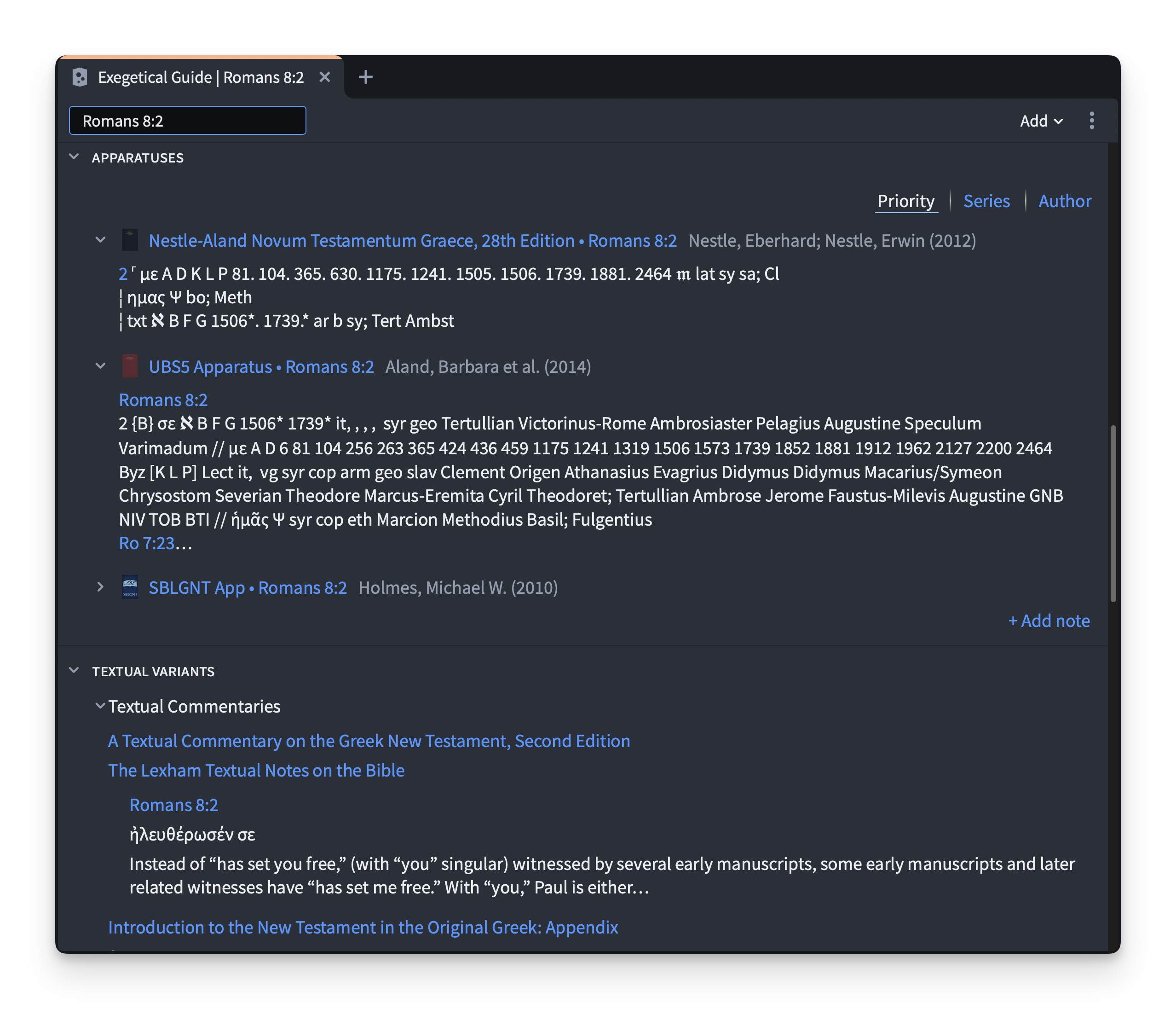
A textual variant is any place where two or more manuscripts differ from one another in wording.
Across all New Testament manuscripts, the total number of textual variants reaches roughly 1.5 million, against a New Testament of about 138,000 words. That ratio—an average of ten variants per word—might sound like sheer chaos!
However, this sheer volume of variants exists precisely because we have an enormous number of manuscripts to compare. An ancient document with only a handful of surviving copies would show far fewer variants, not because our existing copies of it are more reliable, but because there’s simply less data to compare. More witnesses naturally produce more disagreements, even when those disagreements are trivial.
The vast majority of variants do not viably alter the meaning of the New Testament text. Dan categorizes variants into the following categories:
- Spelling differences and nonsense errors. These make up most variants (roughly a million).
- Viable but not meaningful. These are readings that could plausibly go back to the original but would not change the sense of the text whatsoever.
- Meaningful but not viable. These readings would change the meaning—if original. However, they lack the evidence to be taken seriously.
- Meaningful and viable. These are variants that both could be original and would matter if they were. By Dan’s generous estimate, this is less than one-tenth of 1 percent of all variants, around 1,500 in total.
That said, the number of genuinely contested readings amounts to only a dozen or two, and none of them threaten to change any major teachings of the Bible or core doctrines of the Christian faith.
Textual criticism
Textual criticism is the academic discipline of analyzing and comparing surviving manuscript copies in order to reconstruct the original wording of the text.
The fundamental principle employed by textual criticism is determining which reading most plausibly explains the rise of the others. Textual critics of the New Testament weigh two forms of evidence to do so:
- External evidence examines which manuscripts, versions, and Church Fathers attest to each reading, along with age, geographic spread, and quality of those “witnesses.”
- Internal evidence considers what a scribe would likely have done through transmission versus what the original author likely intended.
Typically, the more difficult reading is the more probable reading, since scribes are more likely to have introduced readings that smooth out difficulties than introduce them (apart from obvious transmission errors).
Popular misconceptions
Dan addresses some of the most common myths regarding the New Testament text.
1. The New Testament’s transmission is akin to the telephone game
New Testament copying wasn’t like the party game of degrading oral transmission. Scribes copied by sight (not ear) and could check their work (instead of hearing a whispered message just once). Furthermore, transmission didn’t happen along a single line (as in the telephone game). Multiple independent lines of transmission spread across the Mediterranean world. This dispersion, rather than weakening reliability, safeguards it: No single corrupting influence could contaminate all the copies.
2. Constantine chose the canon and invented Christ’s deity
Works like Dan Brown’s The Da Vinci Code popularized the claim that, at the Council of Nicaea, Emperor Constantine decided which books would belong in the New Testament and invented the doctrine of Christ’s deity. In reality, the canon had already been substantially settled before Nicaea—Constantine had nothing to do with determining it. Nor did he introduce the idea of Christ’s divinity. The council’s purpose was not to invent the doctrine but to define it with greater theological precision based on the New Testament manuscripts, which predate Constantine and already affirmed Christ’s divinity.
3. Modern translations have removed verses from the Bible
Some Christians worry that contemporary translations have removed material present in the King James Version (KJV). In reality, the KJV contains added, unoriginal material that lacks support in the oldest and most reliable manuscripts. The appearance of “missing” verses is an artifact of prior verse numbering.
4. Scribes corrupted the text to support later doctrines
Scribes are sometimes accused of altering the text for theological reasons, for instance, to manufacture doctrines like the Trinity (an interpolation in 1 John 5:7–8) or to erase Christ’s stated ignorance of his return (“nor the Son”; Matt 24:36). However, as Dan points out, these truths are still taught elsewhere in the New Testament.
5. Without the autographs, we can’t meaningfully speak of the original text
Finally, sometimes folks claim that since we do not have the original autographs of the New Testament, we cannot meaningfully speak of its original text (e.g., its inspiration, infallibility, or inerrancy). However, as Dan contends, losing the original manuscripts doesn’t mean losing the original text of those manuscripts. It just means that scholars must reconstruct that original text from the available copies that transmit it.
Logos values thoughtful and engaging discussions on important biblical topics. However, the views and interpretations presented in this episode are those of the individuals speaking and do not necessarily reflect the official position of Logos. We recognize that Christians may hold different perspectives on this passage, and we welcome diverse engagement and respectful dialogue.
Let us know what you think
Are we able to reconstruct the New Testament text? Join us in the Word by Word group to share your thoughts.
Daniel B. Wallace’s recommended books on New Testament textual criticism
- Charles L. Quarles, New Testament Textual Criticism for the 21st Century: A Practical Guide.

The Text of the New Testament: Its Transmission, Corruption, and Restoration, 4th ed.
Regular price: $67.99
Daniel B. Wallace’s select bibliography on New Testament textual criticism
The following are arranged in order of relevance and accessibility for a lay audience. The first five are especially valuable.
- Daniel B. Wallace, “Textual Criticism of the New Testament” in The Lexham Bible Dictionary.
- Daniel B. Wallace, “The Reliability of New Testament Manuscripts” in the ESV Study Bible (Wheaton, IL: Crossway, 2008) 2587–89.
- Daniel B. Wallace, “How Badly Did the Early Scribes Corrupt the New Testament? An Examination of Bart Ehrman’s Claims” in Contending with Christianity’s Critics, ed. Paul Copan and William Lane Craig (Nashville: B&H, 2009), 148–66.
- Daniel B. Wallace, “Inerrancy and the Text of the New Testament: Assessing the Logic of the Agnostic View” in Evidence for God: 50 Arguments for Faith from the Bible, History, Philosophy, and Science, edited by William A. Dembski and Michael L. Licona (Grand Rapids: Baker, 2010), 211–19.
- Lee Strobel, “Challenge #2: The Bible’s Portrait of Jesus Can’t Be Trusted Because the Church Tampered with the Text” (interview with D. B. Wallace) in The Case for the Real Jesus (Grand Rapids: Zondervan, 2007): 65–100.
- Daniel B. Wallace, “The Reliability of the New Testament Manuscripts” in Understanding Scripture: An Overview of the Bible’s Origin, Reliability, and Meaning, edited by Wayne Grudem, C. John Collins, and Thomas Schreiner (Wheaton, IL: Crossway, 2012), 111–20.
- Daniel B. Wallace, “Has the New Testament Text Been Hopelessly Corrupted?” in In Defense of the Bible (Nashville: B&H, 2013), 139–63.
- Daniel B. Wallace, “Lost in Transmission: How Badly Did the Scribes Corrupt the New Testament Text?” in Revisiting the Corruption of the New Testament: Manuscript, Patristic, and Apocryphal Evidence, ed. Daniel B. Wallace; volume 1 of Text and Canon of the New Testament (Grand Rapids: Kregel, 2011).
- Daniel B. Wallace, “Foreword” to Myths and Mistakes in New Testament Textual Criticism, ed. Elijah Hixson and Peter Gurry (Downers Grove, IL: IVP, 2019).
- Cover story, “Daniel Wallace: The Worshipful Call to Learning, Teaching, and Learning Again,” by Neil Coulter, DTS Magazine, Fall 2022 (vol 8.3): 17–19.
- “Manuscript Detective,” DTS Magazine, Fall 2022 (vol 8.3): 20–21.
Related content
- What Is Textual Criticism of the Bible? A Crash Course
- How Textual Critics Reconstruct the Bible’s Text: 6 Key Principles
- “Only Begotten God”? 9 Ways to Translate John 1:18
- “The Earliest Manuscripts Do Not Have …”: How to Preach Mark 16 & John 8
- How the Dead Sea Scrolls Changed Our Bibles: 3 Exciting Examples


