
 Gene Veith

Technology pessimists are saying that AI will kill us all. To me, technology optimists are even scarier, believing that AI will eliminate our need to work, think, create, communicate, learn, invent, and have relationships.
Either scenario would end humanity as we know it.
To make sure we are using emerging technology—including AI—to benefit humanity, rather than to eliminate humanity, we need to think through both the purpose of technology and the purpose of human beings.
Table of contents
Humans were created with a purpose
The first purpose statement given in the Bible for human beings occurs at the very beginning of our creation:
Then God said, “Let us make man in our image, after our likeness. And let them have dominion over the fish of the sea and over the birds of the heavens and over the livestock and over all the earth and over every creeping thing that creeps on the earth.” (Gen 1:26)1
That God made man “in our image” is connected to man having “dominion … over all the earth.” Just as God has dominion over all that he has created, so, in a far lesser way, does man have dominion over the earth and its other inhabitants. God exercises his dominion, in part, by means of human beings.
The Hebrew word translated as “dominion” (רָדָה) refers to royal authority, not exploitation or tyranny. The nature of human dominion over the natural order is indicated in the next chapter, in which humanity is put to work: “The Lord God took the man and put him in the garden of Eden to work it and keep it” (Gen 2:15). This defines humanity’s purpose toward the created order.
Later, though, the Bible lays out the purpose of human beings in relationship to God and to each other. “You shall love the Lord your God with all your heart and with all your soul and with all your mind,” says Jesus. And “you shall love your neighbor as yourself” (Matt 22:37, 39; cf. Mark 12:28–31; Luke 10:27).
Jesus has pulled together two teachings, each repeated multiple times in the Bible. The part about loving God with all of your being is reiterated with variations no less than six times in the Old Testament (Deut 6:5; 10:12; 11:13; 13:3; 30:6; Josh 22:5). Significantly, Jesus adds to the Old Testament lists “mind”: We are to love God with our minds, as well as with our hearts and souls, opening up the intellectual pursuits to the Christian life. “You shall love your neighbor as yourself” is repeated as a separate phrase five times throughout the Bible (Lev 19:18; Matt 19:19; Rom 13:9; Gal 5:14; Jas 2:8).
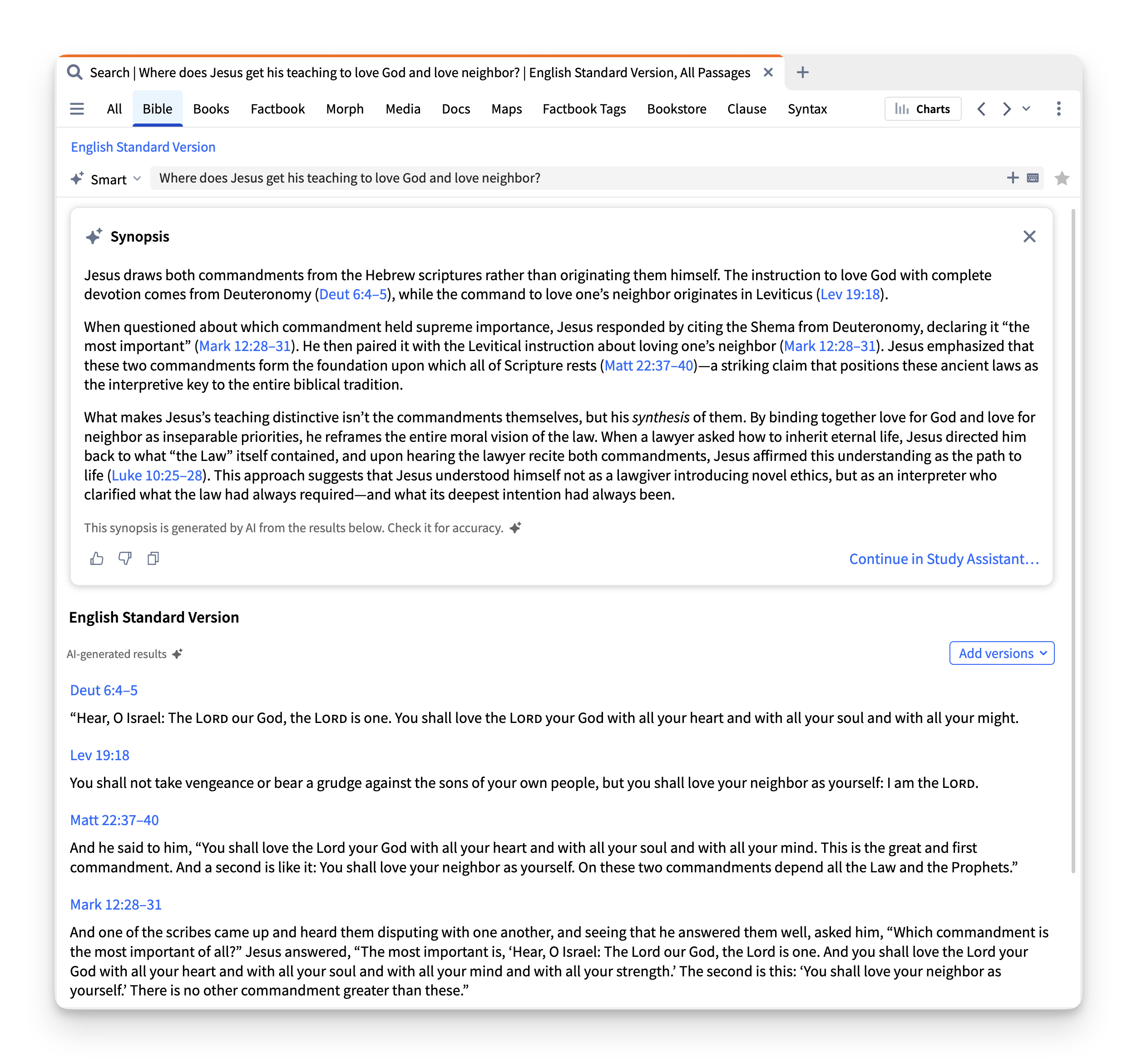
 Where does the Bible teach us to love God and neighbor? Find key verses along with a synopsis with Smart Search. Try Logos for free!
Together, Jesus says, these two statements sum up everything that God requires of us. “On these two commandments depend all the Law and the Prophets” (Matt 22:40).
These two commandments also connect to other teachings in God’s Word. How, exactly, do we love God? The apostle John explains: “In this is love, not that we have loved God but that he loved us and sent his Son to be the propitiation for our sins” (1 John 4:10). We don’t love God in our natural, sinful condition. But because of his love for us and the gift of his Son, who atoned for our sins, we cannot help but love him.
How, exactly, do we love our neighbor? Just as the gospel, which we receive by faith, enables us to love God, it also enables us to love our neighbor. John continues: “Beloved, if God so loved us, we also ought to love one another. No one has ever seen God; if we love one another, God abides in us and his love is perfected in us” (1 John 4:11–12). Because of our faith in Christ’s propitiation for our sins, God dwells in us. Therefore, God expresses his love for our neighbors through our love for our neighbors.
Thus, the two commandments come together and are resolved and fulfilled through the gospel. Faith works through love (Gal 5:6), both love of God and love of neighbor. “We love” them both “because he first loved us” (1 John 4:19).
Vocation is how we live out that purpose
If you put together those three biblical purposes for human life—dominion over creation, love of God, and love of neighbor—you get the doctrine of vocation.
That term, which is simply the Latinate word for “calling” (vocatio), is a powerful teaching for living the Christian life. It also gives a wealth of guidance for dilemmas we face, including how we should use technology.
But vocation is greatly misunderstood. Medieval Catholicism narrowed it to mean simply the calling to become a priest, a monk, or a nun. But we moderns have narrowed it in another way, so that it simply means “job.” Sometimes it is expanded slightly to mean a job that is particularly fulfilling or meaningful. But that too misses the richness and applicability of the biblical doctrine of vocation.
To recover that, we need to listen to the great theologian of vocation, Martin Luther.2 Vocation, for Luther, is not a matter of some “will of God for our life” that we have to discover. Nor is it a job that we find really, really fulfilling. Rather, vocation encompasses all the tasks, offices, and relationships of the Christian life.
“Only let each person lead the life that the Lord has assigned to him, and to which God has called him” (1 Cor 7:17). The Lord assigns to us a “life,” and then he calls us—that is, he gives us vocations—to that life. According to Luther, we have vocations in all of the “estates” that God established for human flourishing. We have vocations in the family (husbands and wives; parents and children), in the workplace (employers and workers; craftsmen and professionals), in the state (citizens and officials; soldiers and firefighters), and—for Christians—the church (pastors and laypeople; musicians and teachers). Luther also saw an estate that comprises the informal relationships of human life (friends and enemies; good Samaritans and strangers bleeding by the side of the road) that he called “the common order of Christian love.”3
Characteristic of Luther’s teaching is his insight that God works through human beings in their vocations. As we’ve seen, God exercises his dominion over the creation when human beings, who share his image, exercise their dominion. God works through the vocations of earthly authorities to punish evildoers and to protect those who do well (Rom 13:1–7). Similarly, God gives us our daily bread through the vocations of farmers and bakers. He creates new human beings through the vocations of mothers and fathers. He brings people to faith and cares for them spiritually through the vocations of pastors who proclaim his Word. We could extend the principle: God heals by means of the medical vocations; he creates beauty by means of artists and musicians; and he makes our lives easier by means of technologists.
According to Luther, the purpose of every vocation—in the family, the workplace, the state, the church, the common order—is to love and serve the neighbors whom the vocations bring into our lives. Husbands are to love and serve their wives, and wives are to love and serve their husbands. People in business are to love and serve their customers. Rulers are to love and serve those under their authority. Pastors are to love and serve their flocks, and Christians should love and serve their fellow Christians. In the common order, we are to love and serve the people whom God brings into our lives.
Again, God is working through us in these vocations. As we’ve seen, God expresses his love for our neighbors through our love for our neighbors. Also, God expresses his love for us through other people when they love and serve us.
When we violate the purpose of our vocations—that is, the purpose of our lives—we sin. Too often we do not love and serve the neighbors we encounter. Instead of serving them, we demand that they serve us. Instead of loving and serving our neighbors, we often ignore, exploit, and even harm them. Resisting God’s love, which is to flow through our vocations to our neighbors, puts us into conflict with him.
In marriage, God calls spouses to love and serve each other, not to be cruel or demeaning. God gives children to parents not to neglect or otherwise abuse them, but to love and care for them. God does not call people into various business vocations for them to cheat their customers, but to give them goods and services that meet their needs. God does not call government officials to tyrannize their people, but to work for their benefit. God does not call pastors to lord it over their members or to mislead them by false teaching, but to feed and care for their flocks.
And God calls technologists to benefit humanity, not to end humanity.
Technology exists to serve our vocations
Nearly every vocation has its tools. Farmers have plows, carpenters have saws, office workers have desks, pastors have pulpits, musicians have instruments, parents have minivans, and nearly every vocation today uses computers. Luther wrote about tools:
If you are a manual laborer, you find that the Bible has been put into your workshop, into your hand, into your heart. It teaches and preaches how you should treat your neighbor. Just look at your tools—at your needle or thimble, your beer barrel, your goods, your scales or yardstick or measure—and you will read this statement inscribed on them. Everywhere you look, it stares at you. Nothing that you handle every day is so tiny that it does not continually tell you this, if you will only listen. … All this is continually crying out to you: “Friend, use me in your relations with your neighbor just as you would want your neighbor to use his property in his relations with you.”4
For Luther, tools are instruments that we use in our vocations to love and serve our neighbors. Tools are a function of technology.
Through technology, we exercise dominion over nature. Of ourselves, we are weak and vulnerable. We would be easy prey for predatory animals, so we invented bows and arrows and eventually firearms. Our bodies are highly susceptible to disease, so we devised medicines. We invented ships, automobiles, and planes to overcome the limitations of distance. We invented the printing press, telephones, and the internet to help us tap into other people’s minds. Technology is a great gift of God, which helps us fulfill our purpose.
The test for technology is whether or not we are using it vocationally; that is, as a means of loving and serving our neighbors.
Then again, technology also helps us violate our purpose. We have turned our bows and arrows and firearms against other human beings. We exercise unlawful dominion over other people. We have used our technology for ravaging nature instead of caring for it. The test for technology is whether or not we are using it vocationally; that is, as a means of loving and serving our neighbors.

Technology fails when it displaces our vocations
Technologies can be used both for love and for sin. For example, computers and the internet can be used vocationally in love and service to our neighbors, keeping us in touch with family and friends, facilitating our work, and enhancing our citizenship by keeping us informed. Then again, they can also be used as a medium for bullying, fake news, and pornography.
So let’s apply this to artificial intelligence. Though AI can function as a tool—to gather research, to sort through information, to make you more productive at work—it also has a generative function that enables it to express ideas, create music, give advice, and simulate relationships. That is, AI presents itself as having vocations. But technology itself has no vocation. Only human beings have vocations and the spiritual makeup to love and serve other human beings like themselves.
Human musicians, filmmakers, writers, and other artists have a God-given ability to create works of beauty and meaning and so bless their neighbors. Today AI-generated music and books are clogging up the streaming services and the publishing industry, crowding out human artists.
A busy pastor can give an AI chatbot a Bible verse and have it generate a sermon. But the AI chatbot does not have a calling from God to preach. The pastor does, and while he may use AI to search out the Bible commentaries, he dare not farm out his divine vocation to an inanimate machine.
Many lonely people are turning to AI chatbots for counseling, friendship, even romantic relationships. But these are needs for human connections. We need to love and to be loved, both of which are satisfied in vocations, not AI simulations.
Students can use AI to do their homework, read their assignments, and write their papers. But that usurps the vocation of being a student, whose work of learning requires the mental exertion of study and original thinking.
When technology undermines or takes us away from our vocations—our family, friends, work, citizenship, church—we are misusing it. When we turn to a machine for what we should be receiving from human vocations, we violate our human purpose. When we use it to harm others or ourselves, we violate the purpose of technology.5
Share your thoughts
If AI can do our work and replicate our functions, what are we for? Join us in the Word by Word group to share your thoughts.
Gene Veith’s recommended resources
- Veith, Gene Edward, Jr., and A. Trevor Sutton. Irreplaceable: Humanity, Vocation, and the Limits of Technology. Baker Books, 2026.
- Sutton, A. Trevor, and Brian Smith. Redeeming Technology: A Christian Approach to Healthy Digital Habits. Concordia Publishing House, 2021.
- Mitchell, Mark T. Breaking Babel: How a Mysterious Biblical Story Can Help Christians Survive the AI Revolution. Creed & Culture, 2026.
Related content
- What Does It Mean to Be Human? Theological Anthropology
- What Does the Bible Say About Transhumanism?
- Redeeming Technology: How Technology Fits into God’s Story
- It’s Not What You Think: Exposing the Limits of Technology
- From Data to Discernment: Why AI Can’t Replace Cultivating of Wisdom

- Scripture quotations are from the English Standard Version.
- See Gustaf Wingren, Luther on Vocation (Wipf & Stock, 2004). See also my book God at Work: Your Christian Vocation in All of Life (Crossway, 2011).
- Martin Luther, “Confession Concerning Christ’s Supper, Part 3 (1528),” in Basic Theological Writings, ed. William R. Russell and Timothy F. Lull, 3rd ed. (Fortress, 2012), 28.
- Martin Luther, Commentary on the Sermon on the Mount, in Luther’s Works, ed. and trans. Jaroslav Pelikan (Concordia, 2007), 21:237.
- There is much more to say about vocation and technology, and I say it in my book with Trevor Sutton, Irreplaceable: Humanity, Vocation, and the Limits of Technology (Baker, 2026).


 Daniel Darling

 Tyran Laws

 Ed Stetzer

 Blake Adams