Kirk E. Miller
Did the apostle Paul allow for divorce and remarriage? In this episode of What in the Word?, Kirk E. Miller sits down with renowned New Testament scholar Craig Keener to navigate a challenging and hotly debated passage, 1 Corinthians 7:12–16. Together they explore its historical context, dissect key Greek terms like “leave” and “not bound,” and survey the different interpretive viewpoints on what Paul’s words mean for believers in religiously mixed marriages.
Follow the show on YouTube, Spotify, Apple Podcasts, and more.
What you’ll find

Connect with us
Ready to increase biblical literacy? Like and share. To go the extra mile, leave us a review on your preferred platform.
Subscribe to get future episodes. (Bonus: We’ll send you a discount to use on your first purchase.)
Thanks for subscribing to Word by Word!
Use code WORDBYWORD to save 10% on your first order.
Episode guest: Craig Keener
Craig S. Keener (PhD, Duke) is F. M. and Ada Thompson Professor of biblical studies at Asbury Theological Seminary. He is author of roughly 40 books, with some 1.4 million copies in circulation. In 2020, Craig was President of the Evangelical Theological Society. He is married to Dr. Médine Moussounga Keener.
Episode synopsis
Setting the tone: charity and care
Kirk frames the conversation with two cautions to set the tone.
First, this is a passage where faithful, well-meaning, and serious Christians disagree. So we want to avoid speaking dogmatically on matters where so many Christians hold reasonable alternative viewpoints.
Second, the topic of divorce and remarriage isn’t some merely academic exegetical question. It’s immensely pastoral, practical, and personal for many, and often in deeply painful ways. Many people’s lives have been deeply affected by marital breakdown. So we want to avoid discussing it in ways that are abstract, distant, and cold, as though this subject were merely an intellectual curiosity. We should speak with conviction and interpretive clarity while refusing to speak carelessly or insensitively.
Why 1 Corinthians 7:15 proves difficult
Craig explains that the difficulty is partly synthetic: How do we harmonize the Bible’s collective teaching (e.g., Paul’s statements with Jesus’s teaching in the Gospels)? Some Gospel texts appear to allow no exceptions, while Matthew includes the well-known “exception clause” (often translated as “sexual immorality”; Matt 5:32; 19:9). Then Paul seems to add another scenario: What happens when a believer is married to an unbeliever and the unbeliever walks away?
Another difficulty is historical. Craig observes that Christian interpretation has varied widely across the centuries. Some early church voices advocated no divorce and no remarriage, while later traditions, especially in the Reformation era, emphasized certain New Testament exceptions.
Finally, we face practical and pastoral difficulties. In many modern contexts, divorce is widespread. We know many who have suffered it, which makes these texts deeply personal. Discussions aren’t happening in a vacuum, but among people who have experienced betrayal, abandonment, abuse, or the long grief of a dying marriage.

Use Factbook to launch your study of topics like divorce and marriage. Start your free trial!
The background issue in 1 Corinthians 7
The Church of Corinth is young in the faith, and Paul encounters many issues that need to be dealt with.
In 1 Corinthians 7, Paul responds to a letter from the Church in Corinth (7:1). We discover those in this fledgling assembly apparently believed abstinence, even within marriage, made for superior holiness. Paul corrects this misunderstanding by affirming marital obligations and warning against naive “spirituality” that ignores real temptations and moral dangers (1 Cor 7:1–9; cf. 6:12–20).
In Corinthians 7:12–16 in particular, Paul addresses another very practical scenario: Many believers in Corinth became Christians after they were already married. So some were now in religiously “mixed” marriages where one spouse believes and the other does not (1 Cor 7:12–16). The question arises: If we’re religiously mismatched, should we separate?
“I say (I, not the Lord)”
In 1 Corinthians 7:10–11, Paul introduces his instructions to married couples with, “I give this command (not I, but the Lord).” He is relaying what Christ (the “Lord”) instructed on this particular matter: Do not leave one’s spouse merely because he or she is an unbeliever (1 Cor 7:10–11; cf. Matt 5:31–32; 19:3–9; Mark 10:2–12; Luke 16:18).
Following this, Paul introduces his next set of instructions as, “I say (I, not the Lord)” (1 Cor 7:12). Paul is not denying that what he says is divinely inspired. That’s not the meaning of “not the Lord” here. Rather, Paul is clarifying that in earlier instruction, he was citing a saying of Jesus; in this latter instruction, he is applying Jesus’s teaching to a situation that Jesus did not explicitly address in his earthly ministry. Paul is doing pastoral theology: honoring Jesus’s standard while reasoning through new cases the early church was facing.
The Roman legal backdrop: “leaving” was divorce
So believers are not to break up such marriages. But what if their unbelieving spouse walks out on the marriage (1 Cor 7:12–16)?
As Craig points out, in the Greco-Roman world, especially in a Roman colony like Corinth, marriage was sustained by mutual consent. If either party walked out, the marriage was considered over.
This matters for interpreting Paul’s instruction, “If the unbelieving one is leaving, let him leave.” Some readers want to interpret this as only physical separation, not legal divorce. But, as Craig argues, in Corinth’s social–legal world, the act of leaving was not a temporary arrangement: It functioned as a dissolution of marriage. So Paul isn’t describing a neat modern category like “separated, but not divorced.” He’s dealing with a reality where abandonment effects marital termination, and the believer cannot control that outcome. Paul is saying, “If that happens, that’s not on you. You can’t do anything about that.”
“Sanctified” spouses and “holy” children?
What does Paul mean in 1 Corinthians 7:14 that the unbelieving spouse and their children are made holy because of the believing spouse?
Presumably, it does not mean they are automatically saved, since 1 Peter 3:1–7 speaks of believing wives winning their unbelieving husbands to the gospel. Instead, Craig suggests this refers to the degree of influence. For instance, in antiquity, the husband would normally get the children in a divorce, meaning the believing wife would lose her religious influence on the children.
Paul’s statement, on this reading, highlights why maintaining the marriage, when possible, maintains the Christian spouse’s influence on their family.
3 views on divorce and remarriage
Most of the debate over divorce and remarriage in 1 Corinthians concentrates on 1 Corinthians 7:15: “Yet if the unbelieving one is leaving, let him leave; the brother or the sister is not under bondage in such cases” (emphasis added).
All interpreters agree that the believing spouse cannot be blamed for the unbelieving spouse’s departure. The question, however, is whether Paul is merely saying, You’re not responsible for their actions; you can’t stop them, or whether he is also saying, You are not bound to this marriage anymore; meaning,
- one has warrant for divorce, and potentially even
- freedom to remarry.
Kirk walks through three primary positions that show up in Christian interpretation:
|
View |
(1) Never divorce, never remarry |
(2) Sometimes divorce, but never remarriage |
(3) Sometimes divorce and with it remarriage |
|
Divorce |
Divorce is always forbidden, so a believer should never initiate it. |
Divorce is permitted under certain conditions. |
Divorce is permitted under certain conditions. |
|
Remarriage |
Remarriage is likewise always forbidden. |
Remarriage is always forbidden while one’s former spouse is still alive. |
Legitimate divorce brings with it freedom to remarry. |
Additionally, within positions 2 and 3, debate exists over what the warranted grounds are for divorce (and, for view 3, remarriage). All recognize sexual immorality (per Matt 5:32; 19:9) and abandonment (per 1 Cor 7:15). Debate, however, exists over what constitutes “sexual immorality” (just adultery?) and abandonment (just physical desertion?) and whether there are additional grounds, like other covenant-shattering actions (e.g., abuse).
Under the vast majority of traditional Christian views though, Christians are not free to divorce (or remarry) for trivial reasons. Among those views that allow for divorce (and remarriage), this freedom comes only when their marriage is broken against their will.
The meaning of “not under bondage”
Craig contends that the language of being “bound” or “not bound” should be read in light of how such terms functioned in ancient divorce and remarriage contexts. In Jewish divorce contexts, this language explicitly meant one was free from marriage so as to marry another.
Additionally, he points to 1 Corinthians 7:27–28, where Paul contrasts being “bound to a wife” with being “released from a wife.” Many English translations blur the force of this by using general language like “unmarried,” but Craig insists Paul is describing someone who has been released (not just “free” but “freed”) from a marriage (7:27), presumably either through divorce or death. Notably, Paul comments that if such a person marries, they have not sinned (7:28). For Craig, this suggests Paul can envision a situation where remarriage after divorce is permissible.
Kirk also points to the end of the chapter, 1 Corinthians 7:39, where Paul uses comparable language (from “bound” to “free”) to speak about the freedom to remarry after one’s spouse has died. This suggests this type of language used elsewhere in this chapter (like in 1 Cor 7:15) generally involved the freedom to remarry.
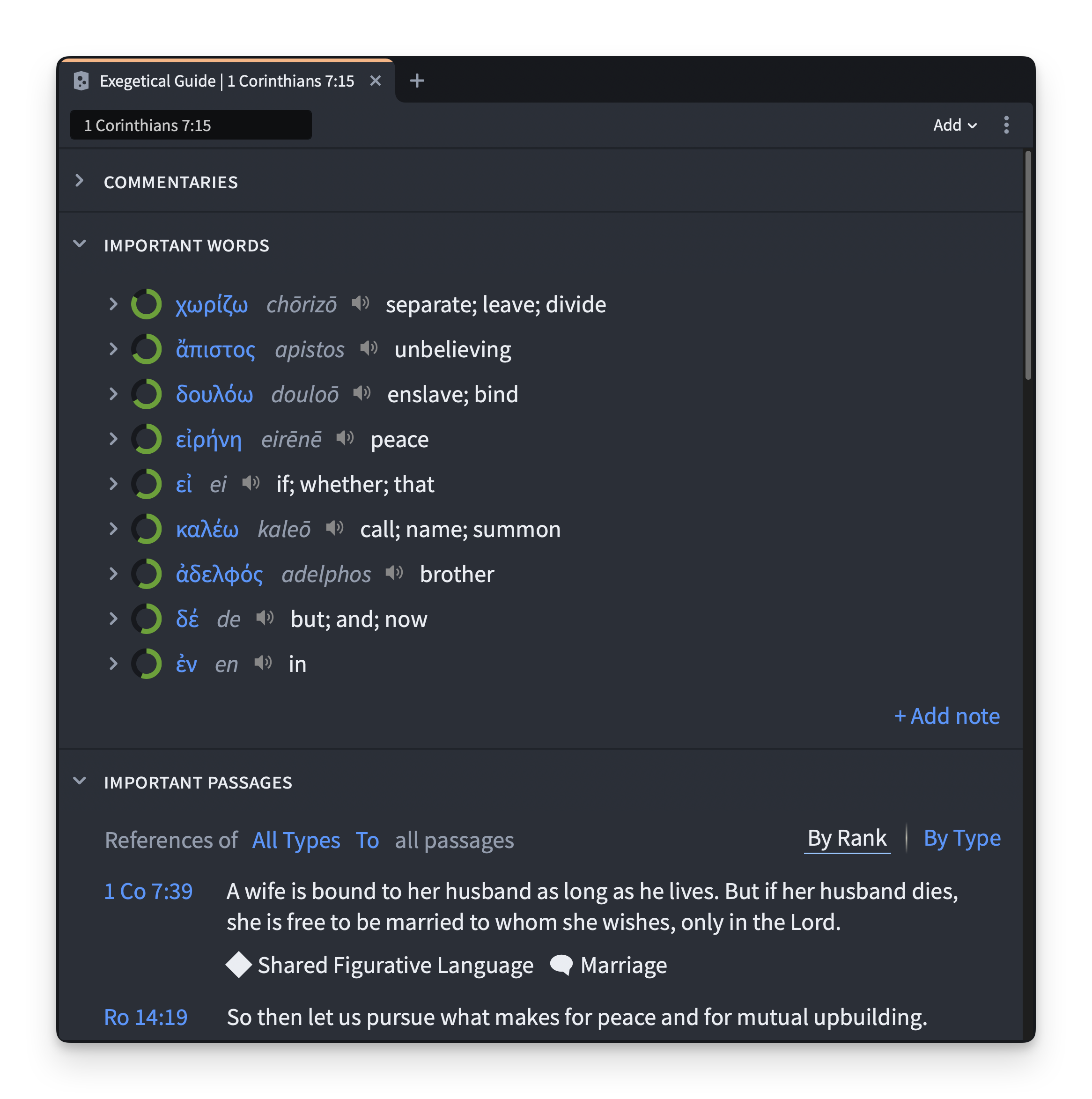
Discover Important Words in your passage with Logos’s Guides.
Start your free trial!
“Such cases” and the question of additional exceptions
Kirk points out that some interpreter’s maintain that Paul’s phrase “in such cases” (1 Cor 7:15) indicates that Paul’s specific exception here is not meant to be exhaustive. Instead, the logic of Paul and Jesus’s permissions for divorce and remarriage can be applied to include analogous situations. Craig agrees, observing that Paul uses similar language (“things like these”; Gal 5:21) elsewhere.
Nonetheless, we need a careful controlling principle, lest we adopt overly permissive divorce standards, like some in Jesus’s day (e.g., burning toast). The ethical gravity of marriage must shape the ethical gravity of any exception.
Craig proposes that the New Testament exceptions all involve scenarios where at least one party is functionally rupturing the marriage. The believer is called to pursue faithfulness and peace, but a marriage can be shattered unilaterally through abandonment, sexual betrayal, or other severe violations. Craig points to abuse as one such example of something that amounts to abandoning the marital covenant, even if the abuser never physically leaves the home.
Jesus’s adultery sayings: literal or hyperbole?
As mentioned at the outset, one of the main difficulties when it comes to the Bible’s teaching on divorce and remarriage is how we synthesize it all. Thus, Kirk asks Craig how he reconciles Jesus’s various statements to the effect of, “Whoever divorces and remarries commits adultery” (see Matt 5:32; 19:9; Mark 10:11–12; Luke 16:18) with the apparent existence of exceptions in Matthew 5:32, 19:9, and in 1 Corinthians 7:15.
Craig observes that if Jesus’s words are taken in an unqualifiedly literal way, the pastoral consequences would be severe: It would imply many second or third marriages are ongoing adultery, requiring we break up those marriages. This misunderstands how Jesus uses hyperbole elsewhere in the same context, e.g., Jesus’s dramatic statements about tearing out an eye or cutting off a hand (Matt 5:27–30), language most Christians recognize as forceful rhetoric rather than literal commands.
The presence of recognized exceptions (e.g., sexual immorality, abandonment) in these “adultery” sayings indicates that Jesus is not denying that divorce genuinely dissolves a marriage (cf. John 4:17–18 and Mark 10:9, which assume divorce is a real possibility). Rather, on this reading, Jesus’s adultery language is a graphic warning: Divorce is a serious violation of God’s creational intention for marriage, and pursuing divorce lightly places someone in the moral territory of adultery.
How to preach or teach on divorce and remarriage
Craig’s advice for preachers and teachers aims at a dual responsibility:
- Uphold fidelity to marriage as the Bible’s clear ideal.
- Avoid condemning people whose marriage ended against their will or under coercive, dangerous, or betraying circumstances.
Craig warns against using divorced people as cautionary tales or treating every divorce as automatically suspect. If Scripture contains permissions, those permissions exist for real human evil and real human vulnerability. You don’t punish a victim to demonstrate that you oppose the crime. In the same way, you don’t heap shame on someone victimized by abandonment or betrayal simply to signal that you take marriage seriously.
At the same time, emphasize accountability where it belongs. If someone is responsible for breaking a marriage unjustly, the appropriate response is not denial or rationalization but repentance, ownership, and, where possible, seeking to make things right with God, one’s former spouse, and any children involved.
Logos values thoughtful and engaging discussions on important biblical topics. However, the views and interpretations presented in this episode are those of the individuals speaking and do not necessarily reflect the official position of Logos. We recognize that Christians may hold different perspectives on this passage, and we welcome diverse engagement and respectful dialogue.
Let us know what you think
How do you interpret 1 Corinthians 7:15? Join us in the Word by Word group to share your thoughts.
Craig Keener’s recommended resources on divorce and remarriage

. . . And Marries Another: Divorce and Remarriage in the Teaching of the New Testament
Regular price: $23.99
Remarriage After Divorce in Today’s Church: 3 Views (Counterpoints)
Regular price: $16.99
Divorce and Remarriage in the Bible: The Social and Literary Context
Regular price: $36.99
Other resources for further study
Divorce and Remarriage: Four Christian Views (Spectrum Multiview Books)
Regular price: $17.99
Marriage, Divorce, and Remarriage in the Bible: A Fresh Look at What Scripture Teaches
Regular price: $18.99
Divorce and Remarriage in the Church: Biblical Solutions for Pastoral Realities
Regular price: $14.29
Related content
- Can You Value Marriage Without Also Valuing Singleness?
- “Is This Sinful?”: How to Know Whether Something Is a Sin
- The Corinthians: Who Were They & What Was Paul Saying to Them?
- How to Conduct Christian Premarital Counseling: 6 Essentials
- Is the Song Allegorical? | Fellipe do Vale on Song of Solomon