
 Christa McKirland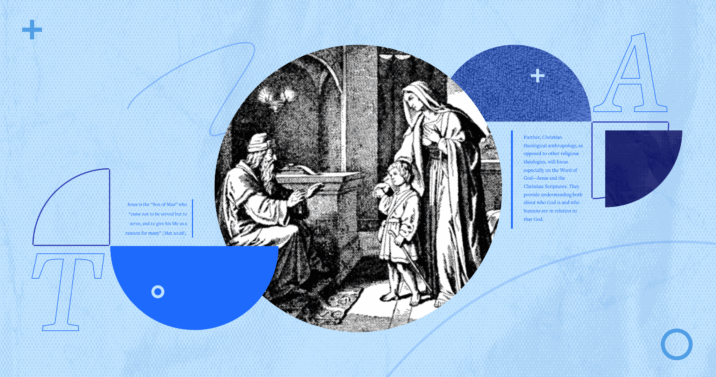
Most simply, theological anthropology is the study of what it means to be human by starting with God and seeking to understand God’s intentions for humankind. Anthropology, as a social scientific discipline, can be done with or without reference to a divine being, whereas theological anthropology cannot.
Further, Christian theological anthropology, as opposed to other religious theologies, focuses especially on the Word of God—Jesus and the Christian Scriptures. They provide understanding both about who God is and who humans are in relation to that God.
The approach in this article is to provide a biblical theological anthropology from Genesis to Revelation that is also sensitive to present-day concerns and issues.
Table of contents
- Methodology & the primary views
- Humanity’s identity as the image of God
- Reckoning with human sinfulness
- Israel’s vocation to be a kingdom of priests
- Christ, the true priest & king
- The church as Christ’s royal priesthood
- New creation: royal-priests forever
- AI & human uniqueness
- Practical implications of theological anthropology
- Conclusion
Methodology & the primary views
But first, a note about methodology.
Many Christian theologians throughout history have begun with the creation accounts of Genesis 1 and 2 as an ideal starting point for theological anthropology. On the other hand, theologians who understand Christ as the true image of God have often started with Christology and taken a more canonical approach. In either case, the primary source for Christian theological anthropology is Scripture and the incarnation of the Son.
The primary views that have emerged throughout church history in regard to the image of God are the substantival, functional, relational, and Christological views. For my part, I would encourage us to be:
- Attentive to ways our understanding of humanness might exclude some from being understood as fully human
- Appreciative of the diversity of human cultures
- Sensitive to our sinfulness
- Centered on Jesus
- Responsive to the Spirit
1. Substantival view
Augustine (354–430) was one of the first to formulate the substantival view, which focuses on how humans are different from animals or similar to God. In other words, there is something in the essence of the human person that makes them God’s image, and it could be determined observationally. His understanding, alongside Boethius (c. 480–524) and Thomas Aquinas (c. 1225–1274), contributed to understanding the image of God as having a rational soul. Such was the dominant view for the first 1,600 years of church history.
2. Functional view
With the rise of biblical critical scholarship, a closer reading of the Genesis texts and their surrounding contexts contributed to the development of the functional view. This view is based on the command to have dominion as constituting the image of God (Gen 1:28). Given the ancient Near Eastern understanding of images and idols as representing a divine being in physical form, and acting on its behalf, such a reading made more sense of the text and context of those creation accounts.
3. Relational view
In the twentieth century, scholars describe a relational turn in theological anthropology in which the image of God was increasingly understood to be how humans uniquely relate back to God. This view might also include how humans relate to one another and the rest of the created order.
4. Christological view
Finally, the Christological view articulates what it means to be human with a special focus on the person of Christ. According to Marc Cortez, minimally, a Christological anthropology requires Christology in order to make significant claims about what it means to be human, and such claims go further than the image of God and ethics.1
Each of these views has strengths and weaknesses and continues to be debated today, especially on the basis of their exegetical, scientific, and ethical soundness. While those debates will take us too far into the weeds, I will propose below one way of thinking of theological anthropology that brings together the strengths of all these views while seeking to avoid their weaknesses.

Humanity’s identity as the image of God
One of the weaknesses of the substantival view is that the Genesis text is nowhere explicit about the constitution of the image of God. Early readers were prone to insert the most valued attribute of their day as the one which designated God’s image. Such attributes tended to favor those in dominant positions, contributing especially to dynamics of racism and sexism.2
Further, such readings could center humankind in these origin accounts, leading to anthropocentric understandings of creation. Instead, the theological points of Genesis 1 and 2 are largely about God’s power and utter uniqueness in creating by mere speaking.
Finally, this Creator God does not have needs and does not create the world and humans as slave labor to serve the Creator’s whims. Instead, this is a power-sharing God who collaborates with creation and invites the humans—those made in God’s image—to serve and keep this creation.
Image as royal-priestly vocation
To be made in God’s image thus has royal undertones, as the man and woman are representatives of the ruler of the cosmos—to expand God’s shalom-presence throughout the world.3 In the ancient Near East at this time, only the king would have been understood as bearing a deity’s image and would be tasked with expanding that god’s power and authority over a particular domain. Unique to Genesis is the inclusion of all humankind as having this identity—men and women alike.
This identity is one side of the coin. The other side is their calling, or shared function, in light of this identity. Such a calling is both royal and priestly. Royal, because of the association of the man and woman with God as those representing God’s presence and power in the world. Priestly, because of how we see both the place which the man and woman call home and their assigned tasks given to them by God.
In terms of the place, biblical scholarship has also come to a near consensus that Eden is functioning as a sacred space, a temple. This is where God’s presence can dwell, unimpeded. The man and the woman are able to walk with God. Even the verbs used of their serving (עבד) and guarding (שׁמר) is the same language used to speak of the priests in a Levitical context.4 They are meant to minister to creation on God’s behalf, taking care of it that it might flourish. God’s shalom-presence is characterized by right relationship: between God and humans, humans and humans, and humans and creation.

While this view is much stronger exegetically, to say that this form of doing is the image remains textually underdetermined. Further, for those of our human community who might not be able to “do” in this way—for instance, those in utero, infants, people with extreme cognitive disabilities—their value can be undermined.
God’s relation to us
By grounding what it means to be made in God’s image on how God wants to relate to us, we can avoid that weakness. Every human person is unimpeachably valuable. At the same time, we can affirm the purposiveness of humans to be the kind of creatures who can act as co-regents and agents in God’s world.
Importantly, we must be physical in order to act on and for God’s physical world, yet we must be more than merely physical in order to relate to God who is Spirit. We are, what Beth Felker Jones terms, “psychosomatic unities.”5 Yet, we are not meant to be inert psychosomatic unities, actual statues pointing statically to the God of the universe. We have a function. Thus, our substance and function work together.
Grounding both of these aspects of being in God’s image is, ultimately, God’s desire to relate uniquely to humankind, and that humankind might relate back to God in a distinctive way. Humans have a need to relate to God in a personal way.6 In other words, we are meant to know God, not merely know about God.
While this relational view is clear through the language of being made “in” the image “of” God, and then demonstrated through God’s unique address to humankind, it too has weaknesses. As Joanna Leidenhag has cogently proposed, the focus on how humans relate back to God has been biased toward a neuro-typical way of relating.7 To address this, I believe we can focus on the God side of the equation. Whether or not humans ever volitionally relate back, God is desirous of relating to us in this way. Thus, the relational view is best based on how God desires to relate to us.
Jesus as the ideal human
Finally, the perfect image—the one who is perfectly relating back to God and functioning as the ideal, embodied, royal-priest is Jesus of Nazareth.
One weakness of the Christological view is more philosophical. How can Jesus be the true image of God and still include all of humanity? This, and other important questions, receives greater treatment elsewhere.8 However, briefly, Jesus has historically been understood as the truest expression of humanity, even though he came in a particular body at a particular time. He shows us how to perfectly receive God’s way of relating to us. He needed to relate to God in a personal way just like all of us—not as a list of facts, but through a relationship. The fact that he did (and does) so as a first-century Jewish Palestinian man does not mean he can only redeem those who share those exact traits. Thus, we can see the value of each view of the image of God, despite their weaknesses, and how they weave together to provide a picture of what it means to be human.
Reckoning with human sinfulness
Theological anthropology must also reckon with what went wrong. As we return to that Genesis story, we see that it does not take long for royal-priestly humans to fall short of their intended calling. In first distrusting God’s goodness and then acting on that distrust through disobedience, the man and woman are both judged and cut off from the edenic garden where they were able to walk with God (Gen 3:22–24). Thus, the consequence of their sinfulness is a break in relationship with God (no more walking together unimpeded), with each other (patriarchy is a result of sin [Gen 3:16]), and with creation (the land now produces thorns and thistles [Gen 3:18]). The subsequent texts (Gen 4–11) then show how quickly this break in relationship with God corrupts all relationships.
Graciously, these judgements are not meant to remain! Further, the royal-priestly identity and intended function does remain. We can see this in the fact that the “image of God” identity of humans persists even after sin (Gen 5:1; 9:6), and also through the rest of Scripture.
Of course, how we understand the transmission and pervasiveness of sin is another (massive) area of study within theological anthropology. For our purposes, I take the scriptural account to affirm that all humans sin, except Jesus. This is because sin is not essential to being human, but no other human being has resisted sin as Jesus did. This point is important because sometimes people think that being sinful is essential to being human. However, just like being born on planet earth is typical of most humans, we can conceive of a person being born on a space station and yet still being human. Just because most people are born on earth does not mean that one would not be human if you were born off-planet. Similarly, sin is not essential to being human.
Theologian Kelly Kapic encourages us to keep our doctrine of creation and redemption together.9 God deemed creation to be good. Even though sin has corrupted creation, it is not strong enough to undermine what God has deemed good. We will come back to this, but all creation does need redemption (and even groans for it! [Rom 8:22]). If we only have a doctrine of redemption, we can think that we are gross pieces of trash—but we are always valuable to our Creator. Thus, we need to keep our doctrine of creation tethered to our doctrine of redemption.
I would further affirm that sin has affected every aspect of creaturely reality such that we are enslaved by it. Consequently, God set up a way to address human sinfulness, first through the Levitical sacrificial system (as seen in the Torah), and eventually through fulfilling the function of that system through the death, resurrection, ascension, and ongoing ministry of Christ (see especially the book of Hebrews).
Use Logos’s Factbook to explore topics like anthropology.
Start a free trial today!
Israel’s vocation to be a kingdom of priests
Returning to the scriptural story, the next time we see royal-priestly language is in Exodus 19. However, we need some context before we look at that in more detail.
By Genesis 12, we arrive at God’s covenant with Abraham (whose name is initially Abram). There, we see God promising to bless this childless man. While there are several features of this blessing, the most significant aspect is that through Abram “all families will be blessed” (Gen 12:3). Through his family, God wants to bless all peoples of the earth (see Gal 3:8).
From there, we have this same promise given to Abraham’s son Isaac (Gen 26:4), and then again to Isaac’s son Jacob (Gen 28:14). Such a repeated promise to three generations says a few significant things:
- Repetition indicates the weight of such a promise.
- This promise is not about Abraham but about God’s faithfulness.
- Even when Abraham, Isaac, and Jacob are not faithful, God does remain faithful to this promise.
Fast forward and Jacob has twelve sons. Those sons and their families move to Egypt, thanks to a famine and Joseph’s providential placement there to ensure that his family and many others (Gen 50:20) could survive, and then that family grows to be a multitude of Israelites in the land of Egypt.
In the Exodus, we discover that multitude is now enslaved and crying out for a deliverer. God hears their cries, raises up Moses, and brings them out of Egypt.
This finally brings us to Exodus 19. God gives the law at Mt. Sinai. Such a law, if obeyed, would enable this new nation to be holy as God is holy. Yet, this is not a holiness for its own sake—it is so that God could then dwell among them (reminding us of Eden), and also so that they may be a witness to all nations (reminding us of God’s promise to Abraham). This is made explicit when God tells Moses to say to the people, “but you shall be for me a priestly kingdom and a holy nation” (Exod 19:6). As a whole nation, they were meant to intimately relate to the Holy God and to mediate God’s presence to the surrounding nations.
As the rest of the Old Testament attests, Israel has times when this is done faithfully and unfaithfully. However, that calling has remained. When we turn to the New Testament, we see how it is embodied in Jesus Christ and then expanded to (again) include all humankind.

Christ, the true priest & king
With the incarnation of the Son of God as Jesus of Nazareth, we see the true image of God in human form (Col 1:15; see also Heb 1:2–3; John 14:9). Jesus reveals what full human flourishing is meant to look like, even in a sin-conditioned context.
Jesus is the perfect royal-priestly image of God, while also being the divine presence itself. Further, while the Spirit of God was always active and present in the Old Testament, that divine person is now all the more evident through leading, guiding, and empowering Jesus in his fulfillment of his royal-priestly calling.
Finally, he restores the way for humankind to relate to the Father through the Spirit, who is sent after Jesus ascends to the Most Holy Place (Acts 7:55–56; Eph 1:20; Heb 1:3) to serve as our eternal priest and king.
Christian theological anthropology cannot go around Jesus—but must be understood through him.
Christian theological anthropology cannot go around Jesus—but must be understood through him.
- In Jesus, we see the one who is perfectly related to the Father and perfectly led by the Spirit. He is truly an agent, making his own decisions, and he reveals what aligned agency with the will of the Father through the Spirit is meant to look like.
- At the same time, he is fully God. Thus, his priesthood is of an ultimate kind. He is presently interceding on our behalf in the heavenly places, seated at the right hand of the Father. Mere humans cannot function in this way.
- However, if he is not fully human, he could not be both our perfect sacrifice (whereby he has died) nor our empathetic high priest.
- He is also the true king of the universe, sharing the divine identity with the Father and Spirit. What we see in his human life is one who is seeking to reveal the kingdom of heaven and the reign of God on earth as it is in heaven.
Through Jesus’s life, death, resurrection, and ascension, by faith, we are made holy and thus able to receive God’s own indwelling presence. God coming to dwell with us is yet again made possible, even though sin remains part of our present reality. Outrageously, such indwelling presence allows those who follow Christ to be restored to our original calling—to be royal-priests.
The church as Christ’s royal priesthood
The calling to expand God’s shalom-presence is now personalized in Jesus, such that our present royal-priestly vocation is to point people to the Son and to live out kingdom values of love, justice, and humility.
We are able to do this through God’s own indwelling presence. Consequently, we can participate in Jesus’s priesthood. As 1 Peter 2:5 says, “like living stones let yourselves be built into a spiritual house, to be a holy priesthood, to offer spiritual sacrifices acceptable to God through Jesus Christ.” We are likened to the temple, the place where God’s presence dwells. However, it is not a passive building but is described as active and sacrificial.
Later, in that same chapter, the author says, “But you are a chosen people, a royal priesthood, a holy nation, God’s own people, in order that you might proclaim the excellence of him who called you out of darkness into his marvelous light” (2:9). As part of our priestly service, we will live out a life that points to our true king and priest.
Similarly, in Romans 12:1–2 we see how we are to present our whole selves to God, which will mean the renewal of our minds and wills, and will be characterized by love, hope, patience, blessing, hospitality, and not returning evil with evil (12:9–21).
While the calling from Genesis remains the same, in a sin-conditioned context, how that will be outworked is radically different—and yet the goal is the same—to expand God’s shalom-presence in the world.
New creation: royal-priests forever
As we turn to the final book of the Protestant canon, we have a vision of what is to come, and we also see the fulfillment of God’s covenant to Abraham. Revelation 5:9–10 (cf. Rev 1:6) includes this statement by the elders around the throne of the Lamb:
You are worthy to take the scroll and to break its seals, for you were slaughtered and by your blood you ransomed for God saints from every tribe and language and people and nation; you have made them a kingdom and priests serving our God, and they will reign on earth.
Yet again the royal priestly language is given, now in the heavenly domain. Beautifully, this is not a homogenous, mono-cultural royal priesthood—but every ethnos (ἔθνος) is around this throne.
While we can only speculate what the new heavens and new earth will look like in the eschaton (Rev 21–22), the royal-priestly calling seems to remain our identity and function—except then, there will again be no impediment to us living into who we already are.
AI & human uniqueness
The view that I have just provided is not only faithful to the Bible but also increasingly relevant. Allow me to provide just one example.
We are in a stage of technological revolution with the rapid increase of artificial intelligence’s (AI) use and development. Historical views about what it means to be human often relied upon human uniqueness—especially rationality and creativity to explain our likeness to God. Such substantival bases are now less certain. Yet, instead of despairing, the view given above provides space to engage such developments.
The premise that humans are made to be in a unique relationship to God and to uniquely express God’s presence in the world actually provides a firm grounding for understanding human uniqueness. While all of creation exists because God wills it to exist, humans are meant to exist in a particular way—as beings made in God’s image.
Since God is a relational being within God’s self, but also with that which is outside of God’s self, we see humans created with the intention of relating back to God. We could even say that humans are designed to need to relate back to God in order to fully flourish. Such a way of relating, while embodied, is still spiritual. God, who is Spirit, lovingly relates to us who are physical and spiritual (however we parse that out), desiring that we relate back to God with a reciprocating love.
By grounding humanness in God’s desire to relate to us in a specific way (i.e., being given the status of being made “in God’s image”), provides a way to understand humanness that is distinct from the rest of creation. Conversely, AI will only ever be made in our image, not the image of God.10 We do not see AI having relational needs nor a spiritual capacity for relating to God. AI is made in the image of humans, while humans are made in the image of God. This does not mean that AI cannot have positive functions, but as a purely physical mechanism, it cannot relate at a spiritual level.
Practical implications of theological anthropology
Christian theological anthropology is of vital importance today.
Universal human dignity
By viewing every human person as made in God’s image, wherein God is desirous of a relationship with them, and desirous that they participate in God’s shalom-expanding care for all the world—we have the grounding to seek the care and protection of every human life. Regardless of a person’s gender, ethnicity, country of origin, stage of life, sexuality, economic status, or ability, God wants to be in relationship with that person.
The necessity of salvation
At the same time, the one who embodies God’s shalom-expanding care of the world is Jesus. And thus, God desires that all humans become like the true image. Such a becoming now requires an act of God’s grace given to us by the true image, Jesus, through the Spirit.
As we have seen, however, human sinfulness has affected all aspects of the created world, and thus we have rejected living into this purpose even though we remain creatures made in God’s image. As John F. Kilner would say, we fall short of the standard (who is Jesus) while retaining our status of being made in God’s image.11 The story of Scripture is about restoring us to that identity and purpose.
The church as the new humanity
In the New Testament, we see that most clearly in the formation of the church. This community of royal-priestly siblings is meant to be an outpost of God’s kingdom on earth, pointing both to what restored humanity relating to God and to each other is meant to look like.12
Capacity for relationship with God
In terms of the substantival and relational views of the image of God, we observe that human persons are embodied beings with the capacity to relate personally to the God of the universe—to be made for union with the triune God. Whether or not that capacity is ever used to relate back to God, this is what God desires for human beings, which is sufficient to ground humanness.
Inclusion against ableism
Such a priority on the substantival and relational views also addresses ableism, in that God is the one who chooses how to relate to people, and we may not be able to see how they are relating back.13 Consequently, thinking of our gathered worship, are there barriers for those with disabilities from being able to meaningfully participate?
Care for God’s creation & creatures
Yet our relating back to God also has a functional outworking. In our origin story, this is to look like care of the rest of the created world. This can be participated in through a variety of ways, but “love of neighbor” is a consistent summary statement of this intention throughout Scripture. I know in my own life, we talk about living into our royal priesthood with our children. We make this connection with simple actions such as picking up trash on the street or dropping off a meal to a friend in need. We talk with our children about the goodness of God and how we get to share that goodness because we are made in God’s image.
Conformed to Christlikeness
Finally, we see the Christological view (above) encompassing all the rest—the Son becomes physically embodied in the incarnation. He perfectly lives out his relating back to the Father, which looks functionally like love of neighbor—even to the point of death. Yet, as the perfect high priest, he ascends to the right hand of the Father, sends us his Spirit, and by faith we are enabled to live into our standard who is Jesus.
This view is perhaps most challenging of all. In Jesus, we see the only one who has ever been blameless lay down his life for us. Even on the cross he cries out for the forgiveness of his tormentors. Jesus loves sacrificially and to the uttermost. Being conformed to his likeness, means that this is the standard to which we are called.
Conclusion
There are many ways to discuss a Christian theological anthropology. However, I am compelled by the value of this royal-priestly way of understanding what it means to be human. Such a view helps us to think of the value of every human person and also the weighty responsibility we all bear.
Christian theological anthropology is thus not only an identity but an invitation.
Christa L. McKirland’s recommended resources
- Farris, Joshua R., and Charles Taliaferro, eds. The Ashgate Research Companion to Theological Anthropology. New edition edition. Ashgate Pub Co, 2015.

ReSourcing Theological Anthropology: A Constructive Account of Humanity in the Light of Christ
Regular price: $14.99
God’s Many Splendored Image: Theological Anthropology for Christian Formation
Regular price: $23.99
The Image of God in an Image Driven Age: Explorations in Theological Anthropology
Regular price: $25.99
Related content
- The Ideal Human: How Christ’s Humanity Defines Our Own
- As I Live and Breathe: “Soul” and “Spirit” in Christian Physicalism
- Sometimes Less Is Just Less: Contending for Dichotomy over Monism
- What Is the Creation Mandate—and Does It Still Matter?
- Every Person an Icon: Why Creation Signifies Dignity for All
- Marc Cortez, Christological Anthropology in Historical Perspective: Ancient and Contemporary Approaches to Theological Anthropology (Zondervan, 2016), 22.
- John F. Kilner, Dignity and Destiny: Humanity in the Image of God (Eerdmans, 2014), 3–51.
- J. Richard Middleton, A New Heaven and a New Earth: Reclaiming Biblical Eschatology (Baker Academic, 2014), 52.
- Peter J. Gentry and Stephen J. Wellum, Kingdom Through Covenant: A Biblical-Theological Understanding of the Covenants (Crossway, 2012), 212–13.
- Beth Felker Jones, Practicing Christian Doctrine: An Introduction to Thinking and Living Theologically, 2nd ed. (Baker Academic, 2023), 99.
- Christa L. McKirland, God’s Provision, Humanity’s Need: The Gift of Our Dependence (Baker Academic, 2022).
- Joanna Leidenhag, “The Challenge of Autism for Relational Approaches to Theological Anthropology,” International Journal of Systematic Theology 23, no. 1 (2021): 109–34.
- Cortez Marc, ReSourcing Theological Anthropology (Zondervan, 2018).
- Kelly M. Kapic, You’re Only Human: How Your Limits Reflect God’s Design and Why That’s Good News (Brazos, 2022), 10.
- Stephen Driscoll, Made in Our Image (Matthias Media, 2024), 111.
- Kilner, Dignity and Destiny, 140–47.
- Michael J. Rhodes, Robby Holt, Brian Fikkert, and Christopher J. H. Wright, Practicing the King’s Economy: Honoring Jesus in How We Work, Earn, Spend, Save, and Give (Baker Books, 2018).
- McKirland, God’s Provision, Humanity’s Need, 2–3.


 Dustin Burdin
 Lexham Press
 Veli-Matti Kärkkäinen
 Michael Horton