
 Kirk E. Miller
Recently, we asked our Logos community to share their favorite books on Christology, the study of the person and work of Christ. Here are some of the Logos community’s top recommended books, in no particular order.
Whether you’re looking for patristic wisdom, modern biblical scholarship, or devotional depth, these recommendations offer multiple points of entry into the church’s rich reflection on its central confession: Jesus Christ is Lord, truly God and truly human, the Savior of the world.
1. On the Incarnation, Athanasius of Alexandria
Far and away the most recommended book was Athanasius’s On the Incarnation.
Written in the fourth century by one of the early church’s most influential defenders of orthodoxy, On the Incarnation centers on God’s loving intention to restore humanity through the incarnate Son, explicitly establishing that creation and redemption flow from the same divine Logos. Humanity faced the irreversible consequence of corruptibility and death following transgression. Yet the Son of God took on human nature so that humanity might participate in the divine life. According to Athanasius, through his incarnation, death, and resurrection, Christ conquers death and restores human nature.
The book defends Christ’s full divinity as inseparable from his redemptive work, a conviction Athanasius maintained despite being exiled five times for his stance. Athanasius’s core argument against Arianism, the heresy that Christ was a created being, hinged on soteriology: only a divine Savior could accomplish what salvation requires.
Despite being written nearly 1,700 years ago, this accessible work remains essential reading, famously championed by C. S. Lewis, who wrote a well-known preface, itself worth the price of the book.
Every age has its own outlook. It is specially good at seeing certain truths and specially liable to make certain mistakes. We all, therefore, need the books that will correct the characteristic mistakes of our own period. And that means the old books.1
Read old books. And if you are looking for a place to start, there may be no better place than Athanasius’s On the Incarnation.

2. On the Unity of Christ, Cyril of Alexandria
Written after the Council of Ephesus in 431 AD, this dialogue addresses one of the most intense theological controversies in church history. Cyril responds to Nestorius, who Cyril believed taught that the divine and human characteristics in Jesus should be kept so distinct as to fragment them into two persons. Cyril, in contrast, insists that Christ is one unified person, the eternal Word who truly became human. Jesus Christ cannot be divided into separate divine and human persons, but is the one Lord who possesses both natures completely.
According to Cyril, this hypostatic unity is essential for salvation: If the Word had merely indwelt a human person rather than becoming human himself, the redemption of humanity would be jeopardized.
The book remains important, defending the coherence of Christ’s single identity while preserving the reality of both his divine and human natures, offering an orthodox alternative to both Nestorian division and later Monophysite confusion.
3. Jesus and the God of Israel: God Crucified and Other Essays on the New Testament’s Christology of Divine Identity, Richard Bauckham
This scholarly collection addresses a crucial question: How did early Jewish Christians, committed to strict monotheism, come to worship Jesus as God? Through careful examination of Second Temple Judaism and close reading of New Testament texts, premier New Testament scholar Richard Bauckham demonstrates that the New Testament writers included Jesus within the unique identity of the one God of Israel. This would mean that early Christians expressed high Christology from the very beginning, challenging the notion that such Christology represents a later development.

Jesus and the God of Israel: God Crucified and Other Essays on the New Testament’s Christology of Divine Identity
Regular price: $28.99
Tune into Graham Cole’s Logos Live interview on the incarnation.
4. God the Son Incarnate: The Doctrine of Christ, Stephen J. Wellum
Stephen Wellum offers a systematic treatment of classic Chalcedonian Christology while addressing contemporary theological challenges, such as modern kenotic theories. Written at an academic level but accessible to serious students, this volume serves as a substantial reference work that integrates biblical theology, historical theology, and systematic formulation. (Yet consider also his more introductory and concise, The Person of Christ: An Introduction.)
As Wellum explains, only the God-man could mediate reconciliation between God and humanity by offering himself as a sinless, sufficient, substitutionary sacrifice. As the divine Son, Christ alone satisfies God’s judgment upon sinful humanity and demand for perfect righteousness. As the incarnate Son, Christ alone identifies with sinful humanity in suffering and represents new humanity as our Covenant Lord.
God the Son Incarnate: The Doctrine of Christ (Foundations of Evangelical Theology)
Regular price: $27.99
The Person of Christ: An Introduction (Short Studies in Systematic Theology)
Regular price: $13.99
5. The Two Natures in Christ, Martin Chemnitz
This sixteenth-century work provides a distinctive Lutheran attempt to explain Chalcedonian Christology, namely, how the divine and human natures unite in the person of Christ, defending the Lutheran position against both Roman Catholic and Reformed opponents.

Use Logos’s Factbook to study of Christology. Start your free trial!
Rather than treating the divine and human natures as separate substances joined externally, he described their union through the communicatio idiomatum (“communication of attributes”) in terms of a “true and real” penetration of the human nature by the divine nature. This then grounds Lutheran sacramentalism: the “real presence” of Christ in the Lord’s Supper is made possible by the God-man’s ability to be present wherever and however he wills. Martin Chemnitz’s work remains the classic Lutheran treatment of Christology.
6. The Lord, Romano Guardini
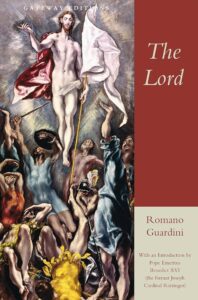
In this classic work, German Catholic theologian Romano Guardini provides a series of meditations offering a contemplative yet theologically rigorous portrait of Jesus drawn from the Gospel narratives. Guardini invites readers into sustained reflection on Christ’s person and work through careful attention to notable Gospel scenes, his teachings, miracles, relationships, and redemptive suffering. Each meditation deepens the reader’s awareness of who Jesus is and what his incarnation means for human existence.
According to The Lord, understanding Jesus requires more than intellectual and historical analysis (although Guardini includes those things); it demands the transformation of the whole person through an encounter with the living Christ. Christology, in other words, is an exercise in spiritual perception. Thus, Guardini’s work combines academic rigor and spiritual formation.
Guardini composed The Lord (Der Herr) in 1937, while actively resisting the Nazi regime. (See also his work, Jesus Christus.)
7. Gentle and Lowly: The Heart of Christ for Sinners and Sufferers, Dane C. Ortlund
Rather than exploring Christ’s nature and work in systematic fashion, Dane provides a series of devotional reflections based on Jesus’s own self-description in Matthew 11:28. Relying on insights from Puritans, Dane presents Christ’s heart for sinners as the gravitational center of the Christian experience.
This work invites readers to encounter the beauty of Jesus’s character, namely, his disposition to those who are weary, struggling with sin, or suffering. The book carefully demonstrates from Scripture that Christ’s deepest inclination toward believers is mercy, tenderness, and compassion, rather than disappointment or frustration, helping readers understand not just what Christ has done, but who Christ is at his core.
Related content
- What Is Christology & Why Should We Care?
- How to Teach the Hypostatic Union: 2 Natures, 1 Person, 0 Heresies
- What Is Nestorianism? The Theotokos Debate Explained
- Is Jesus Inferior to the Father? | Michael Horton on John 14:28
- Nicene Christology for Today: Expressing Christ in Mystery & Metaphor

- C. S. Lewis, “Preface: From the First Edition,” in On the Incarnation, ed. and trans. John Behr, Popular Patristics Series 44a (St Vladimir’s Seminary Press, 2011), 12.


 Daniel R. Hyde
 Damon Richardson