
 Ingrid Faro
Women are crucial to the mission of God. From the beginning, women were created by God as co-image bearers with men to carry the reign of God to the ends of the earth (Gen 1:26–28).1
While women represent a relatively small percentage of named people in Scripture,2 their stories and presence are strategic to its plot structure and in advancing redemption history. Many of the women have been overlooked and some have been wrongfully vilified. Yet the Bible provides a cohesive narrative that includes women, in addition to men, as essential to God’s mission from creation and Eden onward. As we evaluate the accounts of women in the Bible, three theological themes emerge:
- Women are strategically placed in Scripture to initiate or advance key movements in redemption history.3
- God overturns humanity’s false perceptions of power through the reversal of expectations.
- The treatment of women serves as a barometer reflecting the moral character of a man or society, signaling the rise or decline of a leader, community, or nation.4
Across generations and through a diverse cast of characters, we are led unflinchingly from God’s “very good” creation through the realities of human brokenness. The stories in the Bible, especially those of women, include beauty and triumph, as well as pain and trauma. Yet even these point us toward a beautiful hope, the restoration of harmony and the ultimate promise of shalom between God and his creation and between one another.
Within this unfolding drama, women are purposefully placed in Scripture to teach us, lead us, and guide us toward God’s grace and love for all humanity. Their stories are not incidental. They are revelatory. When humans, men and women, collaborate with God and each other for the good of an individual and society, blessings flow. When women are silenced or demeaned, the lives of those responsible begin to unravel.
Many more stories of women and girls, named and unnamed, prominent and overlooked, reveal their importance in God’s mission through the Old Testament and into the New. In this article, we’ll highlight some of the key women in Scripture and the themes that emerge from their stories.5
Table of contents
God’s original design for men and women
The way a book begins sets the stage for how to read the rest of the book.
The Bible opens with creation through God, who acts alone for the good and blessing of all his creation. The creation account shapes Scripture’s view of women. God creates humanity as his image (צֶלֶם) and likeness (דְּמוּת), as male and female, so that they may rule over the living creatures (Gen 1:26–28). Everything that God makes in creation is good, and in the end result, “very good.” The sevenfold repetition of “good” underscores goodness as the essence of God’s being (Gen 1:31).
The image of God as male and female (Gen 1)
The divine purpose of men and women created as God’s image establishes them as co-heirs, “vice-regents,” assigned to spread God’s goodness and blessings throughout his creation (Gen 1:26–28).6 The biblical understanding of what it means to be created in the image of God starkly contrasts the importance of humanity with the rituals and practices of the ancient Near East (ANE).
Outside ancient Israel, from Egypt to Mesopotamia, images (idols or statues) were predominantly made of two kinds of beings: gods or kings/rulers. These surrounding cultures crafted idols of bronze, stone, clay, or precious metals. The idol was considered the very image of the god it represented. After an idol was formed, it was frequently brought into a garden or to a stream to conduct rituals to bring it to life, beginning with the “washing of the mouth” and “opening of the mouth” ceremony so it could eat and speak.7 A final ritual was the “opening of the eyes” vivification ceremony, in which the idol was inhabited by the spiritual entity, thereby becoming a god. In Genesis 3:5, we recognize the serpent’s language of “your eyes will be open” as he tempts the woman and man to no longer worship or obey Yahweh as God, but rather to be gods themselves.
The second kind of being that had an image (idol or statue) made of themselves were kings or rulers. Kings were often considered gods, representatives of a chosen national deity. The statues of these kings (think, for example, of the statues you’ve seen of Ramses II) represented the king himself, the deity behind that ruler, and the government of the king. The way a person treated the statue was understood as treating the king in the same way.8 Caring for the statue well and bringing it gifts were taken as acts of treating the king well. Mistreatment of the statue was taken as abusing the king himself! Daniel Fleming helpfully points out, “Read in light of the Bible’s abhorrence of images, Gen 1:26 proposes that humanity itself, male and female, represent the only acceptable statues of God. The only legitimate representation of the Creator has been made by himself.”9 In other words, God takes personally the way we treat every person, and the way we are treated by others!
Humanity did not lose our image-bearing of God after the first rebellion or after the flood. God sees every human being as bearing the dignity and value of himself. Mistreatment of a fellow human is a personal affront against God. Jesus expresses the same understanding, that he takes personally the way we treat every other human being: “Truly I tell you, just as you did it to one of the least of these who are members of my family, you did it to me. … just as you did not do it to one of the least of these, you did not do it to me” (Matt 25:40, 45). Any reading of Scripture that ignores this foundational understanding corrupts God’s missional purpose.
The sacred partnership between man and woman (Gen 2)
Genesis 2 expands upon the directive for humanity to image God as his royal children, together as male and female. After installing humanity as priests in God’s first earthly sanctuary in Eden, two sets of words provide imagery to help us understand God’s vision for how they are to function together as his vice-regents.
The first word-picture for God’s intended relationship between man and woman occurs in Genesis 2:18–20. After God tells the man it is “not good” to be alone, he says he will make an עֵ֖זֶר כְּנֶגְדֹּֽו, generally translated something like, “helper, counterpart.” Although עֵזֶר is almost always translated as helper or help, this misleads most readers into thinking the woman is subsidiary, an assistant, less important than the man. However, עֵזֶר occurs twenty-one times in the Hebrew Bible: sixteen of those instances, עֵזֶר refers to God, the Lord, as our help. The other three times, outside of Genesis 2:18, 20, עֵזֶר refers to combatants in a military conflict. עֵזֶר could more fittingly be translated as “powerful partners standing side by side,” a strong ally who has come alongside someone in need. The provision of woman was no inferior or subordinate action.

The second word-picture provided to instruct us regarding God’s intention for the relationship between man and woman occurs in Genesis 2:21–22, when Yahweh God built the woman from the side (צֵלָע) of the man. This word, צֵלָע, occurs forty times in the Hebrew Bible. Only in Genesis 2:21–22 is צֵלָע rendered as rib in most English translations. In the rest of the Hebrew Bible, צֵלָע is generally translated as side, and not just any word for side. צֵלָע is a special architectural term. Interestingly, even Genesis 2:22 uses the verb בנה, meaning “to build,” which is also an architectural term.

So, what is the Bible getting at here? Genesis 2 describes the woman as a צֵלָע: built as the side of the man. Of the forty times צֵלָע occurs in the Hebrew Bible, thirty-six times it refers to the sides of sacred structures:
- The side supporting walls of the temple walls and entrance (1 Kgs 6:5, 8, 15 [2x], 34; Ezek 41:5, 6 [4x], 7, 8, 9 [2x], 11, 26)
- The side structures of the tabernacle (Exod 26:20, 26, 27 [2x]; 36:25, 31, 32)
- The sides of the holy of holies (1 Kgs 6:16)
- The sides of the ark of the covenant (Exod 25:12 [2x], 14; 26:35 [2x]; 37:3 [2x], 5)
- The sides of the altar of incense (Exod 30:4; 37:27)
- The sides of the altar of burnt offerings (Exod 27:7; 38:7)
What do these have in common? Each of these is a holy place where God makes his presence known. The sides of each of these are crafted to fit together for God’s sacred purposes. Likewise, God crafted man and woman to work side-by-side as powerful partners, manifesting God’s presence and fulfilling God’s purposes in the earth.
God crafted man and woman to work side-by-side as powerful partners, manifesting God’s presence and fulfilling God’s purposes in the earth.
The rebellion that arose in Genesis 3 separated man from woman and broke down their relationship as sacred space representing God as co-heirs. This breaking ushered in conflict, chaos, and grief, obscuring the mission God intended for humanity. Yet the plans of God since creation to accomplish his will through men and women working together to bring God’s goodness and blessing to the world remain unchanged. The coming of Christ brought a new chance, a new hope: reconciliation to God and with one another.

Women in the Old Testament
Eve
The first woman in the Bible, Eve (meaning “life,” see Gen 3:20), received her name after she and Adam (meaning “human”) chose to believe the serpent’s words over God’s (Gen 3:1–6). When they ate from the tree of the knowledge of good and evil, they disobeyed Yahweh’s command to eat from all the trees of the garden, except for that tree. God had warned that if they took from that tree, they would cut themselves off from the life of God. Disobedience meant choosing to be their own gods, making decisions independently from Yahweh.
Although the consequences of disobedience meant exile from the garden of Eden, God gave them a promise. Their actions appointed enmity between the serpent and the woman, and between its “seed” (offspring) and her “seed.” Yet one day the seed of woman would crush the serpent’s head (Gen 3:15).
Although Eve was the first woman to fail, she was also the first woman of faith, advancing the movement of redemption history. In exile from Eden, after her first son Cain killed his brother Abel, Eve later bore another son and named him Seth, meaning “appointed.” She said, “God has appointed to me another child [seed] in the place of Abel, because Cain killed him” (Gen 4:25). Eve remembered God’s promise and believed that through this child God would continue his plan. From Seth’s line would eventually come the Messiah.10
Sarah and Hagar
The next key woman, Sarah, also demonstrated failure and faith, as did Abraham. She initially took matters into her own hands by trying to obtain a son through her servant Hagar (Gen 16), and then oppressed Hagar once she was pregnant (Gen 21:8–21).
Later, however, she believed God for the impossible. When Sarah was ninety years old, she had been barren all her life and was long past childbearing; now her womb was dead. Yet, God promised that she herself would bear a son with Abraham, saying, “Is anything too difficult for Yahweh?” (Gen 18:14). Sarah believed God’s word, realizing that having a child of her own meant bringing life from death, moving another step closer to the one who would crush the head of the serpent.
Rebekah, Leah, and Rachel
Sarah’s son Isaac married Rebekah, who began in faith. She willingly left her father’s household to go to a land she did not know in order to marry a man she had never met (Gen 24). Rebekah, like Sarah, experienced barrenness. After Isaac prayed for her, she gave birth to twins, Esau and Jacob (Gen 25:21–26).
Although she believed God’s word that the younger twin, Jacob, would carry on the family line, she used deception to make it happen and taught her son to deceive (Gen 27). But Jacob later met his match in his father-in-law, Laban, father of Leah and Rachel. Through deception, Laban forced Jacob to marry both of his daughters, even though Jacob loved Rachel (Gen 29).
Rachel remained barren for many years, but eventually bore two sons, Joseph (Gen 30:22–24) and Benjamin (Gen 35:16–18). Leah bore six sons before Rachel had her children (Gen 29:31–30:21). With the birth of her first three sons, Leah hoped that each one would draw Jacob’s love toward her (Gen 29:31–34). But when her fourth son, Judah, was born, she simply said, “This time I will praise Yahweh” (Gen 29:35). Through Judah, the lineage of the Messiah continued.
Dinah
Genesis speaks of only one daughter of Jacob, named Dinah, through Leah. After Jacob returned to Canaan with his family, they settled outside of a city called Shechem, where Abraham had once built an altar to Yahweh, and bought a piece of land from Hamor, the ruler of the region (Gen 12:1–7; 33:18–20). Dinah went to the city to try to meet other young women there (Gen 34:1). Tragically, the son of Hamor, also named Shechem, saw Dinah, took her, and sexually debased her. He then wanted desperately to marry her. Hamor and Shechem went to Jacob to make this request and offer whatever Jacob demanded (Gen 34:2–13).
Jacob’s sons Simeon and Levi got involved, and through deception, murdered all the men of the city in revenge and plundered the city, taking the city’s wealth, women, and children. The return of evil for evil by Simeon and Levi brings greater shame and fear, as the family flees to escape reprisal from the surrounding towns. Tragically, through all the many conversations, Dinah’s voice is never heard. She is silenced.
Although Dinah’s name means “judged,” or “vindicated,” she was never vindicated. Her story exposed the ugly side of her father’s lack of care toward her. We never hear of Dinah again, except in the genealogy of Leah. Dinah lived and died alone and childless. Never once did the men of her family seek her thoughts or voice. The divisiveness festers in Jacob’s family and nearly destroys them (Gen 37–50). The hope for a messiah through the line of Abraham lay in the balance.
Tamar
Judah, however, is portrayed as a scoundrel in the earlier part of his life. After helping orchestrate the betrayal of his half-brother Joseph and selling him into slavery, Judah and the other brothers deceived their father Jacob by presenting Joseph’s robe covered in goat’s blood as evidence of his death (Gen 37). When Jacob cried out saying that he would go to his death in grief, Judah left the family and lived among the Canaanites.
However, God had other plans for him. God worked through Judah’s Canaanite daughter-in-law Tamar, to confront Judah with his sins (Gen 38). Afterward, he returned to his family with Tamar and the twin sons. Tamar risked her life to pursue justice. Her bold actions prompted Judah’s transformation from abuser to protector (Gen 43). Judah’s acknowledgement of his failure when confronted by Tamar, and his change of behavior, signaled the rise of his character to prominence.11 The youngest twin, Perez, continued the line that would lead to David and ultimately to the Messiah (Ruth 4:18–22; cf. 4:12; Matt 1:3).
Shiphrah, Puah, Jochebed, Miriam, and Pharaoh’s daughter
In the book of Exodus, women play a central role in the opening chapters. The Israelites were in grave danger after living many generations in Egypt. Pharaoh saw their rapidly growing population as a threat to Egyptian national security and sought to suppress them through slavery and the killing of their newborn boys. Yet it was women who first thwarted his plans. Two midwives, Shiphrah and Puah, refused to obey the Pharaoh’s command and spared the baby boys at great risk to their own lives. God honored their courage (Exod 1:15–22).
The exodus story continues with a Levite woman who sought to save her baby boy. She, her daughter, and Pharaoh’s daughter, whose names are not initially given, each risked their lives to save the slave baby (Exod 2:1–10). Later, we learn their names, except for Pharaoh’s daughter: the mother was Jochebed (6:20), the daughter was Miriam (e.g., 15:20; Num 26:59), and the baby was Moses. These women of different ages and social positions collaborated to rescue this baby. The Pharaoh’s perception of his power over the lives of the Israelite slaves is overturned through the reversal of expectations: the women were the first “freedom fighters” of the exodus.12
Before Moses began his divine assignment to deliver the Israelites, his Midianite wife Zipporah also saved his life by fulfilling the covenant requirement of circumcision for their son, which Moses had neglected (Exod 4:24–26). Without the courage of these six women, Moses would not have survived to deliver the Israelites.
Much later, Miriam, now a prophetess and about ninety years old, led the Israelite women in a victory song and dance after their deliverance through the Sea of Reeds (Exod 15:20–21).
Mahlah, Noah, Hoglah, Milcah, and Tirzah
Another remarkable group appears in the five daughters of Zelophehad: Mahlah, Noah, Hoglah, Milcah, and Tirzah. Their father had died, and they had no brothers. Being unmarried, they were probably all under the age of sixteen. Realizing that the current law would leave them without an inheritance and erase their father’s name, they approached Moses, the high priest, and the leaders of the community at the entrance of the tent of meeting. They appealed to have the law changed so they could receive their father’s land. Moses took the case of these girls seriously and brought the matter before Yahweh. Yahweh declared that the daughters were right. Their father’s inheritance was to be given to them. The boldness of these girls changed the Torah for all Israel (Num 27:1–11; 36:1–13; Josh 17:3–6).
Rahab
After the death of Moses, Joshua was anointed to lead the Israelites into the promised land (Deut 34:5–8). Before entering, he sent two men to spy out the land. They were protected by Rahab, a Canaanite prostitute who demonstrated extraordinary faith by hiding the spies and helping them escape. Her courageous faith played a key role in Israel’s early victory and challenged common interpretations of the conquest narrative, overturning expectations that God has ethnic or national favorites. Rahab openly declared her faith in Yahweh and backed it with life-risking action. Her faith stands in stark contrast to Achan’s disobedience, an Israelite from the tribe of Judah. Rahab and her family were saved, while Achan and his family were buried (Josh 2, 7; see also 5:13–15). Rahab assimilated into the people of Israel, married Salmon, and became the mother of Boaz, the future husband of Ruth (Matt 1:5).
Deborah and Jael
The book of Judges follows Joshua’s death. During this era, the Israelites were led by judges who were responsible for resolving disputes according to the Torah and protecting the people from their enemies. The first judges were generally faithful, but the rest declined into increasing corruption.
One judge, however, stands out as exemplary: Deborah. She is only one of three people in the Old Testament called both a prophet and a judge, the others being Moses and Samuel (Deut 34:10; Exod 18:13–18; Judg 4:4; 1 Sam 3:20; 7:6, 15–17). Deborah, along with Jael, the Kenite, and General Barak, led Israel to victory and brought years of peace (Judg 4–5).
Jael also overturned the expectation in ancient war that women were victims of soldiers. Instead, the Canaanite general fell in defeat at the hands of Jael, who is praised in song (Judg 5:24–30). Deborah’s song of victory sets the theological trajectory for the rest of the book of Judges (see 5:1–31).13
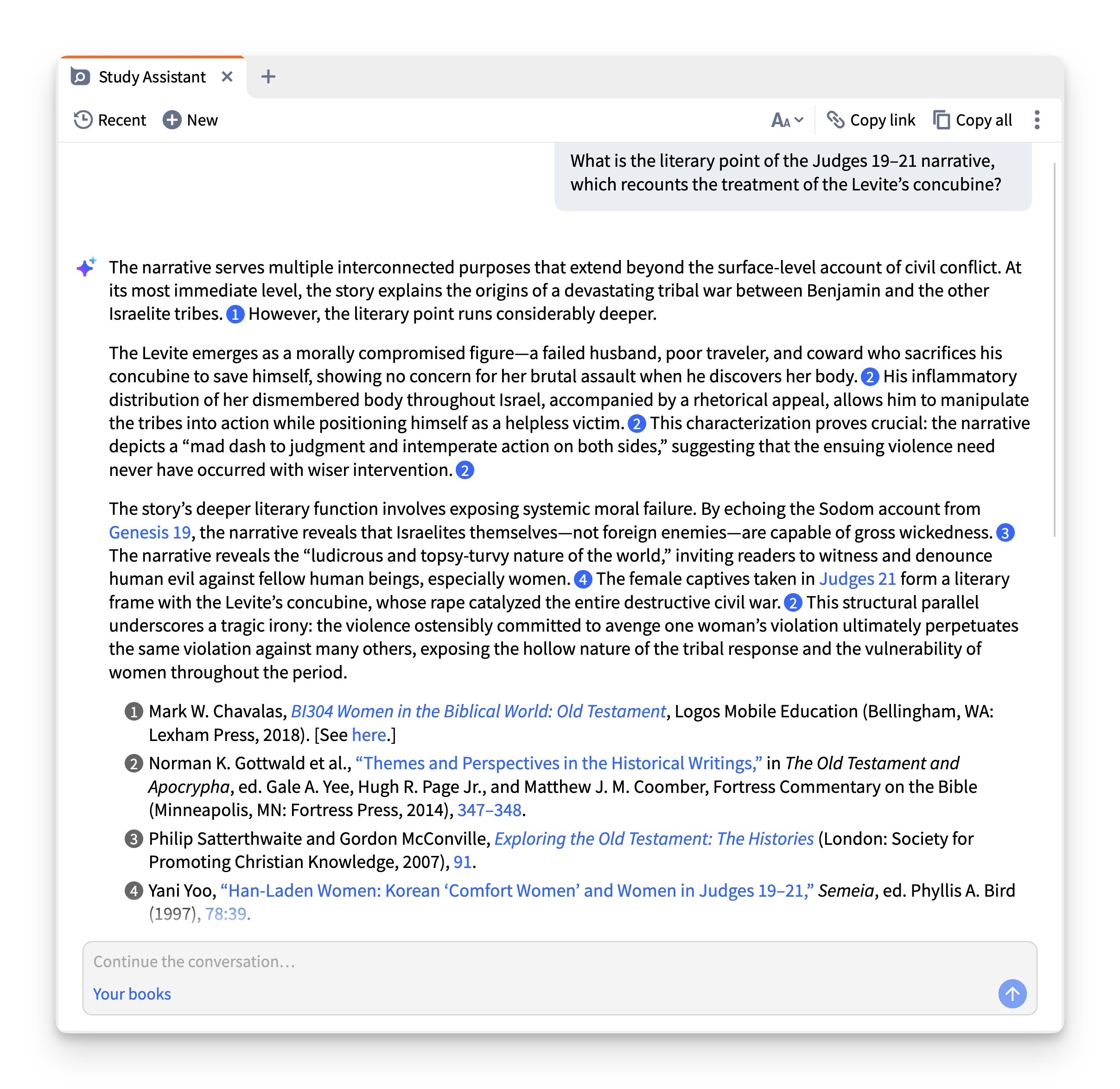
The Levite’s secondary wife
The book of Judges spirals downward into a moral morass as the Israelites move further and further away from Yahweh and the Torah. The final section is framed by these words, “In those days there was no king in Israel, and each one did what was right in his own eyes” (Judg 17:6; 21:25). Levitical priests were reduced to idolatry and forsook the Torah of God (Judg 17:7–18:31).
One particular Levite (Judg 19–21) mistreated his secondary wife, who tried to run back to her father. She was later collected by this Levite to bring her back to his home. On the way, they stopped in the town of Gibeah, in Benjamin. The horrific story echoes the language of abuse, informing the listener that Israel has become like Sodom and Gomorrah.14 The Levite heartlessly throws his newly collected secondary wife out at night to a gang who abuse her all night.
In the morning, we hear the only recorded words the Levite spoke to her, “Get up, let us go!” but she was dead on the doorstep (Judg 19:28). The Levite cut her up and sent her body parts to the twelve tribes of Israel, and lied, seeking to make himself appear righteous and calling for holy war against the Benjaminites. This leads to civil war, the death of most of the Benjaminites and many others. To make matters still worse, the tribal leaders of Israel then sanctioned the kidnapping of young women in the town of Shiloh, all using the name of Yahweh to justify their horrific behaviors.
From the unwarranted sacrifice of Jephthah’s daughter to the close of the book of Judges, the egregious treatment of women signals that the leaders and the nation have abandoned God.
Naomi, Orpah, and Ruth
The book of Ruth is only one of two books in the Bible named after a woman. Its story takes place during the time of the judges. Naomi and her husband leave their hometown in Bethlehem during a famine and move to Moab, where their sons marry Moabite women, Ruth and Orpah. After the deaths of their husbands, the three women are left widowed and childless (Ruth 1:1–5).
Naomi hears that the famine in Bethlehem ended and decides to return home (Ruth 1:6–7). In one of the most moving speeches in Scripture, Ruth pledges her loyalty to Naomi, to her God, and to her people (1:8–18). Ruth is portrayed as a woman of covenant loyalty (חֶסֶד, hesed), mirroring God’s own character, and she is described as a woman of valor (Ruth 3:10–11; cf. Prov 31:10).
Her initiative becomes the turning point in the plot, subverting the social order by lecturing Boaz, who essentially responds that “he was the servant of Ruth, the destitute Moabite widow” (Ruth 3).15 Boaz, a relative of Naomi, marries Ruth as a kinsman-redeemer (Ruth 4). Their son, Obed, becomes the grandfather of King David, further advancing redemption history (4:17).
Hannah
First Samuel opens with the story of Hannah. After years of barrenness, her impassioned prayer and vow led God to grant her a son, Samuel, who became the crucial leader in Israel’s transition to a monarchy. Hannah’s prayer resonates throughout that God overturns human pride and power, lifts up the humble and works his ways through the overlooked (1 Sam 2:1–10). It anticipates themes later echoed in Mary’s Magnificat (Luke 1:46–55).
Michal, Abigail, and Bathsheba
Second Samuel begins with the death of Saul and the rise of David as king (2 Sam 1:1–2:7). Among David’s wives, three are particularly well known: Michal, Saul’s daughter (1 Sam 18:20–29; 19:11–17; 2 Sam 3:13–16; 6:16–23); Abigail, the wise widow of Nabal (1 Sam 25:2–42; 2 Sam 2:2; 3:3); and Bathsheba, the mother of Solomon.
Bathsheba is often wrongfully vilified and sexualized, yet the biblical narrative portrays Bathsheba as a woman of innocence and honor (2 Sam 11:2–5; 26–27; 12:24; 1 Kgs 1:11–31; 2:13–25).16 David’s abuse of Bathsheba and his killing of her husband to hide his offense marks the decline of his reign and sparks the division of the monarchy.
Jezebel and Athaliah
In contrast stands Jezebel, the Phoenician wife of King Ahab of Israel. She promoted Baal worship, persecuted Yahweh’s prophets, arranged the death of Naboth to seize his land, and threatened the life of Elijah. She ultimately died a violent death (1 Kgs 16:31; 18:4–13; 19:1–2; 21:5–15).
Athaliah, a daughter of Ahab and probably Jezebel, married Jehoram of Judah and introduced Baal worship there, as well. After her son Ahaziah died, she attempted to kill all the royal heirs and seize the throne (2 Kgs 8:18, 25–28; 11:1–20). Yet Jehosheba, Ahaziah’s sister and the wife of the high priest Jehoida, rescued the infant Joash and his nursemaid and hid them in the temple for six years before orchestrating Athaliah’s overthrow (2 Kgs 11:2–3; 2 Chron 22:10–12).
Huldah
Later, during the reign of King Josiah of Judah, when the book of the law was discovered in the temple, Josiah sent his officials to consult the prophetess Huldah. She delivered Yahweh’s message of judgment and mercy, which led to Judah’s final national revivals (2 Kgs 22:14–20).
Esther (Hadassah) and Vashti
Finally, the story of Esther takes place during the Persian period under King Ahasuerus (or Xerxes). The book of Esther is the second of two books of the Bible named after a woman. Her Hebrew name is Hadassah.
Esther was an orphan raised by her cousin Mordecai. After Queen Vashti was deposed, Esther was chosen as the new queen. When a decree was issued to destroy the Jewish people throughout all the provinces of Persia, Esther risked her life to intervene. Mordecai’s famous words to Esther ring throughout history, “Who knows but that you have come to your royal position for such a time as this?” Esther responded with courage, “If I perish, I perish” (Esth 4:14–15).
Women in the New Testament
Throughout the Gospels, women are treated with dignity and purpose. Jesus raised the bar in his culture, participating in lengthy discussions with women. He protected and honored women, to the surprise of his disciples. Jesus chose women to be the first to give testimony to his resurrection, contrary to Greco-Roman acceptability. The rest of the New Testament follows suit, acknowledging the wide range of ministries that women fulfill. Here are a few examples.
Mary, Elizabeth, and Anna
The Gospel of Matthew opens with a genealogy of Jesus Christ, which includes four women from the Old Testament—Tamar, Rahab, Ruth, and Bathsheba—and concludes with Mary, the mother of Jesus (Matt 1:3–6, 16, 18). Mary’s relative, Elizabeth, the mother of John the Baptist, appears only in Luke 1:5–80.
Luke is also the only Gospel to mention the prophetess Anna, an elderly widow who had served in the temple for about eighty years with prayer and fasting. She recognized the infant Jesus as the long-awaited Messiah and spread the news about him to others (Luke 2:36–38).
Mary Magdalene, the Samaritan Woman, and others
During Jesus’s earthly ministry, he engaged many women through conversation, healing, and deliverance, though most of them are unnamed. He healed Peter’s mother-in-law (Matt 8:14–15), raised the daughter of a synagogue leader from the dead, healed a woman who suffered from bleeding for twelve years (9:18–26), and cast a demon out of the daughter of a Canaanite woman (15:21–28), among many others.
Some of Jesus’s longest recorded conversations were with women, such as the Samaritan woman at Jacob’s well (John 4:7–42). She became the first evangelist in John’s Gospel, as many in her town came to believe through her testimony (4:39). Other significant conversations took place with Martha and Mary, sisters of Lazarus (11:20–40). Martha was among the first to declare, “Yes, Lord, I have believed that you are the Christ, the Son of God, who comes into the world” (11:27; see also Peter’s declaration in Matt 16:16).
Women who stood with Jesus at the cross include Mary Magdalene, Mary the mother of James and Joseph (generally considered Mary the wife of Clopas), Salome (probably the mother of Zebedee’s sons), and “many other women” who had followed and supported him (Matt 27:55–56; Mark 15:40–41; 16:1; Luke 8:2–3; John 19:25–27).
The women who came to the tomb included Mary Magdalene, Salome, Joanna, Mary the mother of Jesus, and the others who were with them (Luke 24:1–12; Matt 28:1; Mark 16:1). John gives special attention to Mary Magdalene, who plays the central role in his resurrection account (John 20:1–18). Her story has often been wrongfully conflated with those of other women named Mary.17 Yet Mary Magdalene was the first to see and speak with the risen Christ, and Jesus himself sent her to announce his resurrection to the apostles. For this reason, she has rightly been called “the apostle to the apostles” (John 20:17–18).
Phoebe, Priscilla, Junia, and beyond
Other women are named in the New Testament beyond the Gospels. Romans 16 alone mentions several:
- Phoebe, a “deacon” (διάκονος) of the church of Cenchreae and a patron or benefactor (προστάτις) to Paul and many others (v. 1)
- Priscilla (or Prisca), a co-worker (συνεργός) in Christ (v. 3; cf. Acts 18:2)
- Mary, who labored greatly (v. 6)
- Junia, who had been a fellow prisoner and is understood by many to be called an apostle (ἀπόστολος) (v. 7)
- Tryphaena and Tryphosa, who worked in the Lord (v. 12)
- Persis, who “worked hard” in the Lord (v. 12)
- Rufus’s mother, who was a spiritual mother to Paul (v. 13)
- Julia and Nereus’s sister, who are greeted but not given specific titles (v. 15)
Conclusion
Taken together, the stories of women in Scripture reveal a consistent theological pattern. From Eve to Mary Magdalene, from Tamar to Esther, from Deborah to Phoebe, women appear not as marginal figures but as participants in God’s unfolding mission. Sometimes they act quietly, preserving life or sustaining faith. At other times they act boldly, confronting injustice, speaking prophetic truth, or initiating decisive turns in redemption history.
Their lives show that God’s work in the world has never been confined to one gender, one social status, or one sphere of influence. Rather, the biblical narrative repeatedly demonstrates that God calls and works through those who trust him, often overturning human expectations about where authority, courage, and faithfulness will appear.
These stories also expose a deeper moral truth: The way women are treated in Scripture often signals the spiritual health of individuals and societies. When women are honored, protected, and allowed to exercise the gifts God has given them, communities flourish, and God’s purposes move forward. When women are abused, silenced, or disregarded, the narrative frequently reveals a corresponding decline in the moral character of leaders and nations. In this way, the biblical text itself becomes a witness to God’s concern for the dignity of all who bear his image.
Ultimately, the witness of Scripture returns us to the vision of Genesis: men and women together reflecting God’s image and carrying his blessing into the world. Though the fall fractured this partnership, the story of redemption moves steadily toward its restoration. In Christ, reconciliation with God opens the possibility for renewed relationships between men and women, once again working side by side as faithful stewards of God’s creation. The many women whose lives appear across the pages of Scripture remind us that God’s mission has always advanced through the faithful courage of both women and men—partners in bearing God’s image and agents of his redeeming work in the world.
Share your thoughts
What do you make of the role of women across the Bible’s storyline? Join us in Word by Word group to share your thoughts.
Resources mentioned in this article
- Lapsley, Jacqueline E. Whispering the Word: Hearing Women’s Stories in the Old Testament. Westminster John Knox Press, 2005.

Redeeming Eden: How Women in the Bible Advance the Story of Salvation
Regular price: $22.99
Women in Scripture: A Dictionary of Named and Unnamed Women in the Hebrew Bible, the Apocryphal/Deuterocanonical Books and the New Testament
Regular price: $13.19
The Ministry of Women in the New Testament: Reclaiming the Biblical Vision for Church Leadership
Regular price: $24.99
Tell Her Story: How Women Led, Taught, and Ministered in the Early Church
Regular price: $14.99
The Mary We Forgot: What the Apostle to the Apostles Teaches the Church Today
Regular price: $11.99
Womanist Midrash: A Reintroduction to the Women of the Torah and the Throne
Regular price: $21.99
The Biblical World of Gender: The Daily Lives of Ancient Women and Men
Regular price: $17.99
Related content
- 7 Women in the New Testament & Their Example to the Church
- Women in Luke’s Gospel: Christianity’s Elevation & Concern for Women
- Women in Acts: Women’s Role in the Birth of the Church
- Why Did Jesus Appear to the Women Instead of the Disciples?
- 20 Christian Women Who Shaped Church History
- Ingrid Faro, Redeeming Eden: How Women in the Bible Advance the Story of Salvation (Zondervan, 2025), 21, 31.
- The exact number of women mentioned in the Bible is difficult to determine. Wilda C. Gafney, Womanist Midrash: A Reintroduction to the Women of the Torah and the Throne, 1st ed. (Westminster John Knox, 2017), 9. The estimated range of named women is around 170–180 and closer to 205 when the Apocryphal/Deuterocanonical Books are included (Carol Meyers et al., eds., Women in Scripture: A Dictionary of Named and Unnamed Women in the Hebrew Bible, the Apocryphal/Deuterocanonical Books, and the New Testament (Eerdmans, 2001), x–xi, 15; Dorothy A. Lee, The Ministry of Women in the New Testament: Reclaiming the Biblical Vision for Church Leadership (Baker Academic, 2021). The range in the number of women is due to several factors, for example, women with two or more different names, women with the same name, variant spellings in the Hebrew or Greek, and women with composite names. The number of unnamed women in the Bible is over four hundred, closer to six hundred when the Apocryphal/Deuterocanonical books are included (Meyers et al., Women in Scripture, xii). Since only about 10 percent of the named people in the Bible are women, and few of them are headliners, we often have to look deeper into the biblical context to get a more accurate picture of the roles and importance of women in ancient Israel.
- Faro, Redeeming Eden.
- Cheryl You, “The Historian’s Heroines: Examining the Characterization of Female Role Models in the Early Israelite Monarchy,” Journal of Biblical Perspectives in Leadership (Fall 2019): 179.
- For more detail, see Faro, Redeeming Eden; Nijay K. Gupta, Tell Her Story: How Women Led, Taught, and Ministered in the Early Church (InterVarsity Academic, 2023).
- Stephen G. Dempster, Dominion and Dynasty: A Theology of the Hebrew Bible (InterVarsity, 2003), 59–70; Gregory K. Beale, “Eden, the Temple, and the Church’s Mission in the New Creation,” Journal of the Evangelical Theological Society 48 (2005): 5–31.
- Catherine L. McDowell, The Image of God in the Garden of Eden: The Creation of Humankind in Genesis 2:5–3:24 in Light of the Mīs Pî, Pīt Pî, and Wpt-r Rituals of Mesopotamia … and Theology of the Hebrew Scriptures), 1st ed. (Eisenbrauns, 2015).
- W. Randall Garr, “‘Image’ and ‘Likeness’ in the Inscription from Tell Fakharieh,” Israel Exploration Journal 50, no. 3 (2000): 227–34.
- D. E. Fleming, “Religion,” in Dictionary of the Old Testament: Pentateuch, ed. T. Desmond Alexander and David W. Baker (InterVarsity, 2003), 683.
- Faro, Redeeming Eden, 40–43.
- Faro, Redeeming Eden, 59–71.
- Carmen Joy Imes, “Freedom Fighters of Exodus,” in The Biblical World of Gender: The Daily Lives of Ancient Women and Men, ed. Celina Durgin and Dru Johnson (Cascade, 2022), 39–45.
- Michelle Knight, The Prophet’s Anthem: The Song of Deborah and Barak in the Narrative of Judges (Baylor, 2024).
- Jacqueline E. Lapsley, Whispering the Word: Hearing Women’s Stories in the Old Testament (Westminster John Knox, 2005), 35–67.
- Daniel Isaac Block, Ruth: A Discourse Analysis of the Hebrew Bible, ed. Daniel Isaac Block, Zondervan Exegetical Commentary on the Old Testament (Zondervan, 2015), 183.
- Faro, Redeeming Eden, 137–54.
- Jennifer Powell McNutt, The Mary We Forgot: What the Apostle to the Apostles Teaches the Church Today (Brazos, 2024).


 Daniel R. Hyde
 Christopher Kou
 Ryan Lytton
 Kirk E. Miller