
 Kirk E. Miller
In this Logos Live episode, Kirk E. Miller sits down with Mark Barnes (principal product manager at Logos) to discuss responsible use of AI in Bible study and ministry. They explore cautions to implementing AI in Bible study and how Logos is building tools that use AI well—with discernment, safeguards, and theological convictions at the center.
Follow the show on YouTube, Spotify, Apple Podcasts, and more.
Episode guest: Mark Barnes
Mark Barnes has twenty years of experience in pastoral ministry, holds an MPhil in biblical theology, and has served as visiting lecturer at Union School of Theology. He’s a former editor of Evangelical Magazine and has also written for Grace Magazine, Evangelicals Now, and Evangelical Times. He now serves as product manager for the Logos and Verbum apps and lives in the UK with his wife and two sons.
Episode synopsis
What do we mean by AI?
Before we consider a responsible use of artificial intelligence (AI), we should first define what is meant by AI. Mark offers a working definition, especially as it pertains to tools like ChatGPT and Logos.
While AI has been around for decades, it only entered mainstream consciousness recently through large language models (LLMs) that generate text in response to human prompts.
What theological principles & scriptural passages should we use to think about AI?
How should we go about thinking theologically about AI? What theological principles or key biblical passages come to bear?
While the Bible doesn’t address AI directly, it nonetheless equips us theologically to navigate new technologies. Mark mentions several key theological principles:
- Wisdom: True wisdom comes from God, not from machines. Bible study is fundamentally a spiritual discipline, not just a process of information download.
- Discernment: Christians must cultivate the ability to distinguish good from evil, especially as technology offers new forms of convenience and temptation.
- Stewardship: Believers are called to steward their time and resources well, which may include the responsible use of technological tools.
- Community: AI can never replace the role of the church. Seeking answers from machines rather than from other believers risks undermining God’s design for communal discipleship.
- Humility: Knowledge can puff us up. With vast information now at our fingertips, we must guard against pride and the illusion of self-sufficiency.
Kirk adds another important theological lens for evaluating technology and AI: the framework of creation, fall, redemption, and consummation. Technology, including AI, can be viewed as an outworking of the creation mandate—a tool of culture for human flourishing. But because of the fall, it can also be misused in ways that promote pride, self-reliance, and distortion of God’s purposes (e.g., the tower of Babel in Gen 11). An outworking of redemption is harnessing these tools wisely in service of God’s mission.
See our entire series of articles providing thoughtful engagement of AI.
What are some of the potential risks in using AI for Bible study or ministry?
Mark and Kirk caution against several dangers of over-relying on AI in spiritual disciplines.
Studying Scripture is meant to be hard work. The goal of Bible study is not merely to arrive at a right interpretation. The very act of wrestling with Scripture is meant to have a formative influence on us. When AI short-circuits this, whether by generating sermons or circumventing deep reflection, we rob ourselves of the benefits that come thereby.
The very act of wrestling with Scripture is meant to have a formative influence on us.
Mark notes that if a young preacher relies too heavily on AI, they’ll stifle their growth as a pastor, interpreter, and expositor. Kirk likens this to atrophied muscles: If we fail to use our exegetical skills, they’ll inevitably weaken over time.
Additionally, while plagiarism isn’t a new issue, AI provides new ways to do it. It tempts users to substitute automation for original work.
In short, tools meant to assist our work can become tools that replace it. There’s a danger of becoming overly reliant on AI, even transgressing ethical boundaries.
Can AI interpret the Bible like we can?
AI can assemble data and use language generation capabilities to “interpret” and explain Scripture. Yet the Bible teaches us that proper engagement of Scripture is a spiritual task involving the special illumination and work of the Spirit (e.g., 1 Cor 2:12–14; Eph 1:17–18; Heb 4:12; 1 John 2:27). So what parts of Bible study would it be impossible for AI to replace?
As Mark explains, large language models don’t actually understand texts. They simply predict the next most likely word based on statistical patterns. AI may imitate human language convincingly. But AI doesn’t have a soul, doesn’t pray, and doesn’t commune with God. It cannot experience, and therefore cannot draw upon, the illumination of the Spirit in its engagement of Scripture. AI also doesn’t know the people in your congregation or the state of your own heart.
All these dimensions of Bible study and preaching must remain fully human and Spirit-empowered.
How is Logos designing its AI tools to avoid encroaching on contemplative Bible study?
So how is Logos incorporating AI in a theologically and ethically responsible way? Mark outlines a few guiding principles:
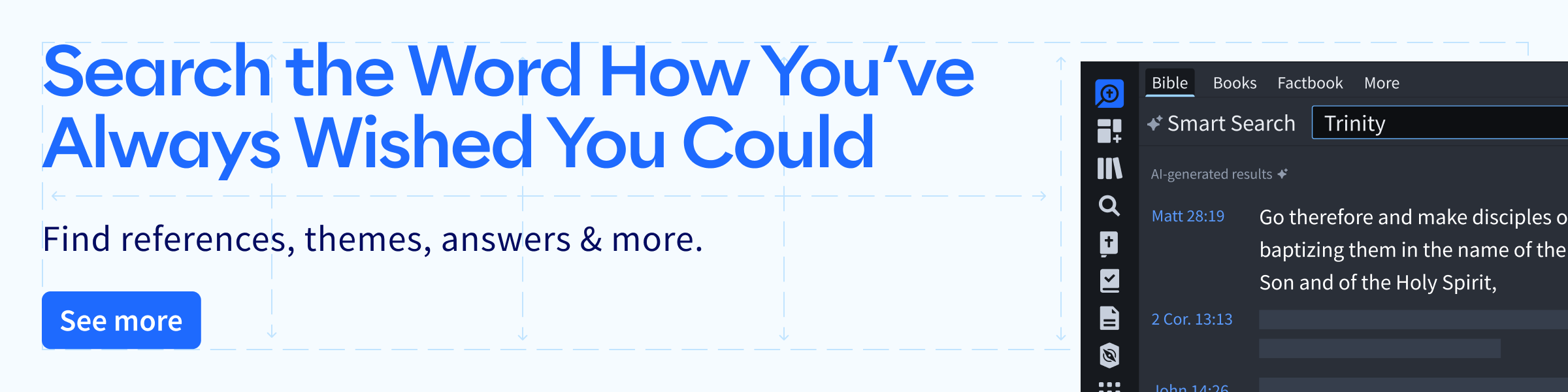
Most of Logos’s AI-powered tools, like Smart Search and Smart Bible Search, are focused on retrieval rather than generation. Instead of creating new content, they help users find relevant passages or books from their library.
Search the Bible the way you always wanted, with Logos’s Smart Search in Bible.
Summaries and synopses are also powered by AI, but they point back to source materials (complete with citations) so users can check the original context. This differs from open-ended models like ChatGPT, which often offer unverifiable responses.
Given that accurately studying God’s Word is of such importance to Christians, how is Logos designing its tools to provide reliable results?
Mark observes that AI models can “hallucinate” and produce plausible-sounding but incorrect or fictional information, especially when asked highly specific questions. This risk increases when AI is used for tasks like language analysis or theological claims.
Logos aims to mitigate this risk by carefully limiting where and how AI is used in the app. Rather than training their own LLMs, Logos uses third-party models but feeds them carefully curated data from Logos libraries. For example, when generating a synopsis, Logos sends the AI only the top search results from a user’s own library. This approach drastically reduces the likelihood of hallucination and ensures a higher level of trustworthiness.1
Users can also limit the scope of their searches (e.g., only searching within Bavinck’s Reformed Dogmatics), giving them even more control and specificity.

Use Smart Search in books to retrieve relevant resources in seconds.
How is Logos approaching its design choices to ensure that its AI tools respect the sacred nature of preaching?
One might express concern that introducing AI into the sermon process undermines its innately pastoral nature. So what specific ethical guidelines does Logos use to ensure tools like Sermon Assistant are used as creative aids, rather than replacements for the pastor’s prayerful work?
Mark makes clear: Logos will not build a feature that writes sermons. That’s a theological decision, not just a technical one. (Logos has the capability to build such a tool, but it’s deliberately choosing not to do so.) Sermon writing and preaching is a pastoral responsibility that cannot, and should not, be outsourced.
Sermon writing and preaching is a pastoral responsibility that cannot, and should not, be outsourced.
So even when it comes to sermon outlines or illustrations, Logos deliberately restricts how powerful or polished those outputs are. The aim is to spark ideas, not replace pastoral preparation. Sermon Assistant tools are designed to be “not quite good enough to use directly,” so that they encourage creativity rather than copy-and-pasting.

Try Sermon Builder with its new AI-empowered Sermon Assistant tools.
What ways can AI aid our Bible study (without replacing our role in it)?
While the dangers are real, so are the opportunities. When used wisely, AI can enhance and deepen our engagement with God’s Word.
One of the greatest advantages of Logos, and now AI in Logos, is not so much that it saves time, but that it allows users to go deeper within the same amount of time. Tasks that used to take hours—flipping through indexes or skimming dense resources—can now be completed in moments, freeing users to invest more energy in study, reflection, and prayer.
What promises might AI hold for the work of the Great Commission & seeing the gospel spread?
AI-powered tools can help democratize in-depth Bible study research, empowering more people to go deeper into Scripture. For instance, Smart Search eliminates the need for learning and using technical search syntax, lowering the barrier and making deep library searches accessible to more users. Research that once required a more specially trained skill can now be accomplished by any serious Bible reader.
Additionally, Logos’s AI can translate works, making more resources available to people despite language barriers. This is especially helpful for students throughout the world that have a lack of theological resources in their own language. Even English speakers can now access theology written in other languages, expanding the global reach of non-anglophone voices. Logos also has partnerships with Bible translators who use the AI tools in Logos to aid them in translation work.
Conclusion
As Kirk summarizes, we can think of the role of AI in Logos as something like a built-in research librarian. A research librarian helps you find the best resources. It points you in the right direction, but doesn’t do the study on your behalf. Or as Mark puts it, AI should be a servant, not a substitute. AI cannot know Scripture, pray, or be conformed to Christ—but it can assist those who do.
Tools like Smart Search and Factbook make Logos more usable than ever before, while Logos stays true to its core mission: to support deep, serious, Spirit-led study.
Try Logos today!
Related articles
- A Theology of AI by a Bible Software Nerd
- It’s Not What You Think: Exposing the Limits of Technology
- 5 Things I’m Most Excited for in the Coming Version of Logos
- Should Christian Higher Ed Be Worried About AI?
- Will There Be Roombas in Heaven? Rethinking AI, Work & Time


