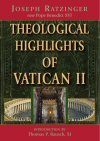
Joseph Ratzinger, now Pope Benedict XVI, writes about the Council from the experience of one who was there—one who took part as an official peritus, or expert, in the work of Vatican II.
Regarded as one of the outstanding young theologians to emerge from the conciliar period, the author mirrors in his observations here his intimate familiarity with the theological issues discussed, the positions taken, and the battles fought. But he does not seek to record the “diplomatic factors, intramural power plays, and antagonism among groups.” His purpose is to “attempt to delineate the inner aspects, the spiritual profile of the Council.”
The book includes a special preface by the author setting forth the character of the observations as his “account of a personal journey through the landscape of each session, with an open view toward further developments.” There is also a new introduction written by Thomas Rausch, SJ, that provides a balanced and contemporary context for the book.
Joseph Ratzinger is one of the most revered Catholic prelates, scholars, theologians, teachers, and authors of our time. He has spoken on many crucial subjects, including sexual consumerism, roles of men and women today, marriage, the priesthood, and the future of the world. As a teenager, he initiated study of classical languages and entered the minor seminary in Traunstein in 1939. Though he was drafted into the German anti-aircraft corps in 1943, he re-entered the seminary in 1945, when World War II ended. On June 29, 1951, Joseph Ratzinger was ordained to the priesthood in the Cathedral of Freising on the Feast of Saints Peter and Paul. He also received his doctorate in theology in 1953 from the University of Munich. Starting in 1959, Ratzinger taught theology at the University of Bonn.
At age 35, Joseph Ratzinger was appointed chief theological advisor for the archbishop of Cologne, Cardinal Joseph Frings, and maintained that title for four years. After many years of teaching at several German universities, Ratzinger was appointed by Pope Paul VI as archbishop of Munich and Freising in March 1977, and was elevated to cardinal in June 1977. In November 1981, Ratzinger was summoned by Pope John Paul II to Rome, where he was named prefect of the Congregation for the Doctrine of the Faith, president of the Pontifical Biblical Commission, and president of the International Theological Commission.
On April 19, 2005, Joseph Ratzinger was elected to be the 265th pope. He took the name Benedict XVI, after St. Benedict of Nursia. Since that time, he has continued to receive worldwide respect and has been a spiritual influence to Christians and non-Christians alike.