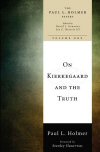
Among his many accomplishments, Paul L. Holmer was one of the most significant American students of Kierkegaard of his generation. Although written in the 1950s and 1960s, Holmer’s theological and philosophical engagement with Kierkegaard challenges much in the contemporary scholarly discussions of this important thinker. Unlike many, Holmer refuses reductionist readings that tie Kierkegaard to any particular “school.” He likewise criticizes biographical readings of Kierkegaard, much in vogue recently, seeing Kierkegaard rather as an indirect communicator aiming at his reader’s own ethical and religious capacities. Holmer also rejects popular existentialist readings of Kierkegaard, seeing him as an analyzer of concepts, while at the same time denying that he is a “crypto-analyst.” Holmer criticizes the attempt to construe Kierkegaard as a didactic religious thinker, appreciating Kierkegaard’s “cool” descriptive objectivity and his ironic and stylistic virtuosity. In his important reading of Kierkegaard on truth, Holmer pits Kierkegaard against those who see truth empirically, idealistically, or relativistically. Holmer’s carefully textured account of Kierkegaard’s conceptual grammar of truth in ethical and religious contexts, 50 years after it was penned, addresses immediately current discussions of truth, meaning, reference, and realism versus antirealism, relativism, and hermeneutics. It will be of great interest to all interested in Kierkegaard and his importance for contemporary theology and philosophy.
Paul L. Holmer was and is still a largely unheralded Kierkegaard scholar and analytic philosopher. This volume, and the collected works series it introduces, should do a lot to correct that oversight in both fields. We owe the editors, both of whom were Holmer’s students, a great deal of thanks for their labor of love.
—Robert L. Perkins, philosophy professor emeritus, Stetson University
Paul Holmer was one of the most interesting and original religious thinkers in mid-twentieth-century America, yet he is little known today. Søren Kierkegaard was his central scholarly interest and his unusual and provocative reading of Kierkegaard is important.
—David Kelsey, lecturer in theology, Yale Divinity School
Almost 50 years ago, Paul Holmer finished a manuscript about Kierkegaard but then left it unpublished. Instead, emulating Socrates, Holmer spent the following decades focused on encouraging Yale Kierkegaard students to examining their own lives with intellectual rigor. The result was a revolution in American Kierkegaard scholarship . . .
—Andrew J. Burgess, professor, The University of New Mexico
With the two-hundredth anniversary of Kierkegaard’s birth approaching in 2013, what a treat to have Paul L. Holmer’s long awaited and now posthumous On Kierkegaard and the Truth to clarify Kierkegaard’s status as a philosopher and the role of logic and reason in his thought. A master philosopher and teacher himself, Holmer knew how to cut to the very essence of a thinker’s thought, as he does here with Kierkegaard’s.
—Sylvia Walsh, scholar in residence, Stetson University
Professor Paul L. Holmer was the doyen of Kierkegaard studies for much of the later part of the twentieth century. His jargon-free writings are crisp, clear, epiphanic, and always in earnest . . .
—Gordon Marino, professor, St. Olaf College
David J. Gouwens is a professor of theology at Brite Divinity School. He is the author of Kierkegaard’s Dialect of the Imagination and Kierkegaard as Religious Thinker.
Lee C. Barrett is Stager Professor of Theology at Lancaster Theological Seminary. He is the author of The Heidelberg Catechism, Foundations of Modern Theology: Kierkegaard, and co-editor of Kierkegaard and the Bible.